Sun to set on Ulysses solar mission on July 1
June 12, 2008
Sun to set on Ulysses solar mission on July 1

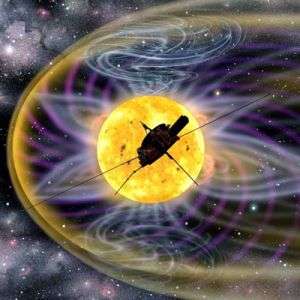
Over more than 17 years of observations above and below the poles of the Sun, the ESA/NASA Ulysses mission has made fundamental contributions to our understanding of the Sun itself, its sphere of influence (the heliosphere), and our local interstellar neighbourhood. The mission provided the first-ever map of the heliosphere in the four dimensions of space and time. Ulysses was launched by Space Shuttle Discovery in October 1990. It headed out to Jupiter, arriving in February 1992 for the gravity-assist manoeuvre that swung the craft into its unique solar orbit. It orbited the Sun three times and performed six polar passes. The mission concludes on 1 July 2008. Credits: ESA (image by D. Hardy)

After over 17 years of operation, the joint ESA/NASA mission Ulysses will officially conclude on 1 July this year. The spacecraft, which studied the Sun and its effect on the surrounding space for almost four times its expected lifespan, will cease to function because of the decline in power produced by its on-board generators.

Ulysses has forever changed the way scientists view the Sun and its effect on the surrounding space. The mission's major results and the legacy it leaves behind have been presented today at ESA Headquarters in Paris.

"Over almost two decades of science observations by Ulysses, we have learned a lot more than we expected about our star and the way it interacts with the space surrounding it," said Richard Marsden, ESA's Ulysses Project Scientist and Mission Manager. "There will never be another mission like Ulysses," he continued.

"Many solar missions have appeared on the space scene in recent years, but Ulysses is still unique today. Its special point of view over the Sun's poles has never been covered by any later mission, making Ulysses's pioneering character still valid. This legendary spacecraft has served us extraordinarily well and it has certainly lived up to its mythical namesake's reputation."

"Ulysses has been a challenging mission since launch," said Ed Massey, Ulysses Project Manager at NASA's Jet Propulsion Laboratory, California, USA. "Its success required the cooperation and the intellect of engineers and scientists from around the world. The diversity of our team was one of its greatest strengths."

That strength and diversity spilled over into the Ulysses spacecraft itself. The spacecraft and its suite of 10 instruments had to be highly sensitive yet robust enough to withstand some of the most extreme conditions in the Solar System, including two polar passes of the giant planet Jupiter.

"The main objective of Ulysses was to study, from every angle, the heliosphere, the vast bubble in space carved out by the solar wind," said Ed Smith, NASA's Ulysses Project Scientist. "The heliosphere separates the solar neighbourhood from the interstellar medium. Over its long life, Ulysses redefined our knowledge of the heliosphere and went on to answer questions about our solar neighbourhood we did not know to ask."

Ulysses was the first mission to survey the environment in space above and below the poles of the Sun in the four dimensions of space and time. It showed that the Sun's magnetic field is carried into the Solar System in a more complicated manner than previously believed. Particles expelled by the Sun from low latitudes can climb up to high latitudes and vice versa, even unexpectedly finding their way down to planets.

This is very important as regions of the Sun not previously considered as possible sources of hazardous particles for astronauts and satellites must now be taken into account and carefully monitored.

Ulysses detected and studied dust flowing into our Solar System from deep space and showed that it was 30 times more abundant than astronomers suspected. Perhaps most remarkably, the spacecraft detected helium atoms from deep space and confirmed that the Universe does not contain enough matter to eventually halt its expansion.

Hurtling through space at an average speed of 56 000 km/h, Ulysses has logged over 8.6 thousand million kilometres. The longevity of the mission is testament to a creative team of engineers who have risen to every challenge. As the power supply has weakened over the years, so they have come up with ingenious ways of conserving energy. Now, however, the power has dwindled to the point where fuel will soon freeze in the spacecraft's pipelines.

"When the last bits of data finally arrive, it will surely be tough to say goodbye to Ulysses," said Nigel Angold, ESA's Ulysses Mission Operations Manager. "But any sadness I might feel will pale in comparison to the pride of working on such a magnificent mission. Although operations will be ending, scientific discoveries from Ulysses data will continue for years to come."

"It is with enormous affection that we bid farewell to Ulysses. It has been a story of remarkable success and collaboration," added David Southwood, ESA's Director of Science and Robotic Exploration.

Source: European Space Agency


Rank 4 /5 (5 votes)
Tags

Relevant PhysicsForums posts
  • Never ending outer space.....
    createdFeb 11, 2012
  • Neutron Star fragments?
    createdFeb 11, 2012
  • stationary or not?
    createdFeb 11, 2012
  • Scale of the Universe
    createdFeb 10, 2012
  • Titan's lack of impact craters
    createdFeb 09, 2012
  • Real pictures of black hole eating a star?
    createdFeb 08, 2012
  • More from Physics Forums - General Astronomy

More news stories

Climate change causes harmful algal blooms in North Atlantic: study

Warming oceans and increases in windiness could be causing of an abundance of harmful algal blooms in the North Atlantic Ocean and North Sea, according to new research.

Space & Earth / Environment

created 2 hours ago | popularity not rated yet | comments 0

New European rocket lifts off on maiden flight

A new lightweight rocket, Vega, lifted off from Europe's space base Monday carrying nine satellites on its inaugural flight, mission control said.

Space & Earth / Space Exploration

created 55 minutes ago | popularity 5 / 5 (2) | comments 1

Salvage workers begin pumping fuel from Italian shipwreck

Salvage workers Sunday began pumping fuel from the shipwrecked Italian cruise liner Costa Concordia, a day ahead of schedule, officials said.

Space & Earth / Environment

created 17 hours ago | popularity 5 / 5 (2) | comments 0

NASA budget will axe Mars deal with Europe: scientists

US President Barack Obama's budget proposal to be submitted next week for 2013 will cut NASA's budget by 20 percent and eliminate a major partnership with Europe on Mars exploration, scientists said Thursday.

Space & Earth / Space Exploration

created Feb 10, 2012 | popularity 5 / 5 (4) | comments 59

Humans may have helped the decline of African rainforests 3000 years ago

(PhysOrg.com) -- Large areas of rainforests in Central Africa mysteriously disappeared over three thousand years ago, to be replaced by savannas. The prevailing theory has been that the cause was a change ...

Space & Earth / Environment

created Feb 10, 2012 | popularity 4.1 / 5 (15) | comments 21 | with audio podcast report


New molecule has potential to help treat genetic diseases and HIV

(PhysOrg.com) -- Chemists at The University of Texas at Austin have created a molecule that's so good at tangling itself inside the double helix of a DNA sequence that it can stay there for up to 16 days before ...

Social psychologist: Lust makes you smarter and evidence that seven deadly sins are good for you

(Medical Xpress) -- Good news for lovers on Valentine’s Day - the seven deadly sins, including Lust, are good for you. University of Melbourne social psychologist Dr Simon Laham uses modern research to make a compelling ...

The joy of cheques

An electronic cheque which eliminates the need for costly processing by banks but preserves the simplicity and ease of a traditional cheque book has been designed by a team of academics in the UK.

Research finds injuries to professional athletes from routine play or practice often reported as 'freak accidents' in me

(Medical Xpress) -- A new report from the Johns Hopkins Center for Injury Research and Policy finds injuries to professional athletes from routine play or practice are often characterized as “freak accidents” in ...

Researchers' paper wins Best Paper Award for 2011

A paper written by Dr. Paul Gratz and his graduate student, Reena Panda, from the Department of Electrical and Computer Engineering at Texas A&M University was selected as one of the best papers from IEEE Computer Architecture ...

Low levels of amplitude-modulated electromagnetic fields elicit therapeutic responses cancer patients

Ryne Ramaker, a senior UALR Donaghey Scholar and University Science Scholar with a double major in biology and chemistry, is a co-author of a cancer research paper creating excitement among other researchers. The article ...