Field project seeks clues to climate change in remote atmospheric region
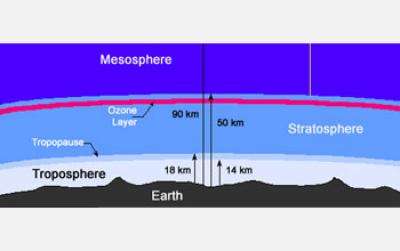
Scientists are deploying an advanced research aircraft to study a region of the atmosphere that influences climate change by affecting the amount of solar heat that reaches Earth's surface.
Findings from the project, based at the National Center for Atmospheric Research (NCAR) in Boulder, Colo., will be used by researchers worldwide to improve computer models of global climate in preparation for the next report by the Intergovernmental Panel on Climate Change (IPCC).
The project, which continues through this month, is known as START 08 (Stratosphere-Troposphere Analyses of Regional Transport). It focuses on a remote part of the atmosphere called the tropopause, which ranges in altitude from approximately 32,000 to 56,000 feet.
Scientists are increasingly interested in the tropopause because of both its importance in the global climate system and the buildup of greenhouse gases has altered this atmospheric region in ways that are not yet understood.
"This region of the atmosphere is the weak link in climate research," explains NCAR scientist Laura Pan, a principal investigator on the project. "In order to understand climate change, you need to have accurate computer models of the planet. In order to have accurate models, you need to understand what's going on in the tropopause."
START is a collaborative effort involving the University of Miami, Texas A&M University, the University of Colorado, Harvard University and the National Oceanic and Atmospheric Administration. Funding for the project comes from the National Science Foundation (NSF), NCAR's primary sponsor, and from NOAA.
START deploys the NSF/NCAR Gulfstream-V, also known as HIAPER, the High-Performance Instrumented Airborne Platform for Environmental Research, a cutting-edge aircraft that will fly about a dozen missions above much of North America at altitudes ranging up to about 47,000 feet.
"No other research aircraft could obtain samples of this critically important region of the atmosphere as effectively," said Cliff Jacobs, program director in NSF's Division of Atmospheric Sciences. "START is the first major study to use that capability."
The flight paths will take the aircraft through the top of the troposphere, which is the lowest layer of the atmosphere, and into the stratosphere.
Focusing on the tropopause, the boundary between these two layers, scientists will take samples of air to determine the movements and concentrations of a number of gases. One of their goals is to learn more about water vapor and ozone, which act as potent greenhouse gases by trapping solar radiation in the atmosphere, thereby warming the planet.
"Understanding the tropopause region is particularly challenging because it involves interactions of winds and atmospheric motion with chemistry, clouds, and solar radiation," says Kenneth Bowman, a principal investigator on the project and an atmospheric scientist at Texas A&M University.
"Properly representing this part of the atmosphere in global climate models requires getting all of these complex components correct. The aircraft allows us to directly observe many of these processes in place, providing a level of detail that cannot be matched by ground-based or satellite observations."
The tropopause is challenging territory for scientists: it is too high to observe with most ground-based instruments or aircraft, and too low for satellites to view with great detail. Also, its altitude has changed in recent years because of global warming.
As Earth's tropical regions have grown, the highest part of the tropopause, which lies above the tropics, has expanded. This movement is related to the jet stream, which has also shifted toward higher latitudes.
These changes are setting off a chain reaction that affects both weather patterns and long-term global climate. The research team wants to determine how weather patterns stir up chemicals in the tropopause and, in turn, how its changing chemical composition influences global climate, including the location of the jet stream.
"We want to collect data that will help map out the chemical composition of this dynamic boundary region," says Elliot Atlas, also a principal investigator on the project, and a marine and atmospheric chemist at the University of Miami. "This is a complex area, where naturally occurring gases and particles mix with pollutants from human activities in ways that can ultimately affect the weather and climate of our planet."
Over the next two years, climate scientists will use observations from START and other sources to adjust computer models that simulate Earth's climate. These models will be used for the next round of IPCC reports, which are likely to be issued about 2012.
Source: National Science Foundation


