Freshwater runoff from the Greenland Ice Sheet will more than double by the end of the century
June 12th, 2008 East Greenland Runoff

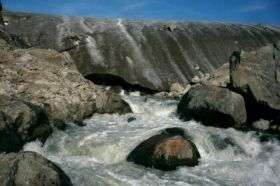
Freshwater runoff in East Greenland, Mittivakkat Glacier, Ammassalik Island in 2005. Credit: Sebastian H. Mernild

The Greenland Ice Sheet is melting faster than previously calculated according to a recently released scientific paper by University of Alaska Fairbanks researcher Sebastian H. Mernild.

The study, published in the journal Hydrological Processes, is based on models using data from the Intergovernmental Panel on Climate Change, as well as satellite images and observations from on the ground in Greenland.

Mernild and his team found that the total amount of fresh water projected to flow from the Greenland Ice Sheet into the North Atlantic Ocean from 2071 to 2100 will be more than double current levels.

Today, the East Greenland Ice Sheet adds 257 cubic kilometers of fresh water to the ocean per year from both melting and iceberg calving. By 2100, those levels are estimated to reach 456 cubic kilometers per year. With land-based runoff factored in, the total fresh water flowing from Greenland into the ocean is estimated to increase from 438 cubic kilometers to 650 cubic kilometers by 2100. The projected increase means that rather than rising at a rate of 1.1 millimeters per year, sea levels would rise by 1.6 millimeters per year.

"The Greenland Ice Sheet mass balance is changing as a response to the altered climatic state," said Mernild. "This is faster than expected. This affects freshwater runoff input to the North Atlantic Ocean and plays an important role in determining the global sea level rise and global ocean … circulation."

Mernild is conducting the research as part of the University of Alaska's International Polar Year efforts. He was appointed a University of Alaska IPY postdoctoral fellow by UA president Mark Hamilton in 2007.

Source: University of Alaska Fairbanks


print this article email this article download pdf blog this article bookmark this article     Digg this Stumble it share on Facebook share on Reddit add to delicious save to Yahoo! bookmarks
3.5/5 after 11 votes

Rank Filter

Move the slider to adjust rank threshold, so that you can hide some of the comments.


Display comments: newest first

  • Ninderthana - Jun 13, 2008
    • Rank: 1.8 / 5 (5)
    This is science reporting at its absolute worst.
    The assumption of this article is that world temperatures will heat up over the next century because of man-made CO2 in the atmosphere.

    This is an unproven scientific hypothesis, yet it is taken as Gospel by pseudo-scientist that wrote this article.

    When will people in the media stop basing alarmist predictions on wild scientific speculation.

    An article like this just degrades the scientific method.
  • rubberman - Jun 13, 2008
    • Rank: 3.7 / 5 (3)
    You just commented on the scientific method, WHILE stating that the article makes an ASSUMPTION that isn't mentioned or even hinted at in the article. How scientific is that?

June 12th, 2008 all stories
Space & Earth / Earth Sciences

Comments: 2
Rank: 3.5/5 after 11 votes

  • Stumble this up

  • Digg this

  • Share it:
  • share on Facebook
  • share on MySpace
  • share on Slashdot
  • rss-newsfeed
  • share on Google
  • share on Reddit
  • add to delicious
  • save to Yahoo! bookmarks
  • share on Windows Live
  • Add to Mixx!
Rating: 3.5/5 after 11 votes


Tags


  • Physicists Demonstrate Quantum Memory with Matter Qubits
    Physicists Demonstrate Quantum Memory with Matter Qubits
    Physics / General Physics
    created Jul 03, 2009 | popularity 4.4 / 5 (16) | comments 1
  • 'Holey' Nanosheets for Wastewater Dye Removal
    Nanotechnology / Nanomaterials
    created Jul 01, 2009 | popularity 5 / 5 (5) | comments 1
  • Jellyfish Robot Swims Like its Biological Counterpart
    Jellyfish Robot Swims Like its Biological Counterpart
    Electronics / Robotics
    created Jun 26, 2009 | popularity 4.4 / 5 (7) | comments 1
  • Could Maxwell's Demon Exist in Nanoscale Systems?
    Could Maxwell's Demon Exist in Nanoscale Systems?
    Physics / General Physics
    created Jun 24, 2009 | popularity 4.4 / 5 (18) | comments 29
  • Living Safely with Robots, Beyond Asimov's Laws
    Living Safely with Robots, Beyond Asimov's Laws
    Electronics / Robotics
    created Jun 22, 2009 | popularity 4.6 / 5 (52) | comments 40
  • Other News

    Forty years ago man first walked on the moon

    Space & Earth / Space Exploration

    created 2 hours ago | popularity 5 / 5 (2) | comments 0

    Forty years ago on July 20, 1969, American astronaut Neil Armstrong realized the oldest dream of human civilizations when he became the first man to walk on the moon.


    The least sea ice in 800 years

    The least sea ice in 800 years

    Space & Earth / Earth Sciences

    created Jul 01, 2009 | popularity 4.3 / 5 (59) | comments 52

    New research, which reconstructs the extent of ice in the sea between Greenland and Svalbard from the 13th century to the present indicates that there has never been so little sea ice as there is now. The ...


    Gas around young galaxy

    Intense heat killed the Universe's would-be galaxies, researchers say

    Space & Earth / Astronomy

    created Jul 01, 2009 | popularity 3.2 / 5 (19) | comments 25

    (PhysOrg.com) -- Our Milky Way galaxy only survived because it was already immersed in a large clump of dark matter which trapped gases inside it, scientists led by Durham University's Institute for Computational ...


    Scientists' Drill Hits Magma: Only Third Time on Record

    Scientists' Drill Hits Magma: Only Third Time on Record

    Space & Earth / Earth Sciences

    created Jun 29, 2009 | popularity 4.7 / 5 (20) | comments 19

    (PhysOrg.com) -- Scientists drilling a borehole deep into Iceland’s rocky crust to explore new methods of using geothermal energy hit a major roadblock on Thursday: Their drill ran into molten rock at a depth ...


    NASA manager pitches a cheaper return-to-moon plan

    Space & Earth / Space Exploration

    created Jun 30, 2009 | popularity 4 / 5 (7) | comments 18

    (AP) -- Like a car salesman pushing a luxury vehicle that the customer no longer can afford, NASA has pulled out of its back pocket a deal for a cheaper ride to the moon.