Roadrunner supercomputer puts research at a new scale
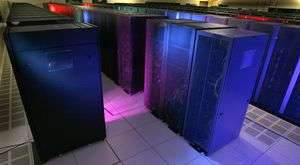
Less than a week after Los Alamos National Laboratory's Roadrunner supercomputer began operating at world-record petaflop/s data-processing speeds, Los Alamos researchers are already using the computer to mimic extremely complex neurological processes.
Welcome to the new frontier of research at Los Alamos: science at the petascale.
The prefix "peta" stands for a million billion, also known as a quadrillion. For the Roadrunner supercomputer, operating at petaflop/s performance means the machine can process a million billion calculations each second. In other words, Roadrunner gives scientists the ability to quickly render mountainous problems into mere molehills, or model systems that previously were unthinkably complex.
Late last week and early this week while verifying Roadrunner's performance, Los Alamos and IBM researchers used three different computational codes to test the machine. Among those codes was one dubbed "PetaVision" by its developers and the research team using it.
PetaVision models the human visual system—mimicking more than 1 billion visual neurons and trillions of synapses. Neurons are nerve cells that process information in the brain. Neurons communicate with each other using synaptic connections, analogous to what transistors are in modern computer chips. Synapses store memories and play a vital role in learning.
Synapses set the scale for computations performed by the brain while undertaking such tasks as locomotion, hearing or vision. Because there are about a quadrillion synapses in the human brain, human cognition is a petaflop/s computational problem.
To date, computers have been unable to match human performance on such visual tasks as flawlessly detecting an oncoming automobile on the highway or distinguishing a friend from a stranger in a crowd of people. Roadrunner is now changing the game.
On Saturday, Los Alamos researchers used PetaVision to model more than a billion visual neurons surpassing the scale of 1 quadrillion computations a second (a petaflop/s). On Monday scientists used PetaVision to reach a new computing performance record of 1.144 petaflop/s. The achievement throws open the door to eventually achieving human-like cognitive performance in electronic computers. PetaVision only requires single precision arithmetic, whereas the official LINPACK code used to officially verify Roadrunner's speed uses double precision arithmetic.
"Roadrunner ushers in a new era for science at Los Alamos National Laboratory," said Terry Wallace, associate director for Science, Technology and Engineering at Los Alamos. "Just a week after formal introduction of the machine to the world, we are already doing computational tasks that existed only in the realm of imagination a year ago."
Based on the results of PetaVision's inaugural trials, Los Alamos researchers believe they can study in real time the entire human visual cortex—arguably a human being's most important sensory apparatus.
The ability to achieve human levels of cognitive performance on a digital computer could lead to important insights and revolutionary technological applications. Such applications include "smart" cameras that can recognize danger or an autopilot system for automobiles that could take over for incapacitated drivers in complex situations such as navigating dense urban traffic.
Los Alamos National Laboratory's computation science team working with Roadrunner includes: Craig Rasmussen, Charles Ferenbaugh, Sriram Swaminarayan, Pallab Datta, all of Los Alamos; and Cornell Wright of IBM.
The PetaVision Synthetic Cognition team responsible for the theory and codes run on Roadrunner includes: Luis Bettencourt, Garrett Kenyon, Ilya Nemenman, John George, Steven Brumby, Kevin Sanbonmatsu, and John Galbraith, all of Los Alamos; Steven Zuker of Yale University; and James DiCarlo from Massachusetts Institute of Technology.
The Roadrunner is the world's first supercomputer to achieve sustained operating performance speeds of one petaflop/s. In partnership with Los Alamos and the National Nuclear Security Administration, Roadrunner was built by IBM and will be housed at Los Alamos National Laboratory, where it will be used to perform calculations that will vastly improve the nation's ability to certify that the United States nuclear weapons stockpile is reliable without conducting underground nuclear tests. Roadrunner also will be used for science and engineering such as energy research, understanding dark energy and dark matter, materials properties and response, understanding complex neural and biological systems, and biomedical applications.
Roadrunner was built using commercially available hardware, including aspects of commercial game console technologies. Roadrunner has a unique hybrid design comprised of nodes containing two AMD OpteronTM dual-core processors plus four PowerXCell 8iTM processors used as computational accelerators. The accelerators are a special IBM-developed variant of the Cell processors used in the Sony PlayStation 3. Roadrunner uses a Linux operating system. The project's total cost is approximately $120 million.
Source: Los Alamos National Laboratory


