Physicists produce quantum-entangled images
June 12, 2008
Quantum Images of a Cat

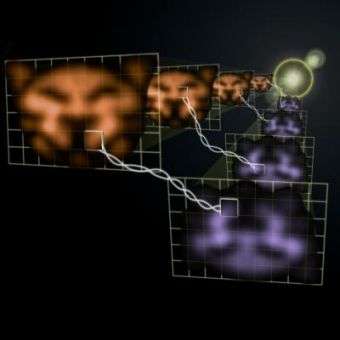
In this photo montage of actual quantum images, two laser beams coming from the bright glare in the distance transmit images of a cat-like face at two slightly different frequencies (represented by the orange and the purple colors). The twisted lines indicate that the seemingly random changes or fluctuations that occur over time in any part of the orange image are strongly interconnected or "entangled" with the fluctuations of the corresponding part in the purple image. Though false color has been added to the cats' faces, they are otherwise actual images obtained in the experiment. Credit: Vincent Boyer/JQI

Using a convenient and flexible method for creating twin light beams, researchers at the Joint Quantum Institute of the Commerce Department's National Institute of Standards and Technology and the University of Maryland have produced "quantum images," pairs of information-rich visual patterns whose features are "entangled," or inextricably linked by the laws of quantum physics. In addition to promising better detection of faint objects and improved amplification and positioning of light beams, the researchers' technique for producing quantum images—unprecedented in its simplicity, versatility, and efficiency—may someday be useful for storing patterns of data in quantum computers and transmitting large amounts of highly secure encrypted information. The research team, led by JQI's Paul Lett, describes the work in the June 12 edition of Science Express.

"Images have always been a preferred method of communication because they carry so much information in their details," says Vincent Boyer, lead author of the new paper. "Up to now, however, cameras and other optical detectors have largely ignored a lot of useful information in images. By taking advantage of the quantum-mechanical aspects of images, we can improve applications ranging from taking pictures of hard-to-see objects to storing data in futuristic quantum computers."
Creating Quantum Images

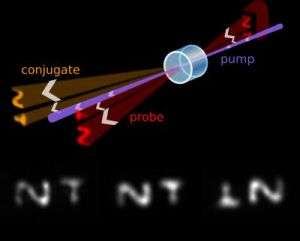
A laser beam (marked as "probe") first passes through a mask that imprints a visual pattern. Along with a second laser beam (marked "pump"), it enters a cell containing a gas of rubidium atoms. Interactions between the rubidium gas and the beams produce an amplified version of the imprinted image as well as a second version of the image, rotated 180 degrees around the pump. The bottom panel shows, from left to right, an incoming probe beam imprinted with the letters "N" and "T," an outgoing probe beam with an amplified image, and an upside-down version of the letters. The middle image is "entangled" with the rightmost image; the images’ changes over time are highly related to one another. Credit: V. Boyer et al., JQI

Conventional photographic films or digital camera sensors only record the color and intensity of a light wave striking their surfaces. A hologram additionally records a light wave's "phase"—the precise locations of the crests and valleys in the wave. However, much more happens in a light wave. Even the most stable laser beams brighten and dim randomly over time because, as quantum mechanics has shown, light has inherent "uncertainties" in its features, manifested as moment-to-moment fluctuations in its properties. Controlling these fluctuations—which represent a sort of "noise"—can improve detection of faint objects, produce better amplified images, and allow workers to more accurately position laser beams.

Quantum mechanics has revealed light's unavoidable noise, but it also provides subtle ways of reducing it to values lower than physicists once imagined possible. Researchers can't completely eliminate the noise, but they can rearrange it to improve desired features in images. A quantum-mechanical technique called "squeezing" lets physicists reduce noise in one property—such as intensity—at the expense of increasing the noise in a complementary property, such as phase. Modern physics not only enables useful noise reduction, but also opens new applications for images—such as transferring heaps of encrypted data protected by the laws of quantum mechanics and performing parallel processing of information for quantum computers.

Perhaps most strikingly, the quantum images produced by these researchers are born in pairs. Transmitted by two light beams originating from the same point, the two images are like twins separated at birth. Look at one quantum image, and it displays random and unpredictable changes over time. Look at the other image, and it exhibits very similar random fluctuations at the same time, even if the two images are far apart and unable to transmit information to one another. They are "entangled"—their properties are linked in such a way that they exist as a unit rather than individually. Moreover, they are squeezed: Matching up both quantum images and subtracting their fluctuations, their noise is lower—and their information content potentially higher—than it is from any two classical images.

To create quantum images, the researchers use a simple yet powerful method known as "four-wave mixing," a technique in which incoming light waves enter a gas and interact to produce outgoing light waves. In the setup, a faint "probe" beam passes through a stencil-like "mask" with a visual pattern. Imprinted with an image, the probe beam joins an intense "pump" beam inside a cell of rubidium gas. The atoms of the gas interact with the light, absorbing energy and re-emitting an amplified version of the original image. In addition, a complementary second image is created by the light emitted by the atoms. To satisfy nature's requirement for the set of outgoing light beams to have the same energy and momentum as the set of incoming light beams, the second image comes out as an inverted, upside-down copy of the first image, rotated by 180 degrees with respect to the pump beam and at a slightly different color.

One breakthrough in the experiment is that each image is made of up to 100 distinct regions, akin to the pixels forming a digital image, each with its own independent optical and noise properties. A pixel on one image forms a partnership with a pixel on the other image.

Look at two unrelated pixels—for example, a pixel in the top row of the first image and a pixel in the top row of the second image—and they appear to be doing their own random thing. But for two entangled pixels—the upper left pixel in the first image and the lower right pixel in the second image—their random fluctuations over time are eerily similar—one could predict many of the properties in the second pixel just by looking at the first.

"Making entangled quantum images is really striking, but what is most impressive to us is that the technique for making them is so much easier than what was possible before," says Lett.

Previous efforts at making quantum images have been limited to building them up with "photon counting"—collecting one photon at a time over a long period of time, or having very specialized "images" such as something that could only be constructed from a dot and a ring. In contrast, the new method produces an entire image at one time and can make a wide variety of images in any shape. Moreover, those earlier efforts have been difficult to implement—some setups required light to bounce back and forth between tightly controlled, precisely spaced mirrors. By contrast, the four-wave mixing approach requires easy-to-prepare laser beams and a small cell of rubidium vapor.

A next goal for the researchers is to produce quantum images with slowed-down light; such slowed images could be used in information storage and processing as well as communications applications.

Citation: V. Boyer, A. Marino, R. Pooser, and P. Lett. Entangled Images from Four-Wave Mixing. To Appear in Science Express, 12 June 2008.

Source: National Institute of Standards and Technology

4.6 /5 (58 votes)  

Filter


Move the slider to adjust rank threshold, so that you can hide some of the comments.


Display comments: newest first

SmartK8
Jun 12, 2008

Rank: 3.2 / 5 (6)
Nice..
GoodElf
Jun 13, 2008

Rank: 5 / 5 (1)
The images are linked "historically" with each other back along their common worldlines. Considered as Wheeler-Feynman Absorber Theory Events, each photon is connected to the other one by a null geodesic. This means in their own (photon) frames of reference they are contemporaneous conjugate events occupying the one place in space and time. They are co-resonant expressions of each other. What happens to one happens to the other until the link between them collapses when the "inner product" is evaluated. It is analogous to the Delayed Choice Quantum Eraser Experiment and why the entangled photons "always" find themselves instantaneously linked to each other for all "history". Spacetime are not "two concepts" (space and time) they are just one concept. Retrocausality is not a significant feature until after a collapse.
earls
Jun 14, 2008

Rank: not rated yet
"Spacetime are not "two concepts" (space and time) they are just one concept."

I think this is the most important thing to remember, this is simple a manifestation of "every force has an equal and opposite reaction." Along the lines of anti-matter...

There are two sides of everything to our Universe coin. As Elf mentioned, these "individual" apparitions are of little consequence, however, that's not to say you can't link or chain multiple "apparitions" together to achieve faster than relative communications... Tis only a suggestion, I've hardly pondered the consequences and requirements.

stupid post, posting anyway

haha, btw, what is that a metroid?
AdrianAnansi
Jun 14, 2008

Rank: not rated yet
Wait a minute, I thought you couldn't transmit information through Quantum Entanglement, as that would imply faster than light transmission?

Its a cat, it says so in the little blurb next to theimage.
mabarker
Jun 18, 2008

Rank: 5 / 5 (1)
I think it's a cat scan - or a meow-troid.
GoodElf
Jun 18, 2008

Rank: not rated yet
This is related to a comment I made on another news item on Physorg...
"World's Largest Quantum Bell Test Spans Three Swiss Towns" Unfortunately it seems links do not work here but look at article in Physorg.com "news132830327.html". In this case a signal is actually sent faster than light using a "semaphore". Entanglement at each end only lasts as long as the state is not read and when it collapses the state of the linked conjugate photon is scattered and becomes "gaussian noise". In this case the signal is not found in the two photons but in the "coherent state alone"... coherence signifying the qubit and loss of coherence being Gaussian noise. For instance the signal at one end will be source coherent and produce interference fringes if it passes through a slit. This state will only occur (the inter fence fringes) if the twin photons are not disturbed. If I disturb the state of one end of this stream (a distant end) and read the state or deliberately collapse it with a shutter then the state at the single slit will no longer show an Airy pattern but will indicate a gaussian pattern. A well placed photocell (placed on a minimum of the interference pattern will register "nothing" until the pattern is destroyed when the Gaussian "brightening" signals a loss of coherence. A series of dots and dashes can be sent with a shutter. In this case the "signal" is a picture of a cat.
"The photons in each stream image are source "coherent" with each other and linked to the conjugate twin until one is "read" then the other photon state in the alternate "beam" is instantly scattered and no longer forms part of the coherent "message" but becomes a separable part of a Gaussian distribution of photon noise (... through a loss of the qubit). There are enough entangled photons in each beam to send the classical signal of an "image of a cat"... then where parts of the image appear and disappear the noise in the image is not sufficient to destroy this "semaphore" of the "cat picture". Like watching an "old time silent film" with a lot of scratches and mars (which are individually transient)... the "image" is still viewed above the background "noise" even if 50% of the photons are scattered."

The other article is here...
"Plan for an Interstellar Grid allowing instantaneous Network Communication utilizing Quantum Entanglement - with some preliminary implications for SETI: John Walsh" can be found on www.seti.org.au/spacecom/ page reference "quantumcom.html" just add this page to the reference.
Rank 4.6 /5 (58 votes)
Tags

Relevant PhysicsForums posts
  • Liverpool vs Manchester United
    created1 hour ago
  • Wearing black in a desert
    created1 hour ago
  • Did space exist before mass?
    created1 hour ago
  • How can E&M Waves be polarized?
    created1 hour ago
  • Does light travel for ever?
    created2 hours ago
  • Infinity by Particles
    created3 hours ago
  • More from Physics Forums - General Physics

More news stories

Putting the squeeze on planets outside our solar system

(PhysOrg.com) -- Using high-powered lasers, scientists at Lawrence Livermore National Laboratory and collaborators discovered that molten magnesium silicate undergoes a phase change in the liquid state, abruptly ...

Physics / Condensed Matter

created 8 hours ago | popularity 4.4 / 5 (5) | comments 0 | with audio podcast

Hovering not hard if you're top-heavy, researchers find

Top-heavy structures are more likely to maintain their balance while hovering in the air than are those that bear a lower center of gravity, researchers at New York University's Courant Institute of Mathematical Sciences ...

Physics / General Physics

created 9 hours ago | popularity 5 / 5 (1) | comments 1 | with audio podcast

SLAC, Stanford team focuses on high-energy electrons to treat cancer

Accelerator physicists at SLAC and cancer specialists from Stanford are working on a new technology that could dramatically reduce the time needed for cancer radiation treatments. The team ran an initial experiment ...

Physics / General Physics

created 12 hours ago | popularity 5 / 5 (1) | comments 0

Measurements from high-energy collisions lead to better understanding of why meson particles disappear

For several years, physicists at the Relativistic Heavy Ion Collider (RHIC) at Brookhaven National Laboratory (BNL), USA, have studied an unusual state of matter called the quark–gluon plasma, which they ...

Physics / General Physics

created 13 hours ago | popularity 4.5 / 5 (2) | comments 0

Explained: Sigma

It's a question that arises with virtually every major new finding in science or medicine: What makes a result reliable enough to be taken seriously? The answer has to do with statistical significance -- but ...

Physics / General Physics

created Feb 09, 2012 | popularity 5 / 5 (16) | comments 53


Google users warned of threat to smartphone wallets

Users of Google smartphone wallets were being warned on Friday that there is a way to crack pass codes intended to thwart thieves from going on illicit shopping sprees.

Anonymous knocks CIA website offline (Update)

The website of the Central Intelligence Agency was inaccessible on Friday after the hacker group Anonymous claimed to have knocked it offline.

Complex wiring of the nervous system may rely on a just a handful of genes and proteins

Researchers at the Salk Institute have discovered a startling feature of early brain development that helps to explain how complex neuron wiring patterns are programmed using just a handful of critical genes. ...

New error-correcting codes guarantee the fastest possible rate of data transmission

Error-correcting codes are one of the triumphs of the digital age. They’re a way of encoding information so that it can be transmitted across a communication channel — such as an optical fiber o ...

The power of estrogen -- male snakes attract other males

A new study has shown that boosting the estrogen levels of male garter snakes causes them to secrete the same pheromones that females use to attract suitors, and turned the males into just about the sexiest ...

Humans may have helped the decline of African rainforests 3000 years ago

(PhysOrg.com) -- Large areas of rainforests in Central Africa mysteriously disappeared over three thousand years ago, to be replaced by savannas. The prevailing theory has been that the cause was a change ...