New Map Locates Metals in Millions of Milky Way Stars
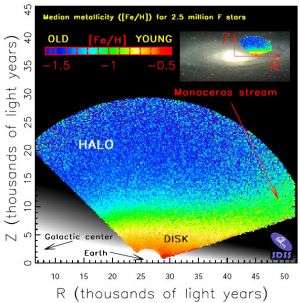
An international team of scientists from the Sloan Digital Sky Survey (SDSS-II) has unveiled the most complete and detailed map yet of the chemical composition of our Galaxy.
"This compilation of the compositions of more than 2.5 million stars in the Milky Way will greatly enhance our understanding of our galactic home, and likely will help to solve some mysteries about our Galaxy's birth and growth," said Donald Schneider, Distinguished Professor of Astronomy and Astrophysics at Penn State, who is a member of the research team and a leader in the SDSS-II organization.
Previous maps of the chemical composition of the Milky Way were based on much smaller samples of stars and didn't go as far as the distances SDSS-II surveyed--a region extending from near the Sun to about 30,000 light years away. "Older sky surveys that did include a lot of stars were not accurate enough to measure the chemical composition of those stars," explained study leader, Zeljko Ivezic, a University of Washington astronomer.
"With the new SDSS map, astronomers can begin to tackle many unsolved mysteries about the birth and growth of the Milky Way," Ivezic said. The construction and first implications of the map are described in a paper titled "The Milky Way Tomography with SDSS: II. Stellar Metallicity," slated to appear in the 1 August 2008 issue of The Astrophysical Journal.
Astronomers use the term "metals" to describe all elements heavier than hydrogen and helium, including the oxygen we breathe, the calcium in our bones, and the iron in our blood. Although hydrogen, helium, and traces of lithium were created at the beginning of the universe in the Big Bang, all other elements, such as iron and carbon, were forged in the cores of stars or during the explosive deaths of massive stars.
As a result, stars that formed early in the history of our Galaxy, some 13-billion years ago, were made of gas that had few metals created by the generations of stars that came before. These "metal-poor stars" provide astronomers with a chemical fingerprint of the origin and evolution of the elements. As subsequent generations of stars formed and died, they returned some of their metal-enriched material to the interstellar medium, the birthplace of later generations of stars, including our Sun.
The scientists explain that, by mapping how the metal content of stars varies throughout the Milky Way, astronomers can decipher star formation and evolution, just as archaeologists reveal ancient history by studying human artifacts. To make this new map of the Galaxy, the SDSS-II team used the colors of millions of stars to infer their metal content -- often referred to as metallicity. To estimate the metallicity of so many stars at once, the team compared the colors of the stars with spectroscopic observations for many tens of thousands of these stars. A group researchers on the SDSS-II team devised methods to estimate the metallicities of these stars based on their spectra that are more effective by a factor of ten over earlier methods -- a significant improvement.
"The map of the distribution of metallicity for several million stars reveals the differing content of chemical elements in the stellar populations of our Galaxy," explained Ivezic. The color of a star is influenced slightly by the presence of dark regions in a star's light spectrum-- called absorption lines. When the metals are depleted in the star, the amount of blue light emitted by the star is slightly increased. "By using two-dimensional images in different colors, we built up a three-dimensional 'tomographic' map that clearly delineates the disk and halo components of the Milky Way," Ivezic said.
The metal map also shows that galaxies cannibalized by the Milky Way--including shards of one known as the Monoceros Stream--possess stars with metal content that is different from the expected metal content at the Monoceros Stream's position.
Many features of the map confirm standard views of the structure of the Milky Way. But, Ivezic noted, the projected motions measured for metal-poor stars appear to contradict a long-standing hypothesis of galaxy construction: that an ancient act of galactic cannibalism gave rise to the "thick disk" of stars enveloping the thin disk in which our star-- the Sun--resides.
The SDSS-II results also provide a roadmap for future, even-larger surveys, such as those planned for the 8.4-m Large Synoptic Survey Telescope (LSST). LSST maps could extend ten times further, to the very edge of the Milky Way, measuring the chemical compositions of hundreds of million stars using the technique pioneered in this study by the SDSS-II team.
A preprint version of the research paper is available on the Web at http: //lanl.arxiv.org/abs/0804.3850 .
Source: Penn State


