Phoenix Mars Lander Delivers Soil Sample to Microscope
June 12, 2008 Phoenix Mars Lander Delivers Soil Sample to Microscope

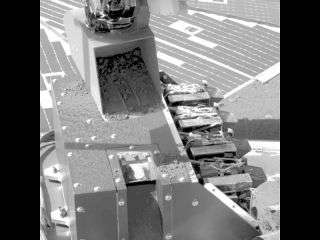
The Robotic Arm on Phoenix has just delivered the first sample of dug-up soil to the spacecraft's microscope station in this image taken during the mission's Sol 17 (June 12), or 17th Martian day after landing. Image credit: NASA/JPL-Caltech/University of Arizona/Texas A&M

NASA's Phoenix Mars Lander sprinkled a spoonful of Martian soil Wednesday onto the sample wheel of the spacecraft's robotic microscope station, images received early Thursday confirmed.

"It looks like a light dusting and that's just what we wanted. The Robotic Arm team did a great job," said Michael Hecht of NASA's Jet Propulsion Laboratory, Pasadena, Calif. He is the lead scientist for the Microscopy, Electrochemistry and Conductivity Analyzer (MECA) instrument on Phoenix.

The delivery of scooped-up soil for inspection by the lander's Optical Microscope, a component of MECA, marks the second success in consecutive days for getting samples delivered to laboratory instruments on Phoenix's deck. Some soil from an earlier scoopful reached a tiny oven in another instrument on Tuesday, as confirmed in data received early Wednesday.

That instrument is the Thermal and Evolved-Gas Analyzer, or TEGA. Commands being sent to Phoenix today include instructions to close TEGA oven number 4 and begin analyzing the sample inside, a process that will take several days.

The soil now in the microscope station came from the same scoopful that was used for a practice run of the sprinkle delivery technique on Monday. That scoopful has the informal name "Mama Bear." The sample delivered to TEGA oven 4 has the informal name "Baby Bear." Both came from a trench now called "Goldilocks" but earlier referred to as Baby Bear, on the northwest side of the lander.

The Phoenix team assembled at the University of Arizona plans to command the Robotic Arm in the next day or two to dig deeper into the Goldilocks trench and an adjacent trench called "Dodo" to determine the depth to an underlying layer of hard material that may be ice.

Source: NASA


print this article email this article download pdf blog this article bookmark this article     Stumble it Digg this share on Facebook retweet share on Reddit add to delicious
Rate this story - 3.9 /5 (10 votes)


June 12, 2008 all stories

Comments: 0

3.9 /5 (10 votes)
  • Stumble this up

  • Digg this

  • share this

  • hide
  • Related Stories

  • Phoenix Lander Finishes Soil Delivery to Onboard Labs
    created Oct 22, 2008 | popularity not rated yet | comments 0
  • Phoenix Gets Bonus Soil Sample
    created Oct 20, 2008 | popularity not rated yet | comments 0
  • Next Mars Soil Scoop Slated for Last of Lander's Wet Lab Cells
    created Sep 10, 2008 | popularity not rated yet | comments 0
  • Analysis Begins on Deepest Martian Soil Sample
    created Sep 02, 2008 | popularity not rated yet | comments 0
  • Phoenix Mission Conducting Extended Activities on Mars
    created Sep 01, 2008 | popularity not rated yet | comments 0


  • hide
  • Relevant PhysicsForums posts

  • Gravity on Mars
    created 4 hours ago
  • Question about the orbit between Mars and Earth
    created 12 hours ago
  • SIMBAD/NED help
    created 16 hours ago
  • Black hole confusion
    created Nov 14, 2009
  • More from Physics Forums - General Astronomy

Other News

Ancient high-altitude trees grow faster as temperatures rise

Space & Earth / Earth Sciences

created 57 minutes ago | popularity 5 / 5 (2) | comments 0

PIC=32536:left]Increasing temperatures at high altitudes are fueling the post-1950 growth spurt seen in bristlecone pines, the world's oldest trees, according to new research.


NASA 'Drops' Next Generation Robotic Lander During Autonomous Tests

NASA 'Drops' Next Generation Robotic Lander During Autonomous Tests

Space & Earth / Space Exploration

created 4 minutes ago | popularity not rated yet | comments 0

(PhysOrg.com) -- NASA has successfully completed a series of autonomous "drop" tests of a robotic lander test article - in a record 10 months - to demonstrate the ability to perform a controlled landing on ...


Taking a Bite of Antarctic Ice

Taking a Bite of Antarctic Ice

Space & Earth / Space Exploration

created 20 minutes ago | popularity not rated yet | comments 0

Scientists with NASA’s IceBite project are heading this week for University Valley, a hanging valley perched more than 1600 feet (more than 1 mile) above sea level in Antarctica’s McMurdo Dry Valleys. Their ...


New climate treaty could put species at risk

Space & Earth / Environment

created 47 minutes ago | popularity not rated yet | comments 0

Plans to be discussed at the forthcoming UN climate conference in Copenhagen to cut deforestation in developing countries could save some species from extinction but inadvertently increase the risk to others, scientists believe.


Close-up movie shows hidden details in the birth of super-suns

Close-up movie shows hidden details in the birth of super-suns (w/ Video)

Space & Earth / Astronomy

created 3 hours ago | popularity 4.7 / 5 (3) | comments 0

(PhysOrg.com) -- The constellation of Orion is a hotbed of massive star formation, most prominently in the Great Nebula that sits in Orion's sword. The glowing gas of the Nebula is powered by a group of young ...