Ultraviolet gives view inside real 'death star'
June 13, 2008 Ultraviolet gives view inside real 'death star'

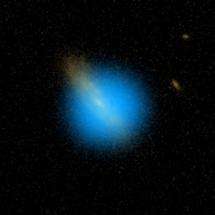
Flash of ultraviolet light revealing the death throes of a star.

Scientists have, for the first time, observed a flash of ultraviolet light from within a dying star giving vital evidence of how stars turn into supernovae.

An international team, including nine scientists from Oxford University, combined data from ground-bound telescopes observing visible light from supernovae with data from a space telescope looking for an earlier peak in ultraviolet light from an associated dying star. They were able to spot telltale signs of the shockwave that forms within a star before it explodes into a supernova. A report of the work appears in this week’s Science.

‘Supernovae are huge stellar explosions that light up galaxies but often we have no idea which star has exploded,’ said Dr Kevin Schawinski of Oxford University’s Department of Physics. ‘The nature of such an explosion is that we can’t look inside it and it destroys almost all evidence of the original star – scientists have been trying to catch such an event happening for decades.’

Previously, scientists have observed stars nearing the end of their lives and supernova explosions and their afterglow, but have had little firm evidence of what happens in between. The new observations give a first glimpse of what happens inside a star during its final hours of life.

‘Out of all the supernovae we looked at we found one that was preceded by a dramatic ‘flash’ of ultraviolet light given off by a red super-giant star in a galaxy around a billion light years away. This flash occurred about two weeks before it was detected as a normal supernova,’ said Dr Stephen Justham of Oxford University’s Department of Physics.

‘We believe that this light, emanating from deep within the star, was generated after its core collapsed and compressed the gas surrounding it to around one million degrees Kelvin.’ Around four hours after this light was observed a shockwave from the collapsed core, travelling at 50 million kilometres an hour, would have hit the surface of the star and blown it apart. However, it was almost two weeks before the resulting fireball was spotted by supernova hunters using telescopes in Hawaii.

‘With this observation we have managed to peer inside one of the hundred billion stars in a galaxy and see what it is like at the very moment that it dies,’ said Dr Christian Wolf of Oxford University’s Department of Physics. ‘We’ve been extremely fortunate to capture this moment but this is just one event and, of course, we’d love to capture other similar events with different stars which could deliver many more surprises.’

Source: Oxford University


print this article email this article download pdf blog this article bookmark this article     Stumble it Digg this share on Facebook retweet share on Reddit add to delicious
Rate this story - 4.9 /5 (21 votes)

Rank Filter

Move the slider to adjust rank threshold, so that you can hide some of the comments.


Display comments: newest first


June 13, 2008 all stories

Comments: 1

4.9 /5 (21 votes)
  • Stumble this up

  • Digg this

  • share this

  • hide
  • Related Stories

  • In amoeba world, cheating doesn't pay
    created Oct 01, 2009 | popularity not rated yet | comments 0
  • Transparent aluminium is 'new state of matter'
    created Jul 27, 2009 | popularity not rated yet | comments 0
  • Unique sky survey brings new objects into focus
    created Jun 15, 2009 | popularity not rated yet | comments 0
  • Celebrating gravity’s light-bending landmark
    created May 29, 2009 | popularity not rated yet | comments 0
  • 'Missing link' galaxies discovered
    created Nov 25, 2008 | popularity not rated yet | comments 0


  • hide
  • Relevant PhysicsForums posts

  • Black hole confusion
    created Nov 14, 2009
  • Moon tied to Earth
    created Nov 13, 2009
  • Water on the Moon!
    created Nov 13, 2009
  • Is it possible for a single super-massive black hole...
    created Nov 13, 2009
  • More from Physics Forums - General Astronomy

Other News

Hawaii's famed white sandy beaches are shrinking (AP)

Hawaii's famed white sandy beaches are shrinking

Space & Earth / Environment

created 2 hours ago | popularity not rated yet | comments 0

(AP) -- Jenn Boneza remembers when the white sandy beach near the boat ramp in her hometown was wide enough for people to build sand castles.


Wu Chang Gong temple in Taiwan was partially levelled by a powerful earthquake ten years ago

Taiwan to boost quake warning system

Space & Earth / Earth Sciences

created 3 hours ago | popularity not rated yet | comments 0

Taiwan plans to build its first undersea seismic station, designed to improve the island's early warning system and save valuable seconds when earthquakes strike, officials said.


Commuters wait on the platform shrouded by fog in London

Climate change not man-made, say majority of Britons: poll

Space & Earth / Environment

created 3 hours ago | popularity 3 / 5 (2) | comments 2

Less than half of Britons believes that human activity is to blame for global warming, according to a poll carried out for The Times newspaper and published on Saturday.


NASA on track for Monday space shuttle launch (AP)

NASA on track for Monday space shuttle launch

Space & Earth / Space Exploration

created 18 hours ago | popularity 3 / 5 (1) | comments 0

(AP) -- NASA has cleared space shuttle Atlantis for liftoff Monday on a trip to stock up the International Space Station with several years' worth of spare parts.


Controversial new climate change results

Controversial new climate change results

Space & Earth / Environment

created Nov 10, 2009 | popularity 4 / 5 (39) | comments 81

(PhysOrg.com) -- New data show that the balance between the airborne and the absorbed fraction of CO2 has stayed approximately constant since 1850, despite emissions of CO2 having risen from about 2 billion ...