World's Largest Quantum Bell Test Spans Three Swiss Towns
June 16, 2008 By Lisa Zyga
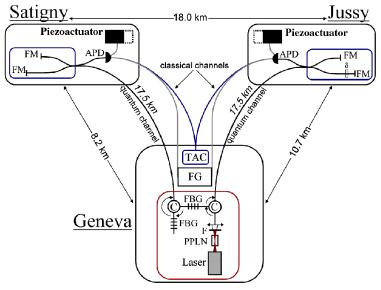
In the Bell test, two photons from an entangled pair were sent from Geneva to Satigny and Jussy, two small towns located 18 km apart. This distance enabled the space-like separation necessary for finishing a quantum measurement in each town, which required a macroscopic mass to move. Detection of the mass’ movement was completed before information could have traveled between the two towns. Credit: D. Salart, et al.
In an attempt to rule out any kind of communication between entangled particles, physicists from the University of Geneva have sent two entangled photons traveling to different towns located 18 km apart – the longest distance for this type of quantum measurement. The distance enabled the physicists to completely finish performing their quantum measurements at each detector before any information could have time to travel between the two towns.
Many other experiments have observed quantum nonlocality – the “spooky interaction at a distance” that occurs between two entangled particles – and also known as a violation of Bell inequalities. But, as physicists Daniel Salart, et al., explain in a recent issue of Physical Review Letters, these Bell tests might not have gone far enough. If quantum measurements aren’t finished until after a mass has moved (as the team assumes here), then the Bell violations in previous tests might merely have been due to some type of classical communication between particles unknown to today’s physics.
In their experiment, the physicists sent pairs of entangled photons from Geneva through optical fibers leading to interferometers in two other Swiss towns: Satigny and Jussy, located 8.2 and 10.7 km away, respectively. The distance between the interferometers in Satigny and Jussy was 18 km.
With this large distance between the interferometers, the physicists could perform a more complete quantum measurement than has previously been done. Somewhat surprisingly, physicists have never decided exactly when a quantum measurement is finished (when the “collapse” occurs, if there is any).
Different interpretations of quantum mechanics lead to different answers. The most common view is that a quantum measurement is finished as soon as the photons are absorbed by detectors. Previous experiments have been set up to allow enough distance between particle detectors to prohibit communication under this view. But there are also other views of when the measurement is finished, including “when the result is secured in a classical system,” “when the information is in the environment,” or even that it is never over – a view that leads to the many worlds interpretation.
The Swiss team followed a view proposed independently by Penrose and Diosi, which assumes a connection between quantum measurements and gravity, and requires a macroscopic mass to be moved. In this view, the measurement takes more time than it does for a photon to be absorbed by a detector. The significance of the Swiss test is that it is the first “space-like separated” Bell test under the Penrose-Diosi assumption.
“There is quite a large community of physicists that speculates on possible connections between quantum gravity and the measurement problem,” coauthor Hugo Zbinden told PhysOrg.com. “The advantage of the Penrose-Diosi model is that it is testable using today's technology.”
In the physicists’ experiment, the detection of each photon by a single-photon detector triggers a voltage to a piezoelectric actuator. The actuator expands, which in turn causes a tiny gold-surfaced mirror to move. By measuring the mirror displacement, the researchers could confirm by the gravity-quantum connection that the quantum measurement had been successfully finished.
All of the steps – from photon detection to mirror movement – take about 7.1 microseconds, which is significantly less than the 60 microseconds it would take a photon to cover the 18 km between interferometers. So measurements made simultaneously at each of the interferometers could not be been influenced by anything traveling at – or even a few times more than – the speed of light.
“The significance of our experiment lies entirely in achieving space-like separation, even under the assumption that a quantum measurement is only finished after a macroscopic mass has moved, as in the Penrose-Diosi model,” Zbinden explained.
Altogether, the experiment serves to fill a loophole by ruling out any kind of communication between two entangled particles separated by a distance, provided the collapse happens only after a mass has moved. By spatially separating the entangled photons, the test once again confirms the nonlocal nature of quantum correlations.
More information: Salart, D.; Baas, A.; van Houwelingen, J. A. W.; Gisin, N.; and Zbinden, H. “Spacelike Separation in a Bell Test Assuming Gravitationally Induced Collapses.” Physical Review Letters 100, 220404 (2008).
Copyright 2008 PhysOrg.com.
All rights reserved. This material may not be published, broadcast, rewritten or redistributed in whole or part without the express written permission of PhysOrg.com.


VIOLATION!!!
Once again quantum mechanics defeated hidden local variables!
God have mercy on our souls!
So there is FTL communication between the entangled photons?
Thanx, for your explanation.
Is this a joke?
Or was this piece left over from April Fool's and today was just a slow news day?
Does no one read this stuff before it gets posted?
These are all serious questions. I would like to hear someone from the source please respond.
Perhaps there is a way to explain this using a hidden global variable?
What if time is not linear? Suppose it has two or three perpendicular dimensions?
In that case, "information" could travel "instantaneously" from one photon to the other in such a way that no time at all passes in the classical time dimension, but the information did not move faster than C, it simply moved through space, but with respect to a seperate time dimension.
Relativity and classical mechanics were not actually violated. They only appear to have been violated because of "missing" dimensions.
http://en.wikiped..._Theorem
http://math.ucr.e...ity.html
Take two balls, dip them in the same unknown-color paint bucket (hidden variable, heh, as long as we agree not to look at the balls' color), send them apart, and then "measure" their colors simultaneously. Woah, man, they are the same color! Spooky action at a distance! Wait.. what?
Do we need any faster-than-light communication or non-locality or other weird stuff to explain this result? No.
Why should be the case with photons any different? Why can't we assume that the result of our measurement was already predetermined at the time of the photon entanglement, when the pair of photons was at the same place, and that result just stayed as a pair of "hidden variables" until we measured it? How is that a violation of locality - each variable in the pair is local to the photon it applies to, and the correlation between their values is not developed at a distance, but when they were in the same locality.
For me, all that this proves is that "quantum measurements" are essentially deterministic, even if we don't yet know the laws that determine them.
Its not easy to understand at first and yes it often looks like its just a matter of silly redefinition of words, but thats not the case although it may take *considerable* effort to understand why.
The qubits are "entangled" at the source and each one of the pair will form part of a stream of continuously entangled photons heading in each direction respectively. If these were to pass through a slit, for instance, they would produce an interference pattern on a screen at one end... while it's twin entangled photon at the other end of this link would be "scattered" as the result of the first "measurement" (reading this stream as an interference pattern). If this "detection" process was performed at one distant end of the "signal stream" is a classical one (movement of a shutter for instance) the photons at one end of the stream would be "collapsed" before the matched photons in the alternate entangled stream reached the slit to produce the interference pattern on the screen. The interfence pattern would "disappear" or "reappear" in sequence with the shutter. Thus a series of dots and dashes could be sent as a classical semaphore of a shutter signal using thousands of photons in the continuous stream on one end of this "interferometer" by blocking the stream then unblocking the stream the interference pattern at the other end would "switch" the INTERFERENCE PATTERN on and off at the other end ... one moment a series of bands signifying an Airy Pattern the next an incoherent Gaussian distribution of scattered photons. The "signal" is sent by noticing the stream's coherence at the other end on the screen (or not. This coherence is classical and related to de Broglie Matter Waves due to the effect of the "shutter" used to send it.
Plan for an Interstellar Grid allowing instantaneous Network Communication utilizing Quantum Entanglement - with some preliminary implications for SETI
http://www.seti.o...com.html
There is also a strong correlation to another recent article where an entangled image is "sent" as a "signal" to alternative destinations... and as long as not all photons are detected in one stream this can be a "coherent signal" which is instantly entangled to the image in the "other stream". The photons in each stream image are source "coherent" with each other and linked to the conjugate twin until one is "read" then the other photon state in the alternate "beam" is instantly scattered and no longer forms part of the coherent "message" but becomes a separable part of a Gaussian distribution of photon noise (... through a loss of the qubit). There are enough entangled photons in each beam to send the classical signal of an "image of a cat"... then where parts of the image appear and disappear the noise in the image is not sufficient to destroy this "semaphore" of the "cat picture". Like watching an "old time silent film" with a lot of scratches and mars (which are individually transient)... the "image" is still viewed above the background "noise" even if 50% of the photons are scattered.
see... Physicists produce quantum-entangled images
http://www.physor...362.html
BTW. If you put links into the comment and then edit the comment the links will be broken.
This experiment appears to contradict the NCT, which is why it is potentially very exciting. I suspect that the NCT is not a strong consensus view. Here's hoping it's wrong!
Here's what I'm thinking: There is a lot of math that points to the existence of more dimensions than we can observe. Is it so bizarre to think that perhaps in a higher dimension, the two entangled particles are actually one entity?
If the entangled pair was really a single object, then at that level there would be no violation of locality.
Anyway, it's just a thought, I have nothing to back this idea up.
PhysOrgForum Science, Physics and Technology Discussion Forums -> Nanotechnology & Quantum Physics -> Quantum physics -> Quantum Entanglement, Compact Dimensions Explain Entanglement?
.. Please feel free to comment in the forum there. (some links just do not seem to work here.... Sorry.)
The "state of play" at the moment is similar to the current discussion on so called "squeezed light" in which the underlying uncertainty is "squeezed out" from the quantum state defying the basic tenant of particle quantum theory of "uncertainty". Coherent light sources suffered a similar beginning when their "coherence" was initially unable to be incorporated into the new quantum theory. Quantum theory and it's methodology tried hard to ignore the underlying order in their otherwise chaotic and "random" processes. They merely emphasized the human philosophies of post-modernism and deconstructionism... everything could be broken down into "particles" of "matter" and "information" which act essentially separately. It placed the quantum observer into a new chaotic center of the Universe. The adage of the age was "shut up and calculate"... there was nothing to be found of "order" in the quantum.
In actual practical terms "squeezed light" is treatment of a form of classical resonance known to electromagnetic theory through tuned circuits made popular by Tesla and Marconi and others but now using the language of particles and not waves and working in the optical domain rather than the radio frequency domain. The same principle are clearly evident. Classical resonance is understood but no attempt is made to incorporate a wave theory with resonance concepts since all quantum theory essentially requires all quanta to be indistinguishable and possess no "history" because they all lack individual worldlines (which would be entirely classical and related to Einstein's Relativity of an underlying continuum).
Resonance between sources and sinks is "classical" and is linked by a "path". This "path" is a classical "path" of resonance in cavities described by classical wave functions which may be probed and measured using certain kinds of instruments.
Dedicated Quantum Theorists arbitrarily "choose" what they wish to call "classical" and what they wish to call "non-classical" and incorporate into their particle theory an interpretation that is more about "magic" than about the elucidation of science in clear terms. There is nothing "magic" in resonance phenomena.
This experiment, as in so many others, show a non-locality that is "refreshingly" classical and is to do with the "wave nature" of electromagnetism and to de Broglie Matter waves. The "particle only" theory of interactions is basically shown to be flawed when it omits this global berry phase.
This article and it's associated paper reports on experimental verification of non-local superluminal communication which is breaking a basic tenant of quantum particle theory of locality of particles. "Entanglement" is a wave property of photons as waves interacting with de Broglie Matter Waves in "generalized cavities" that even one photon, or in this case, two entangled photons exhibit. This happens through the "connection" of null geodesics linking the entangled photons in their rest frame and the ability of the photon to "spread" as an eigenstate (or several progressive eigenstates) before a collapse redistributes the energy when it is absorbed. This is classical "transmission line theory" with the incorporation of wavepackets.
This is not "spooky" as Einstein though but it is not part of current theory the way it is currently developing. Waves are non-local while particles are local... regardless of postulates.