Queen's marine biologist investigates aliens beneath the waves
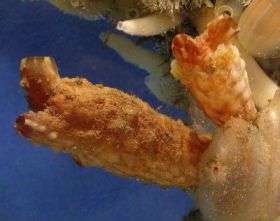
June 16, 2008 Styela clava

Styela clava, one of the non-native species which has been found in UK waters. Credit: John Bishop / Marine Biological Association

Queen's University Belfast is appealing for help from the public in looking at ways to detect and stop the spread of marine aliens.

Activities such as aquaculture, shipping and recreational boating have led to an army of marine alien species hitchhiking around the globe. Now Queen's is attempting to find out exactly where and how non-native species get a foothold in a new area. To do this it is asking for help from the public to record what they have seen.

Part of the Marine Aliens consortium, co-ordinated by the Scottish Association for Marine Science, the project will use the information gathered to look at how invasions can be slowed or preferably prevented. It is very difficult to eradicate an organism once it has become established in a new area.

Professor Christine Maggs, from the School of Biological Sciences at Queen's, said:

"While exotic plants and animals like rhododendrons and grey squirrels are obvious in the British Isles, beneath the waves a hidden invasion of non-native species is taking place around our shores.

"Many marine aliens have left their natural enemies behind and may compete with native species with potentially disastrous consequences for aquaculture, tourism and other marine activities.

"But we can all do our bit for biosecurity - anyone who has a boat or who visits the shore can help by telling scientists what they have seen."

A guide on the Marine Aliens website will help the public identify some of the non-native species which are least wanted, including the Japanese seaweed Sargassum, which has become extremely common in Strangford Lough, the Chinese mitten crab, already found in Ireland, and two species that have not arrived here yet, the Japanese skeleton shrimp and a colonial sea squirt. The site is at www.marlin.ac.uk/marine_aliens

Records of marine life should include as a minimum what was seen, and where and when it was seen. They can be made online at www.marlin.ac.uk/rml and sightings in Ireland can also be reported through the invasive species Ireland website www.invasivespeciesireland.com

Source: Queen's University Belfast


print this article email this article download pdf blog this article bookmark this article     Stumble it Digg this share on Facebook retweet share on Reddit add to delicious
Rate this story - 3 /5 (1 vote)


June 16, 2008 all stories

Comments: 0

3 /5 (1 vote)
  • Stumble this up

  • Digg this

  • share this

  • hide
  • Related Stories

  • Judge says seals can stay in California cove
    created 15 hours ago | popularity not rated yet | comments 0
  • How much is nature worth?
    created Nov 13, 2009 | popularity not rated yet | comments 0
  • You're being followed: Scientists track movement of living things
    created Nov 13, 2009 | popularity not rated yet | comments 0
  • Warming drives off Cape Cod's namesake, other fish
    created Nov 12, 2009 | popularity not rated yet | comments 0
  • A motley collection of boneworms (w/ Video)
    created Nov 10, 2009 | popularity not rated yet | comments 0


Other News

Judge says seals can stay in California cove (AP)

Judge says seals can stay in California cove

Biology / Ecology

created 15 hours ago | popularity 4 / 5 (1) | comments 0

(AP) -- The seals can stay and play at a La Jolla swimming cove.


Rasberry crazy ant

Rapacious Rasberry ants march north

Biology / Plants & Animals

created Nov 13, 2009 | popularity 4.3 / 5 (7) | comments 10

Poor Texas. First it was killer bees, then fire ants. Now, it's the Rasberry ants.


Ancient penguin DNA raises doubts about accuracy of genetic dating techniques

Ancient penguin DNA raises doubts about accuracy of genetic dating techniques

Biology / Evolution

created Nov 10, 2009 | popularity 4.8 / 5 (22) | comments 12

Penguins that died 44,000 years ago in Antarctica have provided extraordinary frozen DNA samples that challenge the accuracy of traditional genetic aging measurements, and suggest those approaches have been ...


Striped skunk

Skunk's Strategy Not Just Black and White

Biology / Plants & Animals

created Nov 10, 2009 | popularity 4.3 / 5 (4) | comments 4

Predators with experience of skunks avoid them both because of their black-and-white coloration and their distinctive body shape, according to UC Davis wildlife researcher Jennifer Hunter. The study was published ...


What is the meaning of 'one'? Evolutionary biologists argue for new meaning of 'organismality'

Biology / Evolution

created Nov 09, 2009 | popularity 4.8 / 5 (6) | comments 3

Rice University evolutionary biologists David Queller and Joan Strassmann argue in a new paper that high cooperation and low conflict between components, from the genetic level on up, give a living thing its "organismality," ...