Lou Gehrig's protein found throughout brain, suggesting effects beyond motor neurons
June 16, 2008
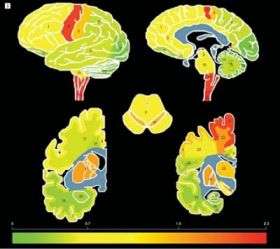
Whole-brain density map of TDP-43 distribution throughout central nervous system of ALS patients. Red, orange, and yellow depict areas of highest density of TDP-43 pathology. Credit: Felix Geser and Nick Brandmeir, University of Pennsylvania; Archives of Neurology
Two years ago researchers at the University of Pennsylvania School of Medicine discovered that misfolded proteins called TDP-43 accumulated in the motor areas of the brains of patients with amyotropic lateral sclerosis (ALS), or Lou Gehrig's disease. Now, the same group has shown that TDP-43 accumulates throughout the brain, suggesting ALS has broader neurological effects than previously appreciated and treatments need to take into account more than motor neuron areas. Their article appeared in last month's issue of the Archives of Neurology.
"The primary implication for ALS patients is that we have identified a molecular target for new therapies," says co-author John Q. Trojanowski, MD, PhD, Director of Penn's Institute on Aging. "The other implication is that new therapies for ALS now need to go beyond treating only motor neurons."
Traditionally, ALS has been diagnosed based on muscle weakness and neurodegeneration of the upper and lower motor neurons that extend from the motor cortex to the spinal cord and brainstem motor neurons, which directly innervate voluntary muscles. For example, if you want to wiggle your big toe, the signal travels from the motor neuron in the cortex at the top of your head to a synapse on the lower spinal cord motor neurons in the lower back, which, in turn transmit the "wiggle" command by sending a signal to the muscles that move your big toe. Patients with ALS cannot wiggle their big toe or complete other voluntary muscle movements, including those carried out by their other extremities and eventually, by the diaphragm that moves air in and of their lungs.
The study was conducted by examining post-mortem brain tissue of 31 ALS patients. The accumulation of TDP-43 was imaged by detecting TDP-43 with an antibody specific for this protein. TDP-43 pathology was observed not only in the areas of the brain and spinal cord that control voluntary movements, as expected, but also in regions of the brain that involve cognition, executive functioning, memory, and involuntary muscle control. TDP-43 pathology was not observed in any of the controls that did not have ALS.
The pathological TDP-43 observed in ALS brains is different in two ways from normal TDP-43 that is found in most cells. The ALS-associated TDP-43 includes fragments of normal TDP-43 as well as other abnormally modified forms of TDP-43, and it is located in the cytoplasm of neurons; whereas, normal TDP-43 is found almost exclusively in the cell nucleus. In ALS, the pathological TDP-43 accumulates in large "globs," mainly in cell bodies.
"Our observation of TDP-43 in the brains of ALS patients suggests that ALS and two other neurodegenerative diseases called ALS- PLUS [ALS with cognitive impairments] and FTLD [frontotemporal lobar disease] may all have the same underlying molecular pathology involving abnormal TDP-43," says Trojanowski. "This constitutes a paradigm shift in the way we think about these diseases."
Current research is focused on understanding the basic biology of TDP-43 in cell culture systems. The research team is now trying to find out whether pathological TDP-43 causes nerve cells to lose their normal function or if they take on a toxic function. "The over-riding goal that drives our work is helping ALS patients," says Trojanowski.
Source: University of Pennsylvania
-
Researchers discover genetic link between both types of ALS
May 05, 2010 |
not rated yet |
0
-
Brain disorder suggests common mechanism may underlie many neurodegenerative diseases
Jan 11, 2009 |
4.9 / 5 (7) |
0
-
Gladstone scientists identify role of key protein in ALS and frontotemporal dementia
Jan 12, 2010 |
not rated yet |
0
-
Fast photon control brings quantum photonic technologies closer
1 hour ago |
5 / 5 (2) |
0
-
Engineers build first sub-10-nm carbon nanotube transistor
Feb 01, 2012 |
4.9 / 5 (33) |
30
-
Something old, something new: Evolution and the structural divergence of duplicate genes
Jan 31, 2012 |
4.6 / 5 (7) |
1
-
The hidden nanoworld of ice crystals: Revealing the dynamic behavior of quasi-liquid layers
Jan 30, 2012 |
5 / 5 (5) |
1
-
Stock market network reveals investor clustering
Jan 27, 2012 |
3.9 / 5 (23) |
8
-
Classical and Quantum Mechanics via Lie algebras
Apr 15, 2011
- More from Physics Forums - Independent Research
More news stories
New ability to regrow blood vessels holds promise for treatment of heart disease
(Medical Xpress) -- University of Texas at Austin researchers have demonstrated a new and more effective method for regrowing blood vessels in the heart and limbs a research advancement that could have ...
57 minutes ago |
5 / 5 (3) |
0
|
Motivation to exercise affects behavior
(Medical Xpress) -- For many people, the motivation to exercise fluctuates from week to week, and these fluctuations predict whether they will be physically active, according to researchers at Penn State. In an effort to ...
47 minutes ago |
not rated yet |
0
|
'It's not nutritious until it's eaten'
As part of her "Let's Move! Initiative," First Lady Michelle Obama unveiled a new web resource highlighting new changes in the Chefs Move to Schools, during a CMST gathering in Dallas, TX today. CMTS advocates ...
34 minutes ago |
not rated yet |
0
New tumor suppressor gene identified
A recent study published in Clinical Cancer Research suggests that the protein hVps37A suppresses tumor growth in ovarian cancer. The work, which was funded by the Austrian Science Fund FWF, shows, for th ...
1 hour ago |
4.7 / 5 (3) |
0
Social psychologist: Lust makes you smarter and evidence that seven deadly sins are good for you
(Medical Xpress) -- Good news for lovers on Valentine’s Day - the seven deadly sins, including Lust, are good for you. University of Melbourne social psychologist Dr Simon Laham uses modern research to make a compelling ...
Medicine & Health / Psychology & Psychiatry
3 hours ago |
4.5 / 5 (2) |
0
Fast photon control brings quantum photonic technologies closer
(PhysOrg.com) -- Using photons instead of electrons to transmit information could lead to faster and more secure ways to communicate, among other advantages. Now a team of physicists has taken another step toward realizing ...
Planck mission steps closer to the cosmic blueprint
(PhysOrg.com) -- ESA's Planck mission has revealed that our Galaxy contains previously undiscovered islands of cold gas and a mysterious haze of microwaves. These results give scientists new treasure to mine ...
A lost world? How zooarchaeology can inform biodiversity conservation
A new study of tropical forests will provide a 50,000-year perspective on how animal biodiversity has changed, explored through an archaeological investigation of animal bones.
Myths and shame keep many from seeking bankruptcy protection
(PhysOrg.com) -- Two interesting facts that may counter modern ideas about bankruptcy: The overwhelming majority of U.S. filings belong to individuals rather than corporations or entities, and most of these ...
Big Society could threaten biodiversity conservation
A study of the Moray Firth Seal Management Plan (MFSMP), in north-east Scotland, identified four key conditions for long-term success, three of which pointed to the importance of direct government involvement.
Independent group inspects Apple supplier
(AP) -- An independent group, the Fair Labor Association, has started auditing Apple Inc.'s Chinese supplier Foxconn after a request by Apple.