Scientists discover DNA knot keeps viral genes tightly corked inside shell
June 17, 2008
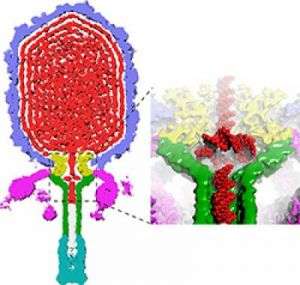
A donut-shaped twist, or toroid, of DNA (shown in red) wedges the viral genome tightly within the protein envelope of the bacteriophage. Credit: Credit: Jinghua Tang/UCSD
A novel twist of DNA may keep viral genes tightly wound within a capsule, waiting for ejection into a host, a high-resolution analysis of its structure has revealed.
Using electron microscopy and three-dimensional computer reconstruction, UC San Diego biologists and chemists have produced the most detailed image yet of the protein envelope of an asymmetrical virus and the viral DNA packed within, they report this week in the journal Structure. The image, with a resolution of less than a nanometer, or a millionth of a millimeter, will help to unravel how the virus locks onto its host and infects the cells by injecting its DNA.
By assembling more than 12,000 microscopic views of frozen viral particles from different angles, UCSD chemists Jinghua Tang, Norman Olson and Timothy Baker, a professor of chemistry and biological sciences, have determined the structure of a bacteriophage called phi29 with a resolution finer than 8 Angstroms (one Angstrom equals a tenth of a nanometer). Their project was part of a long-term collaboration with molecular virologist Dwight Anderson and his colleagues at the University of Minnesota.
Although the structures of spherical viruses with a high degree of symmetry have been resolved using similar methods, many more images were required to accomplish the same task for the head-and-tail shape of phi29. The UCSD scientists said their images of phi29 are twice as fine as those created in previous efforts to visualize viruses with a similar shape.
A comparison between images of the virus with and without its DNA cargo revealed that the DNA twists tightly into a donut shape, or toroid, in the neck of the virus between its head and tail. "This highly distorted DNA structure is unlike anything previously seen or even predicted in a virus," said Timothy Baker who headed the research team. "It's an improbably tight turn for DNA, which is generally considered inflexible over very small distances."
During assembly of the virus, a molecular motor in the neck winds the DNA strand into a tight coil within the head. "It's under tremendous pressure -- about 20 times that of champagne in a bottle," said Tang, the lead author of the paper.
The knot-like shape of the toroid, along with interlocking bumps in the protein envelope, may keep the DNA wedged into the capsid until the virus docks onto the host cell.
"It's poised in this tube waiting to go through the bacterial wall," Baker said. "All of the components work together to create an infection machine."
Source: University of California - San Diego
-
Two-timing and hybrids: Researchers look back on 100 million years of evolution
Jan 17, 2012 |
5 / 5 (1) |
0
-
Scientists identify novel approach to view inner workings of viruses
Jan 12, 2012 |
4 / 5 (5) |
0
-
Exploring the mechanism behind the differentiation of immune cells
Dec 19, 2011 |
not rated yet |
0
-
Beautiful, but deadly to salmonella
Dec 19, 2011 |
not rated yet |
0
-
Researchers reveal SBP8a configurations
Dec 06, 2011 |
not rated yet |
1
-
Engineers build first sub-10-nm carbon nanotube transistor
Feb 01, 2012 |
4.9 / 5 (30) |
30
-
Something old, something new: Evolution and the structural divergence of duplicate genes
Jan 31, 2012 |
4.6 / 5 (7) |
1
-
The hidden nanoworld of ice crystals: Revealing the dynamic behavior of quasi-liquid layers
Jan 30, 2012 |
5 / 5 (3) |
1
-
Stock market network reveals investor clustering
Jan 27, 2012 |
3.9 / 5 (23) |
8
-
Of microchemistry and molecules: Electronic microfluidic device synthesizes biocompatible probes
Jan 26, 2012 |
5 / 5 (1) |
0
More news stories
Ultraviolet protection molecule in plants yields its secrets
Lying around in the sun all day is hazardous not just for humans but also for plants, which have no means of escape. Ultraviolet (UV) radiation from the sun can damage proteins and DNA inside cells, leading ...
10 hours ago |
5 / 5 (5) |
0
|
Deadly bird parasite evolves at exceptionally fast rate
A new study of a devastating bird disease that spread from poultry to house finches in the mid-1990s reveals that the bacteria responsible for the disease evolves at an exceptionally fast rate. What's more, ...
9 hours ago |
5 / 5 (2) |
0
|
Decoding the molecular machine behind E. coli and cholera
Scientists from Queen Mary, University of London have discovered the workings behind some of the bacteria that kill hundreds of thousands every year, possibly paving the way for new antibiotics that could treat infections ...
9 hours ago |
not rated yet |
0
|
Deciding to go left or right: Researchers use device to determine that lower animals can navigate too
For decades, scientists have associated binary decision making opting to go left or right with higher-ranking animals, including humans. A team of Harvard researchers, however, is rewriting that ...
17 hours ago |
not rated yet |
2
|
5-10 percent corn yield jump using erosion-slowing cover crops shown in new study
The most recent annual results from a four-year Iowa State University study on using cover crops between rows of corn reveals that higher yields by as much as 10 percent are possible using the ...
12 hours ago |
not rated yet |
2
'Dark plasmons' transmit energy
Microscopic channels of gold nanoparticles have the ability to transmit electromagnetic energy that starts as light and propagates via "dark plasmons," according to researchers at Rice University.
FDA-approved drug rapidly clears amyloid from the brain, reverses Alzheimer's symptoms in mice
Neuroscientists at Case Western Reserve University School of Medicine have made a dramatic breakthrough in their efforts to find a cure for Alzheimer's disease. The researchers' findings, published in the journal Science, show t ...
Hydrogen from acidic water: Researchers develop potential low cost alternative to platinum for splitting water
A technique for creating a new molecule that structurally and chemically replicates the active part of the widely used industrial catalyst molybdenite has been developed by researchers with the Lawrence Berkeley ...
Anyone can learn to be more inventive, cognitive researcher says
There will always be a wild and unpredictable quality to creativity and invention, says Anthony McCaffrey, a cognitive psychology researcher at the University of Massachusetts Amherst, because an "Aha moment" is rare and ...
Soraa LED light may dim 50-watt halogen rivals
(PhysOrg.com) -- Soraa, a Fremont, California company founded in 2008, this week launched its first product, a light that uses LEDS (light emitting diodes). The "Soraa LED MR16 lamp" is the "perfect" replacement ...
Flexible paper robots
(PhysOrg.com) -- These inexpensive robots can stretch, bend and twist under control, and lift objects up to 120 times their own weight. Being soft, they can apply gentle and even pressure, and adapt to varied ...