Solstice Moon Illusion
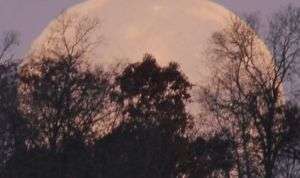
June 17th, 2008 Solstice Moon Illusion

The full moon rising over Manchester, Maryland. Credit: Edmund E. Kasaitis.

Sometimes you just can't believe your eyes. This week is one of those times. On Wednesday night, June 18th, step outside at sunset and look around. You'll see a giant form rising in the east. At first glance it looks like the full Moon. It has craters and seas and the face of a man, but this "moon" is strangely inflated. It's huge!

You've just experienced the Moon Illusion.

There's no better time to see it. The full Moon of June 18th is a "solstice moon", coming only two days before the beginning of northern summer. This is significant because the sun and full Moon are like kids on a see-saw; when one is high, the other is low. This week's high solstice sun gives us a low, horizon-hugging Moon and a strong Moon Illusion.
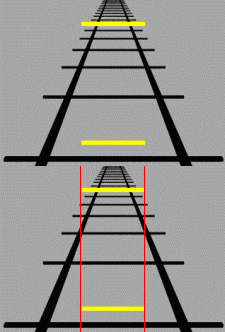
The Ponzo Illusion. Image credit: Dr. Tony Phillips.

The Ponzo Illusion. Image credit: Dr. Tony Phillips.

Sky watchers have known for thousands of years that low-hanging moons look unnaturally big. At first, astronomers thought the atmosphere must be magnifying the Moon near the horizon, but cameras showed that is not the case. Moons on film are the same size regardless of elevation: example. Apparently, only human beings see giant moons.

Are we crazy?

After all these years, scientists still aren't sure. When you look at the Moon, rays of moonlight converge and form an image about 0.15 mm wide on the retina in the back of your eye. High moons and low moons make the same sized spot, yet the brain insists one is bigger than the other. Go figure.

A similar illusion was discovered in 1913 by Mario Ponzo, who drew two identical bars across a pair of converging lines, like the railroad tracks pictured right. The upper yellow bar looks wider because it spans a greater apparent distance between the rails. This is the "Ponzo Illusion."

Some researchers believe that the Moon Illusion is Ponzo's Illusion, with trees and houses playing the role of Ponzo's converging lines. Foreground objects trick your brain into thinking the Moon is bigger than it really is.

But there's a problem: Airline pilots flying at very high altitudes sometimes experience the Moon Illusion without any objects in the foreground. What tricks their eyes?

Maybe it's the shape of the sky. Humans perceive the sky as a flattened dome, with the zenith nearby and the horizon far away. It makes sense; birds flying overhead are closer than birds on the horizon. When the moon is near the horizon, your brain, trained by watching birds (and clouds and airplanes), miscalculates the Moon's true distance and size.

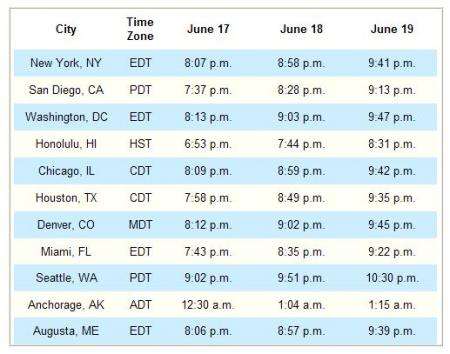
There are other explanations, too. It doesn't matter which is correct, though, if all you want to do is see a big beautiful Moon. The best time to look is around moonrise, when the Moon is peeking through trees and houses or over mountain ridges. The table below (scroll down) lists rise times for selected US cities.

A fun activity: Look at the Moon directly and then through a narrow opening of some kind. For example, 'pinch' the moon between your thumb and forefinger or view it through a cardboard tube, which hides the foreground terrain. Can you make the optical illusion vanish?

Stop that! You won't want to miss the Moon Illusion.
Solstice Moon Illusion
Enlarge


Source: Science@NASA, by Dr. Tony Phillips


print this article email this article download pdf blog this article bookmark this article     Digg this Stumble it share on Facebook share on Reddit add to delicious save to Yahoo! bookmarks
4.5/5 after 60 votes

Rank Filter

Move the slider to adjust rank threshold, so that you can hide some of the comments.


Display comments: newest first

  • itistoday - Jun 18, 2008
    • Rank: not rated yet
    It should probably be mentioned that the picture for this article, and other pictures like it, are therefore photoshopped.

June 17th, 2008 all stories
Space & Earth / Space Exploration

Comments: 1
Rank: 4.5/5 after 60 votes

  • Stumble this up

  • Digg this

  • Share it:
  • share on Facebook
  • share on MySpace
  • share on Slashdot
  • rss-newsfeed
  • share on Google
  • share on Reddit
  • add to delicious
  • save to Yahoo! bookmarks
  • share on Windows Live
  • Add to Mixx!
Rating: 4.5/5 after 60 votes

  • Related Stories

  • Biggest Full Moon of the Year: Take 2
    created Jan 08, 2009 | popularity not rated yet | comments 0
  • Biggest Full Moon of the Year
    created Dec 10, 2008 | popularity not rated yet | comments 0
  • Summer Moon Illusion
    created Jun 28, 2007 | popularity not rated yet | comments 0
  • Strange Moonlight
    created Sep 28, 2006 | popularity not rated yet | comments 0
  • There's more than meets the eye in judging the size of an object
    created Mar 08, 2006 | popularity not rated yet | comments 0

Tags


  • Physicists Demonstrate Quantum Memory with Matter Qubits
    Physicists Demonstrate Quantum Memory with Matter Qubits
    Physics / General Physics
    created Jul 03, 2009 | popularity 4.4 / 5 (17) | comments 1
  • 'Holey' Nanosheets for Wastewater Dye Removal
    Nanotechnology / Nanomaterials
    created Jul 01, 2009 | popularity 5 / 5 (5) | comments 1
  • Jellyfish Robot Swims Like its Biological Counterpart
    Jellyfish Robot Swims Like its Biological Counterpart
    Electronics / Robotics
    created Jun 26, 2009 | popularity 4.4 / 5 (8) | comments 1
  • Could Maxwell's Demon Exist in Nanoscale Systems?
    Could Maxwell's Demon Exist in Nanoscale Systems?
    Physics / General Physics
    created Jun 24, 2009 | popularity 4.4 / 5 (18) | comments 29
  • Living Safely with Robots, Beyond Asimov's Laws
    Living Safely with Robots, Beyond Asimov's Laws
    Electronics / Robotics
    created Jun 22, 2009 | popularity 4.6 / 5 (54) | comments 40
  • Other News

    Researchers test new 'space Internet' system on International Space Station

    Researchers test new 'space Internet' system on International Space Station

    Space & Earth / Space Exploration

    created 27 minutes ago | popularity not rated yet | comments 0

    The University of Colorado at Boulder is working with NASA to develop a new communications technology now being tested on the International Space Station, which will extend Earth's Internet into outer space ...


    Proba-2's journey to Russia marks its first step towards space

    Proba-2's journey to Russia marks its first step towards space

    Space & Earth / Space Exploration

    created 7 minutes ago | popularity not rated yet | comments 0

    (PhysOrg.com) -- Proba-2, one of the smallest satellites ESA has ever built for space, is about to leave its Belgian homeland. Its development and testing complete, the satellite is being packed up for the ...


    China environmental phenomena monitored from space

    Space & Earth / Earth Sciences

    created 3 hours ago | popularity not rated yet | comments 0

    China is in a very seismically active area and has had many catastrophic earthquakes during its history. A joint European-Chinese team is using satellite radar data to monitor ground deformation across major continental faults ...


    California to require sun-blocking car windows

    Space & Earth / Environment

    created 5 hours ago | popularity 2 / 5 (4) | comments 7

    New cars sold in California must include windshields that block or absorb the sun's rays beginning in 2012, the state's Air Resources Board recently ruled.


    Steam billows from the cooling towers at a nuclear power generating station in Byron

    Tropical zone expanding due to climate change: study

    Space & Earth / Earth Sciences

    created 7 hours ago | popularity 3.6 / 5 (7) | comments 3

    Climate change is rapidly expanding the size of the world's tropical zone, threatening to bring disease and drought to heavily populated areas, an Australian study has found.