Oh Baby! First photograph of early modern computer
June 17, 2008 Oh Baby! First photograph of early modern computer

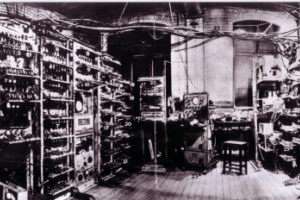
A photograph of a development version of the Baby computer from around 1948.

Here is the first known photograph of the great grandfather of modern digital computers – but you couldn’t use it on the train or take it jogging with you.

The panoramic black and white image, which has been unearthed in the archives at The University of Manchester, shows a development version of ‘The Baby’ taking up a whole room with its towering Post Office racks and jumble of wiring.

The Small Scale Experimental Machine – to give the Manchester invention its full title – successfully executed its first program on 21 June 1948 – and paved the way for the computers, iPods and mobile phones we all take for granted today.

Built and designed by Tom Kilburn and Freddie Williams at The University of Manchester, it was the first electronic digital computer capable of storing a program.

There are no photographs of the original Baby from June 1948. The panoramic image is often described as a photograph of the Baby machine, but it actually shows an intermediate stage, beginning to resemble the later University Mark 1.

The panoramic view of the machine was first published in The Illustrated London News in June 1949 and is actually a composite view made up of about 24 separate photographs taken by one of the project team, Alec Robinson. An entry in his notebook showed that they were taken on 15 December 1948.

The Baby was built using metal Post Office racks, hundreds of valves or vacuum tubes and the keyboard was a series of push buttons and switches, mounted vertically. Instead of a screen, the output was read directly off the face of a Cathode Ray Tube (CRT).

In modern terms the prototype Baby had a RAM (random access memory) of just 32 locations or ‘words’. Each word in the RAM consisted of 32 bits (binary digits) and so The Baby had a grand total of 1024 bits of memory – and a computing speed of 1.2 milliseconds per instruction.

And amazingly, today a pocket-sized 80Gb Apple iPod is capable of storing 640 MILLION times more information than the original room-sized Baby.

Manchester, Cambridge and institutions in the United States all battled to built the first stored program computer but Manchester won the race – a feat that shook the world and placed the city at the forefront of a global technological revolution.

Tom Kilburn founded and led the Department of Computer Science at the University, the first in the UK.

On Friday 20 June 2008, The University and the City of Manchester will celebrate the 60th anniversary of the tremendous achievement of Kilburn and Williams with Digital 60 Day.

The programme includes a live demonstration of the working replica of The Baby at the Museum of Science and Industry (MOSI), an interactive Baby exhibit and a Computer Science Magic Show.

Four surviving member of the Baby design and development team will be awarded the Medal of Honour by The University of Manchester and also by the British Computer Society.

Professor Steve Furber CBE, designer of the BBC Microcomputer, will then deliver the inaugural Kilburn lecture on ‘The Relentless March of the Microchip’.

For more information about Digital 60 please see http://www.digital60.org .

Source: University of Manchester


Rate this story - 4.3 /5 (31 votes)

Rank Filter

Move the slider to adjust rank threshold, so that you can hide some of the comments.


Display comments: newest first

  • seb42 - Jun 18, 2008
    • Rank: 4 / 5 (1)
    Having the mention of the ipod in this article, I was compelled to had a look at these links about the csiro's/Australia's first computer, it was able to play music and was the forth Stored-program computer in the world.

    http://en.wikiped...i/CSIRAC
    http://www.csiro....s4f.html
  • Bonkers - Jun 18, 2008
    • Rank: 3 / 5 (1)
    Nice to see the record coming back over the water.

    oh, and drop the wide-eyed astonishment at 640 MILLION !!! times the storage, its 687194767360 times, erm, do the math i think you say. - anyway its not a fair comparison, its disk storage vs RAM.

  • Mercury_01 - Jun 18, 2008
    • Rank: 3.5 / 5 (2)
    Yeah, thats not a fair comparison, in defense of the baby computer. I happen to know that it could make a line drawn on a piece of paper go from straight to wiggly in like 3 seconds flat. lets see your ipod do that, you geek!
  • Eco_R1 - Jun 23, 2008
    • Rank: not rated yet
    just imagine this machine with windows v 0.000001, nah! dont go there, only difference would be that you would wait 2 weeks to get it started up, and 4 more to get a blue screen!

June 17, 2008 all stories

Comments: 4

4.3 /5 (31 votes)

  • hide
  • Related Stories

  • One tonne 'Baby' goes mobile
    created Oct 27, 2009 | popularity not rated yet | comments 0
  • Tutankhamen fathered twins
    created Sep 01, 2008 | popularity not rated yet | comments 0
  • Uncertain future for elephants of Thailand
    created Jul 26, 2008 | popularity not rated yet | comments 0
  • First digital music made in Manchester
    created Jun 18, 2008 | popularity not rated yet | comments 0
  • Study to explore maternal bond
    created May 01, 2008 | popularity not rated yet | comments 0


  • hide
  • Relevant PhysicsForums posts

  • how to welding thin SS foil (0.002")?
    created Feb 08, 2010
  • Civil Engineering is hazardous to your career prospects
    created Feb 06, 2010
  • hot water circulator, kitchen faucet, ? mixing
    created Feb 06, 2010
  • Static or dynamic pressures in duct
    created Feb 06, 2010
  • More from Physics Forums - General Engineering

Other News

A general view of the arrival area of the Whistler Creek Alpine Skiing venue

Google Maps climbs to Olympic peaks

Technology / Internet

created 37 minutes ago | popularity not rated yet | comments 0

Google sent snowmobiles rigged with cameras into Canadian mountains so folks snug and warm at home will get views of slopes at the Winter Olympic Games kicking off on Friday.


Handling emergencies online

Technology / Internet

created 7 minutes ago | popularity not rated yet | comments 0

Online social networking sites could solve many problems plaguing information dissemination and communications when disaster strikes, according to a report from US researchers in a recent issue of the International Journal of ...


Warner CEO sees e-book 'fracas' as helping music

Technology / Business

created 1hour ago | popularity not rated yet | comments 0

(AP) -- The head of Warner Music Group expressed hope on Tuesday that the recent "fracas" over the price of e-books would help give content creators such as his company more pricing power over device makers.


Spanish Minister of industry Miguel Sebastian (C) sits in an electric car with Jean Pierre Laurent

EU ministers call for common electric car strategy

Technology / Energy

created 1hour ago | popularity 3 / 5 (1) | comments 1

EU industry ministers on Tuesday pressed the European Commission to establish a common strategy to develop electric cars.


PayPal's India transaction block could last months

Technology / Business

created 1hour ago | popularity not rated yet | comments 0

(AP) -- Online payments service PayPal says its suspension of certain transactions in India could last months.