A Slimmer Milky Way Revealed by New Measurements
June 17, 2008
A Slimmer Milky Way Revealed by New Measurements

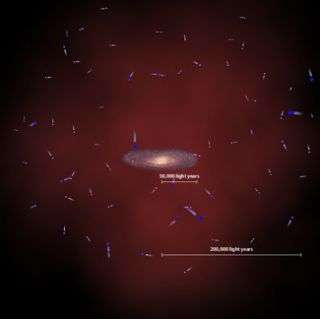
Researchers from the Sloan Digital Sky Survey (SDSS-II) have used the motions of distant stars to measure the mass of the Milky Way galaxy. The new mass determination is based on the measured motions of 2,400 "blue horizontal branch" stars in the extended stellar halo that surrounds the disk. These measurements reach distances of nearly 200,000 light years from the Galactic center, roughly the edge of the region illustrated above. Our Sun lies about 25,000 light years from the center of the Galaxy, roughly halfway out in the Galactic disk. The visible, stellar part of our Milky Way in the middle is embedded into its much more massive and more extended dark matter halo, indicated in dim red. The 'blue horizontal branch stars' that were found and measured in the SDSS-II study are orbiting our Milky Way at large distances. From the speeds of these stars, the researchers were able to estimate much better the mass of the Milky Way's dark-matter halo, which they found to be much 'slimmer' than thought before. Credit: Axel Quetz, Max Planck Institute for Astrophysics (Heidelberg), SDSS-II Collaboration

The Milky Way Galaxy has lost weight. A lot of weight. About a trillion Suns' worth, according to an international team of scientists from the Sloan Digital Sky Survey (SDSS-II), whose discovery has broad implications for our understanding of the Milky Way.

"The Galaxy is slimmer than we thought," said Xiangxiang Xue of the Max Planck Institute for Astronomy in Germany and the National Astronomical Observatories of China, who led the international team of researchers. "We were quite surprised by this result," said Donald Schneider, a member of the research team, a Distinguished Professor of Astronomy at Penn State, and a leader in the SDSS-II organization. The researchers explained that it wasn't a Galactic diet that accounted for the galaxy's recent slimming, but a more accurate scale.

The discovery, accepted for publication in The Astrophysical Journal, is based on data from the project known as SEGUE (Sloan Extension for Galactic Understanding and Exploration), an enormous survey of stars in the Milky Way and one of the three programs that comprise SDSS-II. Using SEGUE measurements of stellar velocities in the outer Milky Way, a region known as the stellar halo, the researchers determined the mass of the Galaxy by inferring the amount of gravity required to keep the stars in orbit. Some of that gravity comes from the Milky Way stars themselves, but most of it comes from an extended distribution of invisible dark matter, whose nature is still not fully understood.

To trace the mass distribution of the Galaxy, the SEGUE team used a carefully constructed sample of 2,400 "blue-horizontal-branch" stars whose distances can be determined from their measured brightness. Blue-horizontal-branch stars can be seen at large distances, Xue explained, enabling the team to measure velocities of stars all the way out to distances of 180,000 light years from the Sun.

The most recent previous studies of the mass of the Milky Way used mixed samples of 50 to 500 objects. They implied masses up to two-trillion times the mass of the Sun for the total mass of the Galaxy. By contrast, when the SDSS-II measurement within 180,000 light years is corrected to a total-mass measurement, it yields a value slightly under one-trillion times the mass of the Sun.

"The enormous size of SEGUE gives us a huge statistical advantage," said Hans-Walter Rix, director of the Max Planck Institute for Astronomy. "We can select a uniform set of tracers, and the large sample of stars allows us to calibrate our method against realistic computer simulations of the Galaxy." Another collaborator, Timothy Beers of Michigan State University, explained, "The total mass of the Galaxy is hard to measure because we're stuck in the middle of it. But it is the single most fundamental number we have to know if we want to understand how the Milky Way formed or to compare it to distant galaxies that we see from the outside."

All SDSS-II observations are made from the 2.5-meter telescope at Apache Point Observatory in New Mexico. The telescope uses a mosaic digital camera to image large areas of sky and spectrographs fed by 640 optical fibers to measure light from individual stars, galaxies, and quasars. SEGUE's stellar spectra turn flat sky maps into multi-dimensional views of the Milky Way, Beers said, by providing distances, velocities, and chemical compositions of hundreds of thousands of stars.

The new results on the mass of the Galaxy are described in a paper titled "The Milky Way's Circular Velocity Curve to 60 kpc and an Estimate of the Dark Matter Halo Mass from Kinematics of 2400 SDSS Blue Horizontal Branch Stars," which will be published this fall in The Astrophysical Journal. The abstract is on the Web at http://arxiv.org/abs/0801.1232 .

Source: Penn State

4.3 /5 (35 votes)  

Filter


Move the slider to adjust rank threshold, so that you can hide some of the comments.


Display comments: newest first

Mercury_01
Jun 17, 2008

Rank: not rated yet
Can anybody speculate what would be different if we lived in a galaxy with a larger dark matter halo? What if we lived in the middle of a gigantic supercluster, do you guys think that a planet the same size and composition of the earth would appear to have a larger mass and greater gravity?
superhuman
Jun 17, 2008

Rank: not rated yet
The planet would have the same gravity but there would also be gravity coming from dark matter. How it would add up depends on how the dark matter would be allocated in space.
Dark matter produces the same gravity as normal matter the only difference is that the matter which is the source is invisible and undetectable in any other way then through its gravitational influence. The concept of dark matter is somewhat weird though.

It could also turn out that gravity related to dark matter does not really come from any matter but is a product of some unknown process which only occurs on astronomical distances or simply isn't present anywhere near Solar System.

All in all although cosmology can be fascinating its important to remember that its not the same kind of science as every day physics. Cosmology has to assume that everything that is important for the evolution of the Universe is accessible to observations from Earth which can very easily not be the case. Its possible that many exotic processes take place next to giant black holes like the ones found in active galactic nuclei.

Besides we really need quantum gravity theory before we can understand Universe.
brant
Jun 17, 2008

Rank: 1 / 5 (2)
Can anybody speculate if we had a astronomical religion that actually worked?

They are guessing.
Mercury_01
Jun 18, 2008

Rank: not rated yet
Wouldnt it stand to reason that an abundance of dark matter in the vicinity of a planet or a star would accrete alongside the body and form a parallel sphere, thus combining the net gravitational effect?
TimESimmons
Jun 18, 2008

Rank: 1 / 5 (1)
Dark matter just doesn't make sense. If it's attracted to itself by gravity why hasn't it collapsed to form dark matter objects? This may be the answer:-

http://www.presto...ndex.htm
adam81
Jun 18, 2008

Rank: not rated yet
couldn't dark matter be a warping of spacetime caused by the mass of a star/galaxy/cluster moving at high speed?
Tissa_Perera
Jun 20, 2008

Rank: 1 / 5 (2)
Folks, Dark Matter and Energy are simply a natural manifestation of an additional 4th bounded cosmic size spatial dimension. See cosmicdarkmatter.com
for a hint.
K. Tissa Perera
Rank 4.3 /5 (35 votes)
Tags

Relevant PhysicsForums posts
  • Never ending outer space.....
    created18 hours ago
  • Neutron Star fragments?
    created20 hours ago
  • stationary or not?
    createdFeb 11, 2012
  • Scale of the Universe
    createdFeb 10, 2012
  • Titan's lack of impact craters
    createdFeb 09, 2012
  • Real pictures of black hole eating a star?
    createdFeb 08, 2012
  • More from Physics Forums - General Astronomy

More news stories

Latin America mining boom clashes with conservation

Latin America is experiencing a mining boom as prices rise fuelled by a hike in global demand, but the region is also being hit by a wave of violent protests, strikes and rallies by environmentalists.

Space & Earth / Environment

created 11 hours ago | popularity 5 / 5 (1) | comments 1

Salvage workers begin pumping fuel from Italian shipwreck

Salvage workers Sunday began pumping fuel from the shipwrecked Italian cruise liner Costa Concordia, a day ahead of schedule, officials said.

Space & Earth / Environment

created 3 hours ago | popularity not rated yet | comments 0

Political leaders play key role in how worried Americans are by climate change: study

More than extreme weather events and the work of scientists, it is national political leaders who influence how much Americans worry about the threat of climate change, new research finds.

Space & Earth / Environment

created Feb 06, 2012 | popularity 5 / 5 (6) | comments 73

NASA budget will axe Mars deal with Europe: scientists

US President Barack Obama's budget proposal to be submitted next week for 2013 will cut NASA's budget by 20 percent and eliminate a major partnership with Europe on Mars exploration, scientists said Thursday.

Space & Earth / Space Exploration

created Feb 10, 2012 | popularity 5 / 5 (3) | comments 58

Humans may have helped the decline of African rainforests 3000 years ago

(PhysOrg.com) -- Large areas of rainforests in Central Africa mysteriously disappeared over three thousand years ago, to be replaced by savannas. The prevailing theory has been that the cause was a change ...

Space & Earth / Environment

created Feb 10, 2012 | popularity 4.1 / 5 (14) | comments 20 | with audio podcast report


Overeating may double risk of memory loss

New research suggests that consuming between 2,100 and 6,000 calories per day may double the risk of memory loss, or mild cognitive impairment (MCI), among people age 70 and older. The study was released today and will be ...

Google might launch Drive for cloud storage soon

(PhysOrg.com) -- Google's next big move, according to the Wall Street Journal, is a cloud storage service called Drive. Hardly first to the plate, Google is simply catching up to introducing its cloud reposi ...

Scientists discover molecular secrets of 2,000-year-old Chinese herbal remedy

For roughly two thousand years, Chinese herbalists have treated Malaria using a root extract, commonly known as Chang Shan, from a type of hydrangea that grows in Tibet and Nepal. More recent studies suggest that halofuginone, ...

New method to examine batteries -- MRI from the inside

There is an ever-increasing need for advanced batteries for portable electronics, such as phones, cameras, and music players, but also to power electric vehicles and to facilitate the distribution and storage of energy derived ...

Lab study raises questions over nano-particle impact

Tests involving chickens have raised questions about the impact on health from engineered nano-particles, the ultra-fine grains commonly used in drugs and processed foods, scientists said on Sunday.

Injured boomers beware: Know when to see doctor

(AP) -- It happened to nurse Jane Byron years after an in-line skating fall, business owner Haralee Weintraub while doing "men's" push-ups, and avid cyclist Gene Wilberg while lifting a heavy box.