New system estimates geographic location of photos
June 18, 2008
Determining Location Based on a Single Image

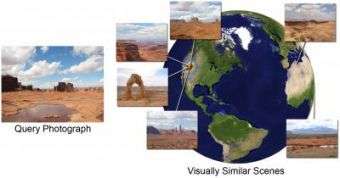
A method developed by Carnegie Mellon University researchers can estimate where a photo was taken by matching it to similar, GPS-tagged photos in the Flickr online photo collection. Credit: James Hays/Carnegie Mellon University

Researchers at Carnegie Mellon University have devised the first computerized method that can analyze a single photograph and determine where in the world the image likely was taken. It's a feat made possible by searching through millions of GPS-tagged images in the Flickr online photo collection.

The IM2GPS algorithm developed by computer science graduate student James Hays and Alexei A. Efros, assistant professor of computer science and robotics, doesn't attempt to scan a photo for location clues, such as types of clothing, the language on street signs, or specific types of vegetation, as a person might do. Rather, it analyzes the composition of the photo, notes how textures and colors are distributed and records the number and orientation of lines in the photo. It then searches Flickr for photos that are similar in appearance.

"We're not asking the computer to tell us what is depicted in the photo but to find other photos that look like it," Efros said. "It was surprising to us how effective this approach proved to be. Who would have guessed that similarity in overall image appearance would correlate to geographic proximity so well?"

Hays and Efros found they could accurately geolocate the images within 200 kilometers for 16 percent of more than 200 photos in their test set — up to 30 times better than chance. And even if their algorithm failed to identify the specific location, they often found that it could narrow the possibilities, such as by identifying the locale as a beach or a desert.

"It seems there's not as much ambiguity in the visual world as you might guess," said Hays, who will present the research at the IEEE Computer Society Conference on Computer Vision and Pattern Recognition June 24-26 in Anchorage, Alaska. "Estimating geographic information from images is a difficult, but very much a doable, computer vision problem."

Identifying the locale of a photo could enhance image search techniques, making them less dependent on captions or associated text. A computer system for geolocating photos could be useful in finding family photos from a specific trip and in some forensic applications. Determining the location of photos also makes it possible to combine them with geographic data bases related to climate, population density, vegetation, topography and land use.

Knowing the locale also can aid in such computer vision tasks as object identification, Hays said. If a computer recognizes that a photo likely was taken in Japan, for instance, the computer will have a better idea of what a taxicab should look like.

Hays said many online photos have some sort of geographic label, but these human descriptions can often be incorrect, or overly broad, such as a photo of the Grand Canyon labeled "U.S." The growing number of online photos that have GPS tags, by contrast, are unambiguous regarding their location, even though many are photos of rooms, people or events such as birthday parties that are useless for geolocation tasks. By using photos with both geographic keywords and GPS coordinates, Hays and Efros were able to find more than six million photos that were useful and accurately geolocated.

The IM2GPS algorithm readily located photographs of such landmarks as the Cathedral of Notre Dame in Paris. More surprisingly, it was able to recognize that a narrow street in Barcelona was typical of Mediterranean villages, rather than an American alleyway.

But some odd matches also occurred. The architecturally unique Sydney Opera House seemed to the computer to be similar to a hotel in Mississippi as well as a bridge in London. A shot of the Eiffel Tower at dusk was matched to other Eiffel Tower shots, but also to San Francisco's Coit Tower and New York's Statue of Liberty, both shot at dusk.

One reason for this confusion, Hays explained, is that the algorithm is not designed to recognize specific objects so much as it is to recognize geographic areas. For instance, an image of Utah's Monument Valley caused the IM2GPS algorithm to successfully retrieve a number of other images from Monument Valley and the American Southwest, rather than images of a specific rock formation.

For more information, see the IM2GPS project Web site: http://graphics.cs … ects/im2gps/

Source: Carnegie Mellon University

3.9 /5 (10 votes)  

Filter


Move the slider to adjust rank threshold, so that you can hide some of the comments.


Display comments: newest first

Damon
Jun 18, 2008

Rank: 3 / 5 (2)
And we still can't find Bin Laden!
Sean_W
Jun 18, 2008

Rank: 4.7 / 5 (3)
He doesn't pose for outdoor shots much. The natural lighting exposes how gray his beard has gotten. Just For Men (or Just For Muslims) hair and beard colour is hard to get in Central Asian caves.

But the technology might be useful for tracking down the scenes of child porn manufacturing if a window scene is partially visible. And lots of other crimes could be solved by linking someone to a location via a photo that may have otherwise seemed meaningless. Not to mention resolving other less criminal mysteries like the history behind old photographs in someone's attic.
Rank 3.9 /5 (10 votes)
Tags

Relevant PhysicsForums posts

More news stories

Google might launch Drive for cloud storage soon

(PhysOrg.com) -- Google's next big move, according to the Wall Street Journal, is a cloud storage service called Drive. Hardly first to the plate, Google is simply catching up to introducing its cloud reposi ...

Technology / Internet

created 16 hours ago | popularity 4.8 / 5 (5) | comments 5 | with audio podcast report

Iran blocks email, restricts net access: reports

Iran has further restricted access to the Internet and blocked popular email services for the past few days, in a move a top lawmaker said could "cost the regime dearly," media reports said on Sunday.

Technology / Internet

created 9 hours ago | popularity 5 / 5 (2) | comments 5

Love a click away in Indonesia's Twitter Republic

He was a geeky kid from Yogyakarta, she a glamorous city girl in Jakarta. In a country with one of the world's most vibrant social networking scenes they fell in love on Twitter.

Technology / Internet

created 17 hours ago | popularity 4 / 5 (1) | comments 0

Walney offshore wind farm is world's biggest (for now)

(PhysOrg.com) -- The Walney wind farm on the Irish Sea--characterized by high tides, waves and windy weather--officially opened this week. The farm is treated in the press as a very big deal as the Walney ...

Technology / Energy & Green Tech

created Feb 11, 2012 | popularity 4.1 / 5 (14) | comments 52 | with audio podcast weblog

Navy to begin tests on electromagnetic railgun prototype launcher

The Office of Naval Research (ONR)'s Electromagnetic (EM) Railgun program will take an important step forward in the coming weeks when the first industry railgun prototype launcher is tested at a facility ...

Technology / Engineering

created Feb 06, 2012 | popularity 4.5 / 5 (19) | comments 95 | with audio podcast


Scientists discover molecular secrets of 2,000-year-old Chinese herbal remedy

For roughly two thousand years, Chinese herbalists have treated Malaria using a root extract, commonly known as Chang Shan, from a type of hydrangea that grows in Tibet and Nepal. More recent studies suggest that halofuginone, ...

New method to examine batteries -- MRI from the inside

There is an ever-increasing need for advanced batteries for portable electronics, such as phones, cameras, and music players, but also to power electric vehicles and to facilitate the distribution and storage of energy derived ...

A mitosis mystery solved: How chromosomes align perfectly in a dividing cell

Although the process of mitotic cell division has been studied intensely for more than 50 years, Whitehead Institute researchers have only now solved the mystery of how cells correctly align their chromosomes during symmetric ...

Lab study raises questions over nano-particle impact

Tests involving chickens have raised questions about the impact on health from engineered nano-particles, the ultra-fine grains commonly used in drugs and processed foods, scientists said on Sunday.

Starve a virus, feed a cure? Findings show how some cells protect themselves against HIV

A protein that protects some of our immune cells from the most common and virulent form of HIV works by starving the virus of the molecular building blocks that it needs to replicate, according to research published online ...

Researchers find extensive RNA editing in human transcriptome

In a new study published online in Nature Biotechnology, researchers from BGI, the world's largest genomics organization, reported the evidence of extensive RNA editing in a human cell line by analysis of RNA-seq data, demons ...