Scientists discover that protons partner with neutrons more often than with other protons
June 18, 2008
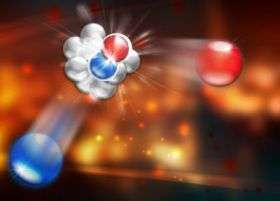
Theoretical work by Penn State professor of physics Mark Strikman predicted that fast-moving protons would have a surprisingly high tendency to form pairs with fast-moving neutrons. A new experiment by researchers at the Thomas Jefferson National Accelerator Facility is based on and confirms, for the first time, Strikman's prediction. Credit: Joanna Griffin, US Department of Energy, Jefferson Lab, courtesy of Penn State
Fast-moving protons are much more likely to pair up with fast-moving neutrons than with other protons in the nuclei of atoms, according to a recent experiment performed at the U.S. Department of Energy's Thomas Jefferson National Accelerator Facility. The experiment confirms previous theoretical research led by Mark Strikman, a professor of physics at Penn State. Strikman's theory predicts that fast-moving protons have a nearly 100-percent tendency to form pairs with other fast-moving protons or neutrons, and that the majority of these pairings are between protons and neutrons. Strikman also suggested the experimental strategy that the researchers at the Thomas Jefferson National Accelerator Facility used to make their discovery.
Strikman's theory, along with its recent experimental confirmation, may help physicists to understand the structure of nuclear systems, from light nuclei to massive neutron stars. Results of the experiment will be published later this year in the journal Science, which recently posted the paper on its Web site.
Two decades ago, Strikman and his collaborator Leonid Frankfurt of Tel Aviv University in Israel suggested that the most direct way to look for pairings of two high-momentum nucleons--a nucleon is a proton or a neutron in the nucleus of an atom--would be to knock a fast-moving nucleon out of an atom's nucleus and to identify the nucleon that is left behind. This method was used in an experiment conducted by researchers at the Brookhaven National Laboratory, and results were published in 2003.
In 2006, Strikman and his colleagues published a paper in the journal Physical Review Letters in which they described the development and results of a detailed model that analyzed the Brookhaven National Laboratory data. The team's analysis indicated that when a proton is moving faster than one-quarter the speed of light, 90 percent of the time it is paired with a neutron, while 10 percent of the time it is paired, presumably, with another proton. "Although we expected a large asymmetry between the number of proton-neutron pairs and proton-proton pairs, the magnitude of the difference was startling to us because it was a significant departure from what estimates using current models of nucleon-nucleon interactions told us it would be," said Strikman.
Recently, a direct measurement was performed by researchers at the Thomas Jefferson National Accelerator Facility to verify the accuracy of the 90-percent to 10-percent ratio predicted by the model developed in 2006 by Strikman and his colleagues. In their experiment, the scientists sent a beam of energetic electrons into a thin sheet of carbon to knock protons out of the nuclei. Next, they counted the number of times that each proton's remaining partner was a neutron versus another proton. Results of the experiment supported Strikman's and Frankfurt's predictions.
"Although we predicted a very large probability of pairing between fast-moving nucleons, it is amazing to me that 100 percent of fast-moving nucleons are paired," said Strikman. "It also is amazing that so little of this pairing is between two protons."
Strikman added that he is excited to finally see experimental evidence in support of the theory that he has spent much of his career establishing. "Previous methods could not distinguish between proton-proton and proton-neutron correlations," he said. "But this new experiment has achieved something that never has been done before. The discovery is the most clear-cut example that the high-energy processes, which we have been advocating for many years, are truly effective tools and can be used for future discoveries."
Source: Penn State
-
Physicists push for underground testing facility
Feb 02, 2012 |
4.6 / 5 (5) |
12
-
The future of Fermilab
Jan 31, 2012 |
4.5 / 5 (4) |
0
-
Watching a gas turn superfluid
Jan 18, 2012 |
4.8 / 5 (8) |
5
-
CMS in 2011: A mountain of particle collision data
Jan 17, 2012 |
5 / 5 (5) |
5
-
Choreographing dance of electrons offers promise in pursuit of quantum computers
Jan 12, 2012 |
5 / 5 (3) |
1
-
Engineers build first sub-10-nm carbon nanotube transistor
Feb 01, 2012 |
4.9 / 5 (33) |
30
-
Something old, something new: Evolution and the structural divergence of duplicate genes
Jan 31, 2012 |
4.6 / 5 (7) |
1
-
The hidden nanoworld of ice crystals: Revealing the dynamic behavior of quasi-liquid layers
Jan 30, 2012 |
5 / 5 (4) |
1
-
Stock market network reveals investor clustering
Jan 27, 2012 |
3.9 / 5 (23) |
8
-
Of microchemistry and molecules: Electronic microfluidic device synthesizes biocompatible probes
Jan 26, 2012 |
5 / 5 (2) |
0
-
Can Plasma Be Solid
4 hours ago
-
What is delta Δ ?
5 hours ago
-
Need some help understanding HertzĀKnudsen formula
5 hours ago
-
Anatomy of Fat man: implosion-critical bomb
7 hours ago
-
what makes two sounds similar???
8 hours ago
-
What would happen when a jet travelling at Mach 10 experiences engine failure
14 hours ago
- More from Physics Forums - General Physics
More news stories
Explained: Sigma
It's a question that arises with virtually every major new finding in science or medicine: What makes a result reliable enough to be taken seriously? The answer has to do with statistical significance -- but ...
Feb 09, 2012 |
5 / 5 (20) |
76
Quantum physicist explains $100K offer for proof scaled-up quantum computing is impossible
(PhysOrg.com) -- MIT researcher Scott Aaronson has certainly riled the physics community with his offer this past Friday, of $100,000 to anyone who can prove that scaled-up quantum computing is impossible. ...
Diamond light, brighter than the sun
Its the size of five football pitches and generates light 10 billion times brighter than the sun. As the Diamond Light Source celebrates its tenth anniversary this year, Penny Bailey visits one of the ...
Feb 07, 2012 |
4.1 / 5 (10) |
18
|
Physicists 'record' magnetic breakthrough
An international team of scientists has demonstrated a revolutionary new way of magnetic recording which will allow information to be processed hundreds of times faster than by current hard drive technology.
Feb 07, 2012 |
4.6 / 5 (43) |
15
|
Hints of the Higgs - papers are submitted
Back in December 2011, the ATLAS and CMS experiments at CERN presented some exciting results that provided tantalising hints of the Higgs boson.
Feb 08, 2012 |
4.3 / 5 (8) |
10
Scientists discover molecular secrets of 2,000-year-old Chinese herbal remedy
For roughly two thousand years, Chinese herbalists have treated Malaria using a root extract, commonly known as Chang Shan, from a type of hydrangea that grows in Tibet and Nepal. More recent studies suggest that halofuginone, ...
New method to examine batteries -- MRI from the inside
There is an ever-increasing need for advanced batteries for portable electronics, such as phones, cameras, and music players, but also to power electric vehicles and to facilitate the distribution and storage of energy derived ...
Google might launch Drive for cloud storage soon
(PhysOrg.com) -- Google's next big move, according to the Wall Street Journal, is a cloud storage service called Drive. Hardly first to the plate, Google is simply catching up to introducing its cloud reposi ...
A mitosis mystery solved: How chromosomes align perfectly in a dividing cell
Although the process of mitotic cell division has been studied intensely for more than 50 years, Whitehead Institute researchers have only now solved the mystery of how cells correctly align their chromosomes during symmetric ...
Lab study raises questions over nano-particle impact
Tests involving chickens have raised questions about the impact on health from engineered nano-particles, the ultra-fine grains commonly used in drugs and processed foods, scientists said on Sunday.
Starve a virus, feed a cure? Findings show how some cells protect themselves against HIV
A protein that protects some of our immune cells from the most common and virulent form of HIV works by starving the virus of the molecular building blocks that it needs to replicate, according to research published online ...
Jun 18, 2008
Rank: 4 / 5 (2)
Jun 18, 2008
Rank: 5 / 5 (3)
Yup... and didn't we conclude... "Well duh!"
Protons would repel each other where a neutron/proton wouldn't....
Jun 20, 2008
Rank: 2 / 5 (2)
That's too simplistic. At these short distances the strong nuclear force dominates.
Jun 22, 2008
Rank: 3 / 5 (2)
Apparently not :) Which is why diprotons (or dineutrons) haven't been observed, right?
Maybe I'm too demanding, just like my mother, but I think it's kind of embarassing that we don't have a good theory of nuclear structure yet. Liquid drop model, shell model, liquid/shell model, none of which work very well without at least a handful of arbitrary fudging constants.
Well over a hundred years after the advent of the periodic table, we still can't explain it clearly. And then there's the pesky problem of mass, which we've had to postulate a hypothetical/undetected Higgs particle (and field) to explain. Look luck at the LHC, but I'm not placing bets that's going to help.
And the nature of charge also remains a big fat ?
Fundamental physics is no less a mess than cosmology: both are at least 90% in the dark.
Academia seems to have failed to nurture creative problem solving abilities in bright young minds. Maybe it's time to start funding and requiring more art classes for the science degrees...
Jun 23, 2008
Rank: 5 / 5 (1)
Jun 24, 2008
Rank: not rated yet