GLAST safely in orbit, getting check-ups
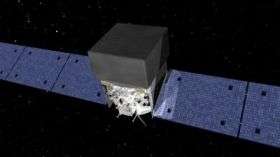
June 19, 2008 Artist's Conception of GLAST in Orbit

Caption: This is an artist's conception of GLAST in orbit. Credit: NASA

A week after launch, NASA's Gamma-ray Large Area Space Telescope, or GLAST, is safely up-and-running well in orbit approximately 350 miles (565 kilometers) above the Earth's surface.

GLAST was successfully launched aboard a Delta II rocket from Cape Canaveral Air Force Station in Florida at 12:05 p.m. EDT on Wednesday, June 11.

For four weeks, engineers will continue to be busy around the clock turning on and checking out the various components on the spacecraft. "Things are looking good so far," said GLAST Deputy Project Scientist Julie McEnery from NASA's Goddard Space Flight Center, Greenbelt, Md. "We expect to turn the instruments on in about a week, and we can't wait to see the first gamma rays!"

Two days after launch, both of GLAST's solar arrays were rotated successfully. The solar arrays are the "wings" of GLAST that utilize the Sun's energy to power the spacecraft. That same day, flight software controlled heaters were enabled. Those heaters are important because they help GLAST to operate in the cold of space.

"Once the Large Area Telescope is operational, GLAST will survey the entire sky every three hours, using the sky survey control mode," said Kathy Turner, U.S. Department of Energy GLAST Program Manager, Germantown, Md. Sky survey is the primary science fine pointing control mode for the mission.

On Monday, June 16, "Two star trackers are also now acquiring and identifying stars," said GLAST program manager Kevin Grady of NASA Goddard. "All systems continue to function well as the activation continues," he said.

NASA's GLAST mission is an astrophysics and particle physics partnership, developed in collaboration with the U.S. Department of Energy, along with important contributions from academic institutions and partners in France, Germany, Italy, Japan, Sweden, and the U.S.


Source: NASA/Goddard Space Flight Center


print this article email this article download pdf blog this article bookmark this article     Stumble it Digg this share on Facebook retweet share on Reddit add to delicious
Rate this story - 4 /5 (3 votes)


June 19, 2008 all stories

Comments: 0

4 /5 (3 votes)
  • Stumble this up

  • Digg this

  • share this

  • hide
  • Related Stories

  • GLAST Observatory in Orbit
    created Jun 11, 2008 | popularity not rated yet | comments 0
  • GLAST Set to Launch Wednesday to Study Cosmic Mysteries
    created Jun 10, 2008 | popularity not rated yet | comments 0
  • Excitement Builds as GLAST Readies Its Gamma-ray Vision
    created May 30, 2008 | popularity not rated yet | comments 0
  • New NASA-NOAO partnership to open doors for cosmic discovery
    created Sep 04, 2007 | popularity not rated yet | comments 0
  • National Radio Astronomy Observatory teams with NASA Gamma-Ray Satellite
    created Jun 05, 2007 | popularity not rated yet | comments 0


  • hide
  • Relevant PhysicsForums posts

  • Favourite Astronomy Book?
    created 7 hours ago
  • dark energy
    created 8 hours ago
  • The shape of our solar system's orbits.
    created Nov 07, 2009
  • Above or Below the Line of Nodes
    created Nov 07, 2009
  • More from Physics Forums - General Astronomy

Other News

Climate studies to benefit from 12 years of satellite aerosol data

Climate studies to benefit from 12 years of satellite aerosol data

Space & Earth / Earth Sciences

created 29 minutes ago | popularity not rated yet | comments 0

Aerosols, very small particles suspended in the air, play an important role in the global climate balance and in regulating climate change. They are one of the greatest sources of uncertainty in climate change ...


Swift, XMM-Newton satellites tune into a middleweight black hole

Swift, XMM-Newton satellites tune into a middleweight black hole

Space & Earth / Astronomy

created 2 hours ago | popularity 5 / 5 (1) | comments 1

(PhysOrg.com) -- While astronomers have studied lightweight and heavyweight black holes for decades, the evidence for black holes with intermediate masses has been much harder to come by. Now, astronomers ...


GOES satellite sees bulk of Ida's clouds and rain inland while center making landfall

GOES satellite sees bulk of Ida's clouds and rain inland while center making landfall

Space & Earth / Earth Sciences

created 1hour ago | popularity not rated yet | comments 0

Tropical Storm Ida made landfall around 6:40 a.m. ET this morning on Dauphin Island, along the Alabama coastline. NASA's GOES Project created the latest image from Geostationary Operational Environmental Satellite ...


Additive copper-zinc interaction affects toxic response in soybean

Space & Earth / Environment

created 1hour ago | popularity 3 / 5 (1) | comments 0

Agricultural soils accumulate trace metals, particularly copper and zinc, as a result of their presence in wastes (sewage biosolids and manures) and fungicides that are applied over long periods of time. Regulations and guidelines ...


Controversial new climate change results

Controversial new climate change results

Space & Earth / Environment

created 5 hours ago | popularity 5 / 5 (5) | comments 6

(PhysOrg.com) -- New data show that the balance between the airborne and the absorbed fraction of CO2 has stayed approximately constant since 1850, despite emissions of CO2 having risen from about 2 billion ...