Researchers confirm benzene-like electron delocalization of important molecule
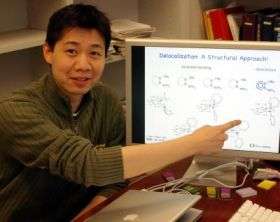
June 19, 2008 Pointing the Way

Caption: Shih-Yuan Liu shows a graphic depicting the findings from his University of Oregon laboratory. Credit: Photo by Jim Barlow

[B]UO team's findings could pave way for synthetic compounds useful in drug discovery and materials science[/B]
Researchers in the lab of University of Oregon chemist Shih-Yuan Liu have successfully synthesized and structurally characterized boron-nitrogen compounds that are isoelectronic and isostructural to the fundamentally important benzene molecule. Given the appearance of benzene derivatives in biomedical research and materials science, the boron-nitrogen substituted analogues could potentially play a pivotal role in these areas.

In the Journal of the American Chemical Society, Liu's team reports that, by using a structural approach, benzene surrogates known as 1,2-dihydro-1,2-azaborines possess electron-delocalized structures consistent with aromaticity -- a core concept in chemistry. The paper already has drawn praise by other researchers in a story in this week's Chemical & Engineering News.

"The bottom line is that we have synthesized reference compounds designed to be non-aromatic, and through the comparisons of the aromatic molecule with the reference compounds, we were able to unambiguously say that this compound is really electron delocalized in a way consistent with aromaticity," Liu said. "With the results of other research in this field, our findings present a very strong case that 1,2-dihydro-1,2-azaborines are indeed aromatic."

Liu is among molecule-making chemists who are interested in manipulating heterocycles -- ring-like structures that contain various elements in addition to carbon. Aromatic heterocycles play a big role in pharmaceuticals, Liu said, noting that eight of the top ten selling molecules on the market today contain aromatic compounds.

For biomedical purposes, Liu said, boron-containing molecules disguised with other components readily accepted by living tissues could conceivably be used as markers to track the location of the drug. Eventually, he said, targeted drug therapies might deliver very specific tumor-destroying action that leaves healthy cells untouched.

"Our objective is really to first develop the synthetic chemistry of these boron-nitrogen heterocycles, make it accessible to other chemists to study, and ultimately go into applied research to create opportunities in cancer therapies and materials sciences," Liu said. "I believe that we have made substantial progress for expanding the scope of accessible molecules such as this. The methods we have developed here at the University of Oregon are beginning to be quite useful."

Source: University of Oregon


print this article email this article download pdf blog this article bookmark this article     Stumble it Digg this share on Facebook retweet share on Reddit add to delicious
Rate this story - 5 /5 (3 votes)


June 19, 2008 all stories

Comments: 0

5 /5 (3 votes)
  • Stumble this up

  • Digg this

  • share this

  • hide
  • Related Stories

  • 1930s drug slows tumor growth
    created Nov 06, 2009 | popularity not rated yet | comments 0
  • Boron-based compounds trick a biomedical protein
    created Sep 07, 2009 | popularity not rated yet | comments 0
  • Boron-based compounds trick a biomedical protein
    created Sep 02, 2009 | popularity not rated yet | comments 0
  • New insights into health and environmental effects of carbon nanoparticles
    created Aug 05, 2009 | popularity not rated yet | comments 0
  • Adult gut can generate new neurons
    created Aug 04, 2009 | popularity not rated yet | comments 0


Other News

Accidental discovery produces durable new blue pigment for multiple applications

Accidental discovery produces durable new blue pigment for multiple applications

Chemistry / Biochemistry

created 4 hours ago | popularity 5 / 5 (1) | comments 3

An accidental discovery in a laboratory at Oregon State University has apparently solved a quest that over thousands of years has absorbed the energies of ancient Egyptians, the Han dynasty in China, Mayan ...


Scientists guide immune cells with light and microparticles

Scientists guide immune cells with light and microparticles (w/ Video)

Chemistry / Biochemistry

created 4 hours ago | popularity 5 / 5 (2) | comments 0

A team led by Yale University scientists has developed a new approach to studying how immune cells chase down bacteria in our bodies. Their findings are described in the November 15 issue of Nature Methods Advanc ...


Biodiesel

Genome Engineering Could Provide New Method of Creating Biodiesel

Chemistry / Biochemistry

created 7 hours ago | popularity 3.5 / 5 (4) | comments 0

When we think of genetic engineering, our minds often jump to giant tomatoes and animal cloning. However, this is not always the case.


Tiny particles can deliver antioxidant enzyme to injured heart cells

Tiny particles can deliver antioxidant enzyme to injured heart cells

Chemistry / Polymers

created 11 hours ago | popularity 5 / 5 (1) | comments 0

Researchers at Emory University and the Georgia Institute of Technology have developed microscopic polymer beads that can deliver an antioxidant enzyme made naturally by the body into the heart.


Tiny bubbles clean oil from water

Tiny bubbles clean oil from water

Chemistry / Materials Science

created 13 hours ago | popularity 4 / 5 (3) | comments 0

Small amounts of oil leave a fluorescent sheen on polluted water. Oil sheen is hard to remove, even when the water is aerated with ozone or filtered through sand. Now, a University of Utah engineer has developed ...