MSU researcher creates system helping police to match tattoos to suspects
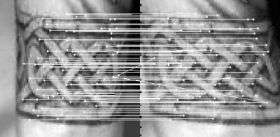
A Michigan State University researcher has created an automatic image retrieval system, whereby law enforcement agencies will be able to match scars, marks and tattoos to identify suspects and victims.
In a world filled with homeland security concerns, identity fraud and natural disasters, the need to establish the identity of an individual based on something other than a driver's license or demographic and personal data is vital, according to Anil Jain, MSU University Distinguished Professor of computer science and engineering. "Identity is usually established using passports, licenses or personal identification numbers, but these are easily forged, lost or stolen."
"There is a very real concern that these types of credentials for identity determination are neither sufficiently reliable nor secure," Jain said. "There is a need to recognize people based on physical characteristics like fingerprints, iris or face. This is the field of biometric recognition where we have been working for the past 15 years."
Biometrics refers to the automatic identification of an individual based on that individual's anatomical or behavioral characteristics. Jain is taking biometric recognition to the next step by adding scar, mark and tattoo recognition capability to the identification tools available to law enforcement, government and military agencies.
Called "Tattoo-ID," the system Jain has been working on is a software program, which includes an annotated database containing images of scars, marks and tattoos, provided by law enforcement agencies. Each tattoo image in the database is linked to the criminal history records of all the suspects and convicts who have a tattoo. If users, like police officers, provide a tattoo image query, the system automatically retrieves the most similar tattoo images from the database along with the linked criminal history records.
"The number of people getting tattoos is rapidly growing. About 20 percent of the population has at least one tattoo, and this percentage is even higher among delinquents," Jain said. "In fact, many gangs have a unique membership tattoo. So, with the rising popularity of tattoos, it makes sense to put these markers to good use."
"Presently, the only way to identify someone from his or her tattoo is to look through books the size of a phone book and try to visually match tattoos based on some keywords. This takes a lot of time, and the process is often inaccurate," Jain said.
The system matches a suspect or a victim's distinguishing marks against a database and determines the suspect's identity with very high accuracy. While a scar, mark or tattoo cannot uniquely identify a person, it can help the authorities narrow down the list of potential identities; it can indicate membership in a gang, social and religious group or military unit.
"This system has huge implications for helping law enforcement with suspect and victim identification," Jain said.
Jain said that if an officer arrests a person who does not have any identifying documents and uses an alias, but has a tattoo belonging to a known gang, the tattoo gives additional evidence to identify which group this person belongs to. The system will help law enforcement agencies to quickly identify and apprehend criminal suspects.
"A body can decompose quickly, particularly in adverse climate conditions, making it difficult to perform face or fingerprint identification," Jain said. "Because tattoo pigments are deeply embedded in the skin, even severe skin burns often do not destroy tattoos. If there are distinguishing tattoos, it can be crucial evidence in identifying a victim."
There is an increased awareness for using tattoos for suspect and victim identification among the law enforcement agencies. This is the reason FBI's Next Generation Identification system calls for an automatic image retrieval system for scars, marks and tattoos.
"Such a system will be of great societal value," Jain said.
Jain's team is continuing its research to improve the tattoo image matching performance in collaboration with the Michigan State Police Identification Section, which has provided him access to its large tattoo image database.
Source: Michigan State University


