Microscopic 'clutch' puts flagellum in neutral
June 19th, 2008 Flagellum

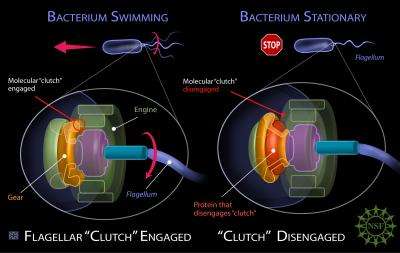
Caption: Scientists have learned a tiny molecular clutch disengages the flagellum's tail from the engine that powers its rotation. To see the full image, click the link below. Credit: Zina Deretsky, NSF Illustration courtesy of the National Science Foundation

A tiny but powerful engine that propels the bacterium Bacillus subtilis through liquids is disengaged from the corkscrew-like flagellum by a protein clutch, Indiana University Bloomington and Harvard University scientists have learned. Their report appears in this week's Science.

Scientists have long known what drives the flagellum to spin, but what causes the flagellum to stop spinning -- temporarily or permanently -- was unknown.

"We think it's pretty cool that evolving bacteria and human engineers arrived at a similar solution to the same problem," said IU Bloomington biologist Daniel Kearns, who led the project. "How do you temporarily stop a motor once it gets going?"

The action of the protein they discovered, EpsE, is very similar to that of a car clutch. In cars, the clutch controls whether a car's engine is connected to the parts that spin its wheels. With the engine and gears disengaged from each other, the car may continue to move, but only because of its prior momentum; the wheels are no longer powered.

EpsE is thought to "sit down," as Kearns describes it, on the flagellum's rotor, a donut-shaped structure at the base of the flagellum. EpsE's interaction with a rotor protein called FliG causes a shape change in the rotor that disengages it from the flagellum's proton-powered engine.

The discovery of EpsE and its function was accidental. Kearns and colleagues were actually interested in learning more about the genes that cause individual cells of B. subtilis to cease wandering in solitude and take up residence in a massively communal, stationary assemblage called a biofilm. The stability of biofilms can be jeopardized by hyperactive bacterial cells whose flagella continue to spin.

"We were trying to get at how the bacterium's ability to move and biofilm formation are balanced," Kearns said. "We were looking for the genes that affected whether the cells are mobile or stationary. Although B. subtilis is harmless, biofilms are often associated with infections by pathogenic bacteria. Understanding biofilm formation may eventually prove useful in combating bacterial infections."

Once the scientists learned EpsE was involved in repressing flagellar motion, they devised two possible explanations for how EpsE acts. The first was that EpsE acts like a brake by pushing a non-moving part against a moving part and locking up the works. The other possibility, they imagined, was that EpsE acts like a clutch, disengaging one moving part from another. In this latter scenario, the engine can no longer drive flagellar spinning because key moving parts are no longer in contact. In this case, the flagellum would still have freedom of motion, listless as it might be.

To determine which hypothesis was correct, the scientists decided it best to let the tail wag the dog. They attached the tail end of the flagellum to a glass slide and examined the movement of the entire cell in the presence and absence of EpsE. In the absence of EpsE, the entire cell rotated once every five seconds. In the presence of EpsE, the cells stopped but could rotate passively, pushed by disturbances in the environment (Brownian motion). If EpsE acted like a brake, the cells would not have rotated at all.

The researchers also learned that when the cell begins producing EpsE, it takes about 15 minutes before the flagellar machinery is disabled.

"This makes a lot of sense as far as the cell is concerned," Kearns said. "The flagellum is a giant, very expensive structure. Often when a cell no longer needs something, it might destroy it and recycle the parts. But here, because the flagellum is so big and complex, doing that is not very cost effective. We think the clutch prevents the flagellum from rotating when constrained by the sticky matrix of the biofilm."

The discovery may give nanotechnologists ideas about how to regulate tiny engines of their own creation. The flagellum is one of nature's smallest and most powerful motors -- ones like those produced by B. subtilis can rotate more than 200 times per second, driven by 1,400 piconewton-nanometers of torque. That's quite a bit of (miniature) horsepower for a machine whose width stretches only a few dozen nanometers.


Source: Indiana University


print this article email this article download pdf blog this article bookmark this article     Digg this Stumble it share on Facebook share on Reddit add to delicious save to Yahoo! bookmarks
4.7/5 after 15 votes

Rank Filter

Move the slider to adjust rank threshold, so that you can hide some of the comments.


Display comments: newest first

  • RAL - Jun 20, 2008
    • Rank: 2 / 5 (2)
    Extremely interesting. But in a clutch the engine continues to turn/idle while the driveshaft is disengaged. Does the cell continue to expend energy on the "engine" after EpsE disengages? That would seem rather wasteful over time. Or is the analogy unavoidably too simple?
  • nano999 - Jun 20, 2008
    • Rank: 1.5 / 5 (2)
    The flagellum is certainly wonder of EVOLUTION.
  • zevkirsh - Jun 20, 2008
    • Rank: 3 / 5 (1)
    there's an intuittive reason for having a clutch in cells that doesn't exist in cars.....

    a car uses a clutch to change gears...a flagellum uses a clutch so that it can run the motor periodically in order to keep it exercised and ready for use at any time when needed...but these periodic exictations of the cellular motor (maintainance exercise) need to happen without disturbing the flagellum or without having the tail to hamper the exercise.
  • 1111 - Jul 10, 2008
    • Rank: 2 / 5 (1)
    nano999 said---"The flagellum is certainly wonder of EVOLUTION"

    LOL!!!!!!!!

    Evolution......LOL!!!!!!

    Please tell me another fairy tale Hans Christian Anderson......

    LOL!!!!!
  • 1111 - Jul 10, 2008
    • Rank: 2 / 5 (1)
    Motors, Rotors, and Clutches, are products of engineering by an intellect......

    When will naturalists give up the charade???

    Don't get me wrong, it is certainly entertaining to see people make themselves look foolish by atributing the flagellum to unintelligent cause, but come on, you people have to be getting tired of looking that silly, right????

June 19th, 2008 all stories
Biology /

Comments: 5
Rank: 4.7/5 after 15 votes

  • Stumble this up

  • Digg this

  • Share it:
  • share on Facebook
  • share on MySpace
  • share on Slashdot
  • rss-newsfeed
  • share on Google
  • share on Reddit
  • add to delicious
  • save to Yahoo! bookmarks
  • share on Windows Live
  • Add to Mixx!
Rating: 4.7/5 after 15 votes

Tags


  • Physicists Demonstrate Quantum Memory with Matter Qubits
    Physicists Demonstrate Quantum Memory with Matter Qubits
    Physics / General Physics
    created Jul 03, 2009 | popularity 4.4 / 5 (13) | comments 1
  • 'Holey' Nanosheets for Wastewater Dye Removal
    Nanotechnology / Nanomaterials
    created Jul 01, 2009 | popularity 5 / 5 (5) | comments 1
  • Jellyfish Robot Swims Like its Biological Counterpart
    Jellyfish Robot Swims Like its Biological Counterpart
    Electronics / Robotics
    created Jun 26, 2009 | popularity 4.4 / 5 (7) | comments 1
  • Could Maxwell's Demon Exist in Nanoscale Systems?
    Could Maxwell's Demon Exist in Nanoscale Systems?
    Physics / General Physics
    created Jun 24, 2009 | popularity 4.4 / 5 (18) | comments 29
  • Living Safely with Robots, Beyond Asimov's Laws
    Living Safely with Robots, Beyond Asimov's Laws
    Electronics / Robotics
    created Jun 22, 2009 | popularity 4.6 / 5 (51) | comments 39
  • Other News

    The calf (bottom centre), yet to be named, was born at the harbourside Taronga Zoo just after 3am

    Australia welcomes its first new-born elephant

    Biology / Plants & Animals

    created 7 hours ago | popularity not rated yet | comments 0

    Australia has welcomed the first elephant ever born in the country with the arrival of a 100-kilogram (220.4-pound) male calf at a Sydney zoo, according to keepers.


    Early detection sought for aquatic invasive weed Eurasian Watermilfoil

    Biology / Ecology

    created 21 hours ago | popularity not rated yet | comments 0

    (PhysOrg.com) -- Battling invasive plants is nothing new to Montanans, but a newcomer on the scene dwells in the water. This aquatic invader is called Eurasian watermilfoil. Fortunately, Montanans can take preventive action ...


    Cells use import machinery to export their goods as well

    Biology / Microbiology

    created 21 hours ago | popularity 3 / 5 (1) | comments 0

    (PhysOrg.com) -- In the bustling economy of the cell, little bubbles called vesicles serve as container ships, ferrying cargo to and from the port — the cell membrane. Some of these vesicles, called post-Golgi vesicles, export ...


    Scientists 'rebuild' giant moa using ancient DNA

    Biology / Plants & Animals

    created Jul 01, 2009 | popularity 5 / 5 (9) | comments 11

    (PhysOrg.com) -- Scientists have performed the first DNA-based reconstruction of the giant extinct moa bird, using prehistoric feathers recovered from caves and rock shelters in New Zealand.


    Pacific Giant Salamander (Dicamptodon tenebrosus)

    Salamanders, regenerative wonders, heal like mammals, people

    Biology / Microbiology

    created Jul 01, 2009 | popularity 4.9 / 5 (17) | comments 10

    The salamander is a superhero of regeneration, able to replace lost limbs, damaged lungs, sliced spinal cord -- even bits of lopped-off brain. But it turns out that remarkable ability isn't so mysterious after ...