Supercomputer explores biochemical landscape to find memory switches
Switches are a part of daily life, from snoozing your alarm, turning on the coffee maker, firing up your car engine, and so on until we turn off the lights at night. Researchers have now cataloged even more templates of possible switches within a living cell than we use throughout our day.
Naren Ramakrishnan, associate professor of computer science at Virginia Tech, USA, and Upinder S. Bhalla, at the National Centre for Biological Sciences (NCBS), part of the Tata Institute of Fundamental Research in India, found that cells can make use of thousands of switches to support important biological functions.
Cells use switches for determining what kind of cell to become – skin or blood, for instance, in responding to stress, and in communication with other cells. "A switch is like a memory unit," said Bhalla. "The state of the switch -- whether it is on or off, is like a computer memory that can store a bit of 0 or 1. Although real biological switches are quite complex and regulated in many ways, we have shown the simplest possible ways in which switches could work", Bhalla said.
The researchers report their work in the June 20 issue of the Public Library of Science (PLoS) Computational Biology, in the article "Memory Switches in Chemical Reaction Space." Their collaboration began during a sabbatical visit by Ramakrishnan to NCBS in Bangalore, India. Ramakrishnan is a computer scientist whose expertise is in numerical simulation and data mining. Bhalla is a computational neuroscientist with broad interests in biochemical network modeling and simulation. They decided to use Virginia Tech's System X supercomputer to search for the many ways in which cells can implement switches.
"Our exploration using System X is rather like how a tinkerer or a kid puts together things to see if they do something useful. We took a lot of 'spare parts', each spare part being one chemical reaction, connected them together every which way, and we found that a surprising number of these artificially constructed networks actually were switches," said Ramakrishnan.
"Popular opinion used to be that there are a small number of ways in which switches can be realized by biology, but we found thousands of switches in our search," Ramakrishnan said.
The researchers report in PLoS Computational Biology, "We find nearly 4,500 reaction topologies, or about 10 percent of our tested configurations, that demonstrate switching behavior."
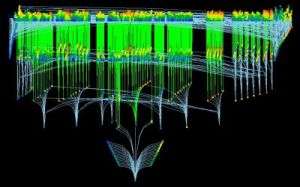
Their research also led to a comprehensive "map" of biochemical switches. The map further revealed that most of the switches form a "family" – that is, the switches are all related to one another. "This has important implications since it suggests how evolution might stumble upon a switch rather easily." Ramakrishnan said.
"Of course, there is more to cells than switches," Bhalla said. "But switching and memory are the most basic behaviors possible. Armed with our catalog of switches, we can now proceed to investigate more interesting behaviors like complex information processing."
Source: Virginia Tech


