Mayfly-Mimicking Sensor Could be High Tech 'Canary in the Coal Mine'
June 21, 2008
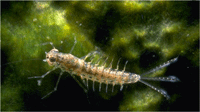
Mayfly nymph

Mayfly nymph (© Dave Funk, Stroud Water Research Center, Avondale, PA)

Security, health and safety sensors in coal mines, buildings or underground public transit areas where air or water does not readily flow may one day be improved by research on young mayflies at the University of Maryland.

Mechanical engineers Ken Kiger and Elias Balaras, of the A. James Clark School of Engineering, and entomologist Jeffrey Shultz, College of Chemical and Life Sciences, have identified a biological mechanism in the young mayflies that could enable sensors in stagnant environments to make air or water flow past them so they can detect harmful substances.

Young aquatic mayflies, or nymphs, enhance their respiration using gills, creating a flow of fresh water with the help of seven pairs of nearby gill plates that flap like a Venetian blind. The flow of fresh water is generated by the plate's motion, directing water to the mayfly's gills as efficiently as possible.

"By duplicating the action of the mayfly gill plates in a tiny robotic device, we hope to create a flow of air or water to sensors in stagnant environments, so they can operate more effectively," Kiger said.

Robotic Gills
The researchers are exploring how the mayfly's gill plates work, and how to make a robotic version, working on duplicating and measuring the gill plate movement in a virtual computer model.

They also are taking a closer look into something that scientists have known for a long time: at a sufficiently small size, an object is less affected by inertia than it is by the thickness (viscosity) of the water it is travelling through.

For example, consider a canoe in comparison to a mayfly. As it travels through the water, the canoe produces a current, which will continue to ripple through the water for some time after the canoe moves on. This is an effect of the water's inertia.

The opposite is true for the tiny mayfly nymph, which is so small that the thickness (viscosity) of the water stops such a current almost as soon as the gill plates stop. Once the mayfly grows to a certain size though, it is capable of creating an inertial effect, or ripples, of its own. Its gills respond accordingly, which is a trait the researchers hope to replicate in their sensors.

"Mayfly sizes are right at the point where issues of viscosity and inertia switch in importance," Kiger said. "Depending on whether the weight or the thickness of the water is influencing its movement, the mayfly switches the way it pumps water to its gills."

Sensor Technology
The current trend in sensor technology is to strive for smaller and more compact devices to enhance their portability and reduce power consumption. As a result of this trend, traditional technology sensors will run into the same difficulty as experienced by the mayfly as the sensors reach smaller and smaller sizes: eventually a transition will occur where inertial flow mechanisms will become ineffective.

Studying how the mayfly deals with this transition can give us insight into how to better develop equivalent engineered sensors. The next step will be to construct a tiny artificial micro-robot that can reproduce the switchable gill action of the mayfly nymph. Such a mechanism could be installed in sensors intended to detect unhealthy air in otherwise stagnant areas, such as in subway stations or mines.

If a miniature set of robotic mayfly gill plates can move air over a sensor, potentially harmful substances can be detected faster. This work is been supported by the National Science Foundation. Entomology graduate student Andrew Sensenig also contributed to this research.

Source: University of Maryland


Rank 5 /5 (2 votes)
Tags

Related Stories
Relevant PhysicsForums posts
  • How to calculate total compressibility in liquid porous solid system
    created6 hours ago
  • Need help reading 3-D
    createdFeb 11, 2012
  • A way to send and receive wireless data
    createdFeb 11, 2012
  • Calling function with no input argument
    createdFeb 10, 2012
  • Force free body diagram problem on gym equipment
    createdFeb 10, 2012
  • Empirical data regarding shower heads and water
    createdFeb 10, 2012
  • More from Physics Forums - General Engineering

More news stories

Google might launch Drive for cloud storage soon

(PhysOrg.com) -- Google's next big move, according to the Wall Street Journal, is a cloud storage service called Drive. Hardly first to the plate, Google is simply catching up to introducing its cloud reposi ...

Technology / Internet

created 14 hours ago | popularity 4.8 / 5 (5) | comments 5 | with audio podcast report

Iran blocks email, restricts net access: reports

Iran has further restricted access to the Internet and blocked popular email services for the past few days, in a move a top lawmaker said could "cost the regime dearly," media reports said on Sunday.

Technology / Internet

created 7 hours ago | popularity 5 / 5 (2) | comments 3

Love a click away in Indonesia's Twitter Republic

He was a geeky kid from Yogyakarta, she a glamorous city girl in Jakarta. In a country with one of the world's most vibrant social networking scenes they fell in love on Twitter.

Technology / Internet

created 15 hours ago | popularity 4 / 5 (1) | comments 0

Walney offshore wind farm is world's biggest (for now)

(PhysOrg.com) -- The Walney wind farm on the Irish Sea--characterized by high tides, waves and windy weather--officially opened this week. The farm is treated in the press as a very big deal as the Walney ...

Technology / Energy & Green Tech

created Feb 11, 2012 | popularity 4.1 / 5 (14) | comments 52 | with audio podcast weblog

Navy to begin tests on electromagnetic railgun prototype launcher

The Office of Naval Research (ONR)'s Electromagnetic (EM) Railgun program will take an important step forward in the coming weeks when the first industry railgun prototype launcher is tested at a facility ...

Technology / Engineering

created Feb 06, 2012 | popularity 4.5 / 5 (19) | comments 95 | with audio podcast


Scientists discover molecular secrets of 2,000-year-old Chinese herbal remedy

For roughly two thousand years, Chinese herbalists have treated Malaria using a root extract, commonly known as Chang Shan, from a type of hydrangea that grows in Tibet and Nepal. More recent studies suggest that halofuginone, ...

New method to examine batteries -- MRI from the inside

There is an ever-increasing need for advanced batteries for portable electronics, such as phones, cameras, and music players, but also to power electric vehicles and to facilitate the distribution and storage of energy derived ...

A mitosis mystery solved: How chromosomes align perfectly in a dividing cell

Although the process of mitotic cell division has been studied intensely for more than 50 years, Whitehead Institute researchers have only now solved the mystery of how cells correctly align their chromosomes during symmetric ...

Lab study raises questions over nano-particle impact

Tests involving chickens have raised questions about the impact on health from engineered nano-particles, the ultra-fine grains commonly used in drugs and processed foods, scientists said on Sunday.

Overeating may double risk of memory loss

New research suggests that consuming between 2,100 and 6,000 calories per day may double the risk of memory loss, or mild cognitive impairment (MCI), among people age 70 and older. The study was released today and will be ...

Starve a virus, feed a cure? Findings show how some cells protect themselves against HIV

A protein that protects some of our immune cells from the most common and virulent form of HIV works by starving the virus of the molecular building blocks that it needs to replicate, according to research published online ...