Reliance on unverifiable observations hinders successful conservation of wildlife species
June 23, 2008
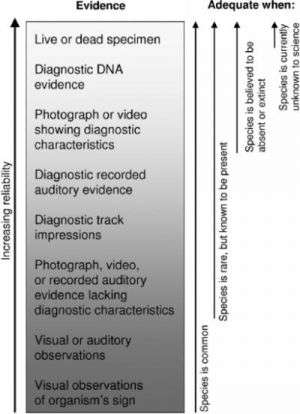
A sample set of evidentiary standards based on a gradient of increasing species rarity. The relative reliability of data types is expected to vary among organism groups. Credit: McKelvey et al.
Nearly any evidence of the occurrence of a rare or elusive wildlife species has the tendency to generate a stir. Case in point: in February 2008, remote cameras unexpectedly captured the images of a wolverine in the central Sierra Nevada, an area from which the species was believed to be extinct since 1922. But frustratingly few observations prove to be so conclusive. So what, then, are managers to make of unverifiable observations, especially those that are not diagnostic?
Researchers from the U.S. Forest Service's Pacific Northwest and Rocky Mountain Research Stations examined three cases of biological misunderstandings in which unverifiable, anecdotal observations were accepted as empirical evidence. Ultimately, they found that this acceptance adversely affected conservation goals for the fisher in the Pacific states, the wolverine in California, and the ivory-billed woodpecker in the southeast by vastly overestimating their range and abundance. The researchers' findings appear in the current issue of the journal BioScience.
"These cases revealed that anecdotal data can be important to conservation by supplying preliminary data, such as early warnings of population declines," said Kevin McKelvey, a research ecologist based in Missoula, Mont., and the study's lead investigator, "but conclusions regarding the presence of rare or elusive species must be based on verifiable physical evidence."
In their study, the researchers found that the dependability of species occurrence data depends on both the intrinsic reliability of each record as well as the rarity of the species in question, because the proportion of false positives increases as a species becomes rarer. To help managers determine the suitability of evidence in conservation decisionmaking, the researchers developed a gradient of evidentiary standards for data that increases in rigor along with species' rarity. This "sliding scale" of standards might permit the use of anecdotal data, the least reliable form, in decisionmaking when the species in question is common, for example, but require indisputable physical evidence for a species thought to be extinct. The authors also encourage professional societies to debate evidentiary standards for their organisms of interest and to establish rules for using occurrence data.
"Over the years, many state and federal management agencies have placed a lot of emphasis on compiling sighting reports and other unverifiable wildlife observations" said Keith Aubry, a research wildlife biologist based in Olympia, Wash., and one of the study's co-investigators. "Unfortunately, the uncritical use of such observations has largely impeded conservation goals, not advanced them."
Source: USDA Forest Service, Pacific Northwest Research Station
-
What do killer whales eat in the Arctic?
Jan 30, 2012 |
4 / 5 (1) |
0
-
Livestock, not Mongolian gazelles, drive foot-and-mouth disease outbreaks
Jan 30, 2012 |
not rated yet |
0
-
High-tech models help guide restoration efforts to save threatened plants
Jan 24, 2012 |
5 / 5 (1) |
0
-
'Extinct' monkey rediscovered in Borneo by new expedition
Jan 20, 2012 |
5 / 5 (6) |
0
-
Trees influence epiphyte and invertebrate communities
Jan 05, 2012 |
5 / 5 (1) |
0
-
Fast photon control brings quantum photonic technologies closer
1 hour ago |
5 / 5 (2) |
0
-
Engineers build first sub-10-nm carbon nanotube transistor
Feb 01, 2012 |
4.9 / 5 (33) |
30
-
Something old, something new: Evolution and the structural divergence of duplicate genes
Jan 31, 2012 |
4.6 / 5 (7) |
1
-
The hidden nanoworld of ice crystals: Revealing the dynamic behavior of quasi-liquid layers
Jan 30, 2012 |
5 / 5 (5) |
1
-
Stock market network reveals investor clustering
Jan 27, 2012 |
3.9 / 5 (23) |
8
-
Do some geologists actually act a lot like Randy Marsh?
Feb 11, 2012
-
Discrepancy between oxygen and carbon-dioxide levels
Feb 09, 2012
-
where gems are found in the world
Feb 09, 2012
-
Wind Waves in Reservoir ~ Wind run-up and Wind set-up
Feb 08, 2012
-
Balance of oxygen in the atmosphere
Feb 01, 2012
-
The case for a methanol-based economy
Jan 30, 2012
- More from Physics Forums - Earth
More news stories
Planck mission steps closer to the cosmic blueprint
(PhysOrg.com) -- ESA's Planck mission has revealed that our Galaxy contains previously undiscovered islands of cold gas and a mysterious haze of microwaves. These results give scientists new treasure to mine ...
1 hour ago |
5 / 5 (3) |
0
|
Slowing ocean current caused Earth to spin faster
(PhysOrg.com) -- Most people probably didn’t notice it, but back in 2009, the Earth spun around on its axis a tiny bit faster than usual, making for some slightly shorter days. It only happened for a ...
New European rocket lifts off on maiden flight
Europe on Monday successfully launched a new lightweight rocket carrying a test payload, culminating a more than 12-year quest to master the entire range of space launchers.
Space & Earth / Space Exploration
4 hours ago |
5 / 5 (5) |
2
Transforming galaxies
(PhysOrg.com) -- Many of the Universe's galaxies are like our own, displaying beautiful spiral arms wrapping around a bright nucleus. Examples in this stunning image, taken with the Wide Field Camera 3 on ...
2 hours ago |
5 / 5 (1) |
0
|
Alien matter in the solar system: A galactic mismatch
This just in: The Solar System is different from the space just outside it.
Space & Earth / Space Exploration
2 hours ago |
4.2 / 5 (6) |
7
|
Independent group inspects Apple supplier
(AP) -- An independent group, the Fair Labor Association, has started auditing Apple Inc.'s Chinese supplier Foxconn after a request by Apple.
Fast photon control brings quantum photonic technologies closer
(PhysOrg.com) -- Using photons instead of electrons to transmit information could lead to faster and more secure ways to communicate, among other advantages. Now a team of physicists has taken another step toward realizing ...
New ability to regrow blood vessels holds promise for treatment of heart disease
(Medical Xpress) -- University of Texas at Austin researchers have demonstrated a new and more effective method for regrowing blood vessels in the heart and limbs a research advancement that could have ...
New molecule has potential to help treat genetic diseases and HIV
(PhysOrg.com) -- Chemists at The University of Texas at Austin have created a molecule that's so good at tangling itself inside the double helix of a DNA sequence that it can stay there for up to 16 days before ...
Ordered planar polymers created for the first time
(PhysOrg.com) -- Scientists under the direction of ETH Zurich have created a minor sensation in synthetic chemistry. They succeeded for the first time in producing regularly ordered planar polymers that form ...
Rapunzel, Leonardo and the physics of the ponytail
(PhysOrg.com) -- New research provides the first mathematical understanding of the shape of a ponytail and could have implications for the textile industry, computer animation and personal care products.