When threatened, a few African frogs can morph toes into claws
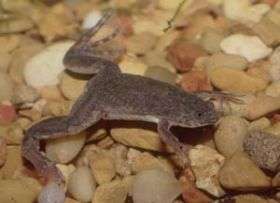
At least 11 species kick at predators with sharp, protruding bones as a defense mechanism
Biologists at Harvard University have determined that some African frogs carry concealed weapons: When threatened, these species puncture their own skin with sharp bones in their toes, using the bones as claws capable of wounding predators.
The unusual defense mechanism is described by Harvard's David C. Blackburn, James Hanken, and Farish A. Jenkins, Jr., in a forthcoming issue of the journal Biology Letters.
"It's surprising enough to find a frog with claws," says Blackburn, a doctoral student in Harvard's Department of Organismic and Evolutionary Biology. "The fact that those claws work by cutting through the skin of the frogs' feet is even more astonishing. These are the only vertebrate claws known to pierce their way to functionality."
"Most vertebrates do a much better job of keeping their skeletons inside," he adds.
Blackburn first became aware of the clawed frogs while conducting fieldwork in the central African nation of Cameroon. When he picked up one of the hulking fist-sized frogs, it flailed its hind legs violently, scratching him and drawing blood.
Back in the U.S., Blackburn examined museum specimens of 63 African frog species. He noticed that in 11 species -- all in the genera Astylosternus, Trichobatracus, and Scotobleps and all native to central Africa -- the bones at the ends of the toes were pointed and hooked, with smaller, free-floating bones at their tips. Eventually he determined that these small nodules at the tips of the frogs' feet were connected to the rest of the toe by a collagen-rich sheath.
"These nodules are also closely connected to the surrounding skin by dense networks of collagen," Blackburn says. "It appears they hold the skin in place relative to these claw-like bones, such that when the frog flexes a certain muscle in the foot, the sharp bone separates from the nodule and bursts through the skin."
This claw-like structure is no conventional claw, though: It is pure bone, free of the keratin sheath that normally surrounds vertebrate claws. And unlike a claw that retracts into a specialized structure in an animal's foot, as in cats, the site where the frogs' foot bones emerge appears to be covered with ordinary skin.
While these frogs were mentioned in the scientific literature on a few occasions from 1900 to 1925, they are generally little-known in the U.S., appearing in few museum collections. Even the handful of researchers who wrote about them a century ago often misinterpreted the piercing of the skin as damage incurred during preservation of specimens.
The frogs are widely roasted and eaten in Cameroon, where hunters -- evidently well aware of the risk of injury -- go to great lengths to avoid handling them when alive.
"Cameroonian hunters will use long spears or machetes to avoid touching these frogs," Blackburn says. "Some have even reported shooting the frogs."
Of more than 5,500 known frog species, Blackburn and his colleagues found just 11 with claws, and speculate there may be another couple of similarly equipped species.
Blackburn plans to study live specimens of the African frogs to determine whether retraction of the foot bones back into the body is an active or a passive process, and how the damaged skin regenerates after the claws are deployed.
"We suspect, since the frog does suffer a fairly traumatic wound, that they probably use these claws infrequently, and only when threatened," Blackburn says.
Source: Harvard University


