Tethered molecules act as light-driven reversible nanoswitches
June 23, 2008 Tethered Molecules Act as Light-Driven Reversible Nanoswitches

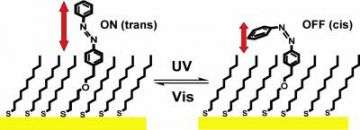
Illustration of the light-activated switch made by the Paul Weiss lab at Penn State. A bridge within the azobenzene molecule, made by two double-bonded nitrogen atoms, each also bound to a benzene ring, reconfigures when the molecule absorbs light. The two benzene rings move to the same side of the molecule (cis configuration) when exposed to ultraviolet light, and to opposite sides (trans configuration) when exposed to visible light. Credit: Paul Weiss lab, Penn State

Our ability to see is based on molecules in the eye that flip from one conformation to another when exposed to visible light. Now, a new technique for attaching light-sensitive organic molecules to metal surfaces allows the molecules to be switched between two different configurations in response to exposure to different wavelengths of light. Because the configuration changes are reversible and can be controlled without direct contact, this technique could enable applications that can be controlled at the molecular scale.

The technology has been suggested as a possible basis for molecular motors, artificial muscles, and molecular electronics. The research results, obtained by a team led by Paul S. Weiss, distinguished professor of chemistry and physics at Penn State University and James M. Tour, Chao professor of chemistry at Rice University, are reported in the June 2008 issue of the journal Nano Letters.

Until now, progress was impeded because, when such molecules were attached to surfaces, they no longer could be switched back and forth, as they could be when they were in solution. The new technique uses a change in the shape of an azobenzene molecule in response to light to provide two different states. The azobenzene molecule consists of a bridge of two nitrogen atoms attached to one another by a double bond, with each nitrogen atom also bound to a benzene ring. The two benzene rings can be on the same side of the molecule (cis configuration) or on opposite sides (trans configuration). When the molecule absorbs energy, in the form of light, it can change between cis and trans configurations in a process called photoisomerization. "This mechanism is essentially the same that we use in our eyes for vision," said Weiss. "The molecule responds to light by making a change that can be harnessed. In the eye, the change causes a neural impulse."

The photoisomerization of azobenzene is understood well in solution, but the molecule must be attached to a surface in order to provide a useful molecular switch or component of a motor. Previous attempts to accomplish the switching with attached molecules were unsuccessful, either due to interactions between the molecule and the surface to which it was attached or to interferences between adjacent molecules. "To overcome the difficulty of reversible photoisomerization of molecules on surfaces, we used a carefully designed 'tether' to isolate the functional molecules from one another and from the metal surface," said Weiss. "We isolated the tethered molecules in the surrounding matrix on a self-assembled monolayer and confirmed this isolation using molecular-resolution scanning tunneling microscopy."

When the tethered molecules were exposed to ultraviolet light in a specially built scanning tunneling microscope, they switched from the trans to the more-compact cis state. This switch was confirmed by an apparent decrease in height of the molecule above the surrounding surface. The researchers further found that exposure to visible light caused a transition back to the more-extended trans state.

Weiss points out that this research advance is just the first step in designing a device that can be driven or actuated by such molecular change. In order to perform useful work as a switch or nanoscale-drive motor, it will be necessary to coordinate the motion of multiple molecules and to build moving parts into some sort of assembly. According to Weiss, further research by the team already has found some surprises when the molecules are lined up to work in unison, like a chorus line.


Source: Penn State


Rate this story - 4.2 /5 (12 votes)

Rank Filter

Move the slider to adjust rank threshold, so that you can hide some of the comments.


Display comments: newest first

  • holoman - Jun 23, 2008
    • Rank: not rated yet
    How many times can it switch back and forth before failure ?

June 23, 2008 all stories

Comments: 1

4.2 /5 (12 votes)

  • hide
  • Related Stories

  • Moss helps chart the conquest of land by plants (w/ Video)
    created Feb 04, 2010 | popularity not rated yet | comments 0
  • New technique helps search for another Earth (Update)
    created Feb 03, 2010 | popularity not rated yet | comments 0
  • Research may lead to new ways to transport and manipulate molecules
    created Feb 02, 2010 | popularity not rated yet | comments 0
  • Researchers Find New Way To Study How Enzymes Repair DNA Damage
    created Jan 28, 2010 | popularity not rated yet | comments 0
  • Grant to study how cells sense electric fields
    created Jan 26, 2010 | popularity not rated yet | comments 0


  • hide
  • Relevant PhysicsForums posts

  • Interception angle
    created 2 hours ago
  • Pressure created by clamping base and cover
    created 2 hours ago
  • How to find static friction
    created 8 hours ago
  • Calculating decible increases
    created 15 hours ago
  • More from Physics Forums - General Physics

Other News

Nanoscale Structures with Superior Mechanical Properties Developed

Nanoscale Structures with Superior Mechanical Properties Developed

Nanotechnology / Nanomaterials

created 16 hours ago | popularity 4.6 / 5 (9) | comments 1 | with audio podcast

(PhysOrg.com) -- Researchers at the California Institute of Technology have developed a way to make some notoriously brittle materials ductile -- yet stronger than ever -- simply by reducing their size.


Spray-on liquid glass

Spray-on liquid glass is about to revolutionize almost everything

Nanotechnology / Nanomaterials

created Feb 02, 2010 | popularity 4.7 / 5 (240) | comments 93 | with audio podcast report

(PhysOrg.com) -- Spray-on liquid glass is transparent, non-toxic, and can protect virtually any surface against almost any damage from hazards such as water, UV radiation, dirt, heat, and bacterial infections. ...


IBM Scientists Demonstrate World's Fastest Graphene Transistor

IBM Scientists Demonstrate World's Fastest Graphene Transistor

Nanotechnology / Nanophysics

created Feb 05, 2010 | popularity 4.9 / 5 (38) | comments 25 | with audio podcast

(PhysOrg.com) -- In a just-published paper in the magazine Science, IBM researchers demonstrated a radio-frequency graphene transistor with the highest cut-off frequency achieved so far for any graphene device ...


Conductive eTextiles: Stanford finds a new use for cloth

Conductive eTextiles: Researchers move from making batteries from paper to making batteries from cloth

Nanotechnology / Nanomaterials

created Feb 05, 2010 | popularity 4.3 / 5 (7) | comments 4 | with audio podcast

(PhysOrg.com) -- Stanford researchers have moved from making batteries from paper to making batteries from cloth. Your-T-shirt could become a lighted, moving display.


Carbon Based Chips May One Day Replace Silicon Transistors

Carbon Based Chips May One Day Replace Silicon Transistors

Nanotechnology / Nanomaterials

created Feb 03, 2010 | popularity 4.7 / 5 (18) | comments 3 | with audio podcast weblog

(PhysOrg.com) -- IBM researchers are hopeful that, over the next decade, silicon-based transistors will be replaced by carbon-based transistors. IBM has already laid out the ground work for carbon-based transistors.