Blue light used to harden tooth fillings stunts tumor growth
June 24, 2008
Blue light used to harden tooth fillings stunts tumor growth

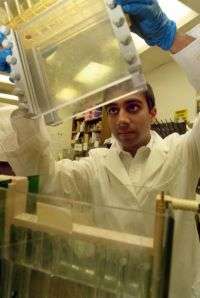
Alpesh Patel, a rising MCG School of Dentistry junior, studies the effects of a blue curing light on tumors.bCredit: Phil Jones

A blue curing light used to harden dental fillings also may stunt tumor growth, Medical College of Georgia researchers say.

"The light sends wavelengths of blue-violet light to the composite, which triggers hardening," says Alpesh Patel, a rising MCG School of Dentistry junior. "The light waves produce free radicals that activate the catalyst and speed up polymerization of the composite resin. In oral cancer cells, though, those radicals cause damage that decreases cell growth and increases cell death."

Mr. Patel, who has been working with Dr. Jill Lewis, associate professor of oral biology, Dr. Regina Messer, associate professor of oral rehabilitation and oral biology, and Dr. John Wataha, adjunct professor of oral rehabilitation and oral biology, studied 10 tumor-bearing mice, five treated with the light and five untreated.

He exposed half the mice to the blue light for 90 seconds a day for 12 days. Then the tumors were extracted and each one was split into two sections. Half were used to create slides for tissue analysis, and half were frozen to prepare protein extracts.

Tissue analysis indicated an approximate 10 percent increase in cell suicide, or apoptosis, in the light-treated tumors. The frozen protein extracts revealed a nearly 80 percent decrease in cell growth in the light-treated tumors.

"The decrease in cell growth, combined with increased apoptosis, helps explain why the tumors didn't grow as much because you have cells that aren't dividing and you have cells that are committing suicide," Mr. Patel says.

Dr. Lewis predicts treating the tumors with blue light sooner will increase the rate of apoptosis, possibly preventing the tumor from ever becoming measurable and easing treatment.

"One desirable feature we've observed with the blue light is that non-cancerous cells appear unaffected at light doses that kill tumor cells," says Dr. Lewis. "We're thinking that some day, blue light therapy may serve as an adjunct to conventional cancer therapy. Patients may, therefore, receive lower doses of chemotherapy, which would decrease the adverse effects most cancer patients experience from standard chemotherapy regimens."

Source: Medical College of Georgia

4.8 /5 (33 votes)  

Filter


Move the slider to adjust rank threshold, so that you can hide some of the comments.


Display comments: newest first

deatopmg
Jun 24, 2008

Rank: 4 / 5 (1)
why not just go out in the sunlight? it contains a lot of blue light. (What was the intensity of the exposure in microwatts/nM?)

Maybe that explains why high vitamin D status leads to reduced cancer rates. The D level is just a marker for sunlight exposure.
E_L_Earnhardt
Jun 25, 2008

Rank: not rated yet
Sunlight has more cancer-causing cosmic rays than any "blue-light". If you could filter one without losing the other you might have something. It's all about electron spin!
Rank 4.8 /5 (33 votes)
Tags

Related Stories
Relevant PhysicsForums posts
  • Is Everyday Technology Killing Us?
    createdFeb 08, 2012
  • Exercise and weight loss
    createdFeb 08, 2012
  • Why do we have head aches? Our brains can't feel anything.
    createdFeb 07, 2012
  • "The end of diseases" by David Agus, interview from Daily Show with Jon Stewart
    createdFeb 04, 2012
  • Oncolytic adenovirus
    createdFeb 04, 2012
  • Nutrition label stuffs and diets
    createdFeb 02, 2012
  • More from Physics Forums - Medical Sciences

More news stories

Tenofovir, leading HIV medication, linked with risk of kidney damage

(Medical Xpress) -- Tenofovir, one of the most effective and commonly prescribed antiretroviral medications for HIV/AIDS, is associated with a significant risk of kidney damage and chronic kidney disease that increases over ...

Medicine & Health / Medications

created 43 minutes ago | popularity not rated yet | comments 0 | with audio podcast

New tumor suppressor gene identified

A recent study published in Clinical Cancer Research suggests that the protein hVps37A suppresses tumor growth in ovarian cancer. The work, which was funded by the Austrian Science Fund FWF, shows, for th ...

Medicine & Health / Cancer

created 13 minutes ago | popularity not rated yet | comments 0

Don't ignore kids' snores

(Medical Xpress) -- Your ears aren’t playing tricks on you – that is the sound of snoring you hear from the bedroom of your preschooler. Snoring is common in children, but in some cases it can be a symptom of a ...

Medicine & Health / Diseases

created 1 hour ago | popularity 5 / 5 (1) | comments 0

WHO calls for stepped-up fight against leprosy

The World Health Organization called Monday for greater efforts to fight leprosy, warning the disfiguring disease was defying efforts to wipe it out across many countries in the Asia-Pacific region.

Medicine & Health / Diseases

created 1 hour ago | popularity not rated yet | comments 0

Social psychologist: Lust makes you smarter and evidence that seven deadly sins are good for you

(Medical Xpress) -- Good news for lovers on Valentine’s Day - the seven deadly sins, including Lust, are good for you. University of Melbourne social psychologist Dr Simon Laham uses modern research to make a compelling ...

Medicine & Health / Psychology & Psychiatry

created 2 hours ago | popularity 4.5 / 5 (2) | comments 0


Researchers make better heat sensor based on butterfly wings

(PhysOrg.com) -- Scientists have long known that butterfly wings produce their iridescent colors by bouncing light around and between tiny ridges in structures made of chitin. More recently they’ve discovered ...

Manipulating genes with hidden TALENs

(PhysOrg.com) -- A better understanding of gene function in model plant and animal systems could be used to develop useful traits in livestock and crop plants, and might someday lead to developments in stem ...

Alien matter in the solar system: A galactic mismatch

This just in: The Solar System is different from the space just outside it.

Transforming galaxies

(PhysOrg.com) -- Many of the Universe's galaxies are like our own, displaying beautiful spiral arms wrapping around a bright nucleus. Examples in this stunning image, taken with the Wide Field Camera 3 on ...

'Smart' microcapsules in a single step

(PhysOrg.com) -- A new, single-step method of fabricating microcapsules, which have potential commercial applications in industries including medicine, agriculture and diagnostics, has been developed by researchers ...

China's pollution puts a dent in its economy

Although China has made substantial progress in cleaning up its air pollution,a new MIT study shows that the economic impact from ozone and particulates in its air has increased dramatically. ...