Genomics of large marine animals showcased in the biological bulletin
June 24, 2008
Sponge

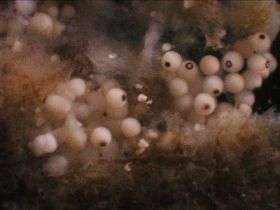
The interior of the brood chamber of a sponge, Amphimedon queenslandica, showing embryos in the early phases of development. Credit: Bryony Fahey (University of Queensland)

Though the slow moving purple sea urchin may look oblivious, lacking a head, eyes and ears, this prickly creature has an impressive suite of sensory receptors to detect outside signals. And don't overlook this animal's self-defense abilities: it has much more ammunition to activate its innate immune system than humans have. The starlet sea anemone lives in coastal areas that face increasing pollution, and it is better equipped than many land, ocean, and freshwater animals to tolerate environmental stress.

These insights into the biology of marine organisms didn't come from observational studies; they were revealed by deciphering and comparing the animals' genomes. The powerful advantages of using gene catalogs to infer biological function in marine animals are highlighted in a virtual symposium in the June issue of The Biological Bulletin, published by the Marine Biological Laboratory (MBL) in Woods Hole, Massachusetts.

Emerging research on the genomic structure of marine organisms is giving scientists new clues as to how certain physiological systems evolved. The genomes of ancient Cnidarians, of which the jellyfish is best known, are being used to discern how cells adhere to form organs and organisms. The genome of Ridgeia piscesae, a tubeworm that has co-evolved with bacteria to thrive in the extreme environment of deep-sea hydrothermal vents, is illuminating the molecular underpinnings of symbiosis.

Genetic sequencing, a once-expensive technology, continues to enjoy reductions in cost and increases in speed that allow even smaller laboratories to produce molecular "maps" to study and compare organisms.

"Science runs on three things – very bright ideas, improved technology and the money to do the research," says R. Andrew Cameron of the California Institute of Technology, who organized The Biological Bulletin virtual symposium along with Jonathan P. Rast of the University of Toronto. "As genomes become less and less expensive to sequence, then it is easier to justify sequencing more genomes to open new areas of study."

By plugging DNA sequences from a marine organism like the sea urchin into a genetic database, researchers can find similarities between sea urchin genes of an unknown function with, for example, human proteins used for sensing light. Further experiments can then test if the sea urchin genes are coding for a sensory protein. Comparing the human and the sea urchin genes can also help illuminate how the sensory protein evolved.

"The benefit of having new model systems is that we can ask questions with organisms in which peculiar characteristics of the genome are very important," Cameron says. For example, some of the marine animals featured in this virtual symposium have unexpectedly complicated sensory systems or immune systems that differ greatly from those of the fruit fly or the nematode worm, standard models in genetic studies. "I think there is good justification for these marine metazoan studies in that we will eventually apply this knowledge to the organism we're most interested in – ourselves," he says.

Source: Marine Biological Laboratory

3.8 /5 (5 votes)  

Rank 3.8 /5 (5 votes)
Tags

Relevant PhysicsForums posts

More news stories

A mitosis mystery solved: How chromosomes align perfectly in a dividing cell

Although the process of mitotic cell division has been studied intensely for more than 50 years, Whitehead Institute researchers have only now solved the mystery of how cells correctly align their chromosomes during symmetric ...

Biology / Cell & Microbiology

created 2 hours ago | popularity 5 / 5 (3) | comments 0 | with audio podcast

The proteins ensuring genome protection

Researchers from the University of Geneva (UNIGE), Switzerland, have discovered the crucial role of two proteins in developing a cell 'anti-enzyme shield'. This protection system, which operates at the level of molecular ...

Biology / Cell & Microbiology

created 2 hours ago | popularity 5 / 5 (2) | comments 0 | with audio podcast

Researchers find extensive RNA editing in human transcriptome

In a new study published online in Nature Biotechnology, researchers from BGI, the world's largest genomics organization, reported the evidence of extensive RNA editing in a human cell line by analysis of RNA-seq data, demons ...

Biology / Biotechnology

created 2 hours ago | popularity 5 / 5 (3) | comments 0 | with audio podcast

Entire genome of extinct human decoded from fossil

(PhysOrg.com) -- In 2010, Svante Pääbo and his colleagues presented a draft version of the genome from a small fragment of a human finger bone discovered in Denisova Cave in southern Siberia. The ...

Biology / Biotechnology

created Feb 07, 2012 | popularity 4.7 / 5 (58) | comments 48 | with audio podcast

Why are there so few fish in the Earth's oceans?

(PhysOrg.com) -- A Stony Brook University researcher has found that, contrary to popular belief, there are not plenty of fish in the sea.

Biology / Plants & Animals

created Feb 08, 2012 | popularity 4.3 / 5 (17) | comments 27 | with audio podcast


Scientists discover molecular secrets of 2,000-year-old Chinese herbal remedy

For roughly two thousand years, Chinese herbalists have treated Malaria using a root extract, commonly known as Chang Shan, from a type of hydrangea that grows in Tibet and Nepal. More recent studies suggest that halofuginone, ...

New method to examine batteries -- MRI from the inside

There is an ever-increasing need for advanced batteries for portable electronics, such as phones, cameras, and music players, but also to power electric vehicles and to facilitate the distribution and storage of energy derived ...

Google might launch Drive for cloud storage soon

(PhysOrg.com) -- Google's next big move, according to the Wall Street Journal, is a cloud storage service called Drive. Hardly first to the plate, Google is simply catching up to introducing its cloud reposi ...

Lab study raises questions over nano-particle impact

Tests involving chickens have raised questions about the impact on health from engineered nano-particles, the ultra-fine grains commonly used in drugs and processed foods, scientists said on Sunday.

Starve a virus, feed a cure? Findings show how some cells protect themselves against HIV

A protein that protects some of our immune cells from the most common and virulent form of HIV works by starving the virus of the molecular building blocks that it needs to replicate, according to research published online ...

Injured boomers beware: Know when to see doctor

(AP) -- It happened to nurse Jane Byron years after an in-line skating fall, business owner Haralee Weintraub while doing "men's" push-ups, and avid cyclist Gene Wilberg while lifting a heavy box.