Phoenix Lander Prepares for Microscopy, Wet Chemistry on Mars
June 24, 2008 Phoenix Scoops Up Martian Soil

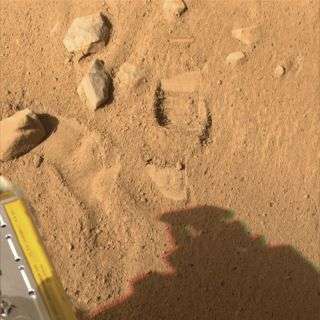
This color image, acquired by NASA's Phoenix Mars Lander's Surface Stereo Imager shows the so-called "Knave of Hearts" first-dig test area to the north of the lander. Credit: NASA

NASA's Phoenix Mars Lander has delivered a scoop of Martian soil from the "Snow White" trenches to the optical microscope for analysis tomorrow, June 24, the 29th Martian day of the mission, or Sol 29.


And the Phoenix lander will position its Robotic Arm to deliver some of that same scoop of soil for its first wet chemistry experiment on the Red Planet in the next day or two.

Scientists did a diagnostic run today that melted ice to water for Phoenix's first wet chemistry experiment. The water is part of the wet chemistry laboratory and comes from Earth.

The laboratory, not yet used on Mars, is designed to test soil for salts, acidity and other characteristics, much like garden soils are tested on Earth. Phoenix's wet chemistry laboratory is part of the suite of tools called the Microscopy, Electrochemistry and Conductivity Analyzer, or MECA.

"The water in the wet-chemistry cell is frozen, and before we do an experiment we have to make sure that it's totally thawed," Phoenix co-investigator Sam Kounaves of Tufts University, wet chemistry laboratory lead, said. "It's like pouring a known amount of water from a beaker when you're doing a chemistry experiment -- you have to use all the water for your experiment to work."

"We are good to go," said Michael Hecht of NASA's Jet Propulsion Laboratory, lead scientist for Phoenix's MECA instrument. "We made liquid water on Mars for the first time for our test."

Source: NASA


print this article email this article download pdf blog this article bookmark this article     Stumble it Digg this share on Facebook retweet share on Reddit add to delicious
Rate this story - 3.7 /5 (7 votes)

Rank Filter

Move the slider to adjust rank threshold, so that you can hide some of the comments.


Display comments: newest first

  • zevkirsh - Jun 24, 2008
    • Rank: 5 / 5 (1)
    dude..they're getting it all wrong. they're supposed to melt water that they dig up from the ice under the soil. damnit!

June 24, 2008 all stories

Comments: 1

3.7 /5 (7 votes)
  • Stumble this up

  • Digg this

  • share this

  • hide
  • Related Stories

  • Podcast: Tiny sea creature and a new medical adhesive
    created Oct 27, 2009 | popularity not rated yet | comments 0
  • Building Planet Earth
    created Oct 22, 2009 | popularity not rated yet | comments 0
  • Harnessing nanopatterns: Tiny textures can produce big differences
    created Sep 24, 2009 | popularity not rated yet | comments 0
  • Biosphere 2 Opens Phoenix Mars Lander Exhibit
    created Sep 18, 2009 | popularity not rated yet | comments 0
  • Invasive mussel may inspire new adhesive
    created Aug 27, 2009 | popularity not rated yet | comments 0


  • hide
  • Relevant PhysicsForums posts

  • The shape of our solar system's orbits.
    created Nov 07, 2009
  • Above or Below the Line of Nodes
    created Nov 07, 2009
  • Supernova vs. Nova?
    created Nov 07, 2009
  • Supernova's Gamma Rays and Comets
    created Nov 06, 2009
  • More from Physics Forums - General Astronomy

Other News

Deep creep means milder, more frequent earthquakes along Southern California's San Jacinto fault

Deep creep means milder, more frequent earthquakes along Southern California's San Jacinto fault

Space & Earth / Earth Sciences

created 16 hours ago | popularity 4.5 / 5 (4) | comments 0

With an average of four mini-earthquakes per day, Southern California's San Jacinto fault constantly adjusts to make it a less likely candidate for a major earthquake than its quiet neighbor to the east, the ...


Success in 'space elevator' competition (AP)

Success in 'space elevator' competition (Update 3)

Space & Earth / Space Exploration

created Nov 05, 2009 | popularity 4.3 / 5 (33) | comments 50

(AP) -- A robot powered by a ground-based laser beam climbed a long cable dangling from a helicopter on Wednesday to qualify for prize money in a $2 million competition to test the potential reality of the ...


In a Galaxy Far, Far Away...

In a Galaxy Far, Far Away...

Space & Earth / Astronomy

created Nov 06, 2009 | popularity 4.8 / 5 (5) | comments 17

(PhysOrg.com) -- Astronomers have published the discovery of the farthest known object in the cosmos: a star that exploded when the universe was only 630 million years old -- only 4.6% of its current age. ...


'Dropouts' pinpoint earliest galaxies

'Dropouts' pinpoint earliest galaxies

Space & Earth / Astronomy

created Nov 06, 2009 | popularity 4.2 / 5 (10) | comments 13

Astronomers, conducting the broadest survey to date of galaxies from about 800 million years after the Big Bang, have found 22 early galaxies and confirmed the age of one by its characteristic hydrogen signature ...


Space hotel taking bookings for 2012 opening

Space hotel taking bookings for 2012 opening

Space & Earth / Space Exploration

created Nov 05, 2009 | popularity 4.4 / 5 (21) | comments 11

(PhysOrg.com) -- The first orbiting space hotel is on track to open for its first customers in 2012, but hurry, as bookings are filling fast.