Migrating songbirds learn survival tips on the fly
June 25, 2008 Migrating songbirds learn survival tips on the fly

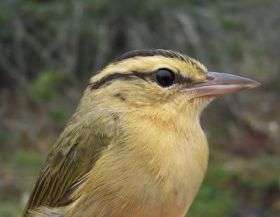
Worm-eating warblers breed in North America, but winter in Central America. While migrating, they frequently inspect "mobs" of local winged residents, Queen's University biologists discovered.Credit: Joseph Nocera

Migrating songbirds take their survival cues from local winged residents when flying through unfamiliar territory, a new Queen's University-led study shows. It's a case of "When in Rome, do as the Romans do," says biologist Joseph Nocera, who conducted the research while working as an NSERC Postdoctoral Fellow at Queen's under the supervision of Biology professor Laurene Ratcliffe.

Avoiding predators can substantially increase a bird's chances of survival during migration, notes Dr. Nocera. But to do that, it first has to recognize who its predators are. "We believe some prey use social cues from other animals to gain information about potential predators," he says.

Findings from the study are published on-line in the current issue of the journal Behavioral Ecology and Sociobiology.

The research team tested whether migratory songbirds observe the anti-predator behaviour of local birds, which are familiar with local predators. One common form of this self-protecting behaviour is "mobbing": The birds approach a potential predator, rapidly changing position around its location and performing restless wing and tail movements while emitting loud, broad-frequency calls. These calls are easily recognizable and act as signals of threat.

Because migrating birds rarely participate in mobs, the researchers speculate that they may gain information about predator location, identity and degree of threat through listening to mob calls of other species residing in the area. To test this theory, they broadcast playbacks of alarm calls that were familiar (black-capped chickadee, common in North America) and foreign (blue-gray tanager, common in Central America) to birds migrating between Canada and Belize.

The Belizean resident birds responded only to the tanager calls, but migrant birds responded to both the tanagers and the chickadees.

These results present the first evidence that migrating birds pay attention to the anti-predator behaviour of local birds during migration, says Dr. Ratcliffe. "We suspect that the behaviour will be found to be a low-cost learning opportunity for migrants."

The next step for the researchers will be to compare sensitivity of migrating birds
to unfamiliar mob-calls during their overwintering and migratory phases, and to assess the amount of information the respondents have learned by using predator decoys.

Source: Queen's University


print this article email this article download pdf blog this article bookmark this article     Stumble it Digg this share on Facebook retweet share on Reddit add to delicious
Rate this story - 4.8 /5 (5 votes)


June 25, 2008 all stories

Comments: 0

4.8 /5 (5 votes)
  • Stumble this up

  • Digg this

  • share this

  • hide
  • Related Stories

  • Experts examine risks to birds from wind turbines (w/ Video)
    created Jun 24, 2009 | popularity not rated yet | comments 0
  • Project succeeding to relocate Caspian terns
    created Jun 16, 2008 | popularity not rated yet | comments 0
  • Bats prey on nocturnally migrating songbirds
    created Feb 14, 2007 | popularity not rated yet | comments 0
  • 'Home run' study on spread of disease published
    created Dec 19, 2006 | popularity not rated yet | comments 0
  • Scientists launch effort to sequence the DNA of 10,000 vertebrates
    created Nov 04, 2009 | popularity not rated yet | comments 0


Other News

With Help from a Bacterium, Cockroaches Develop Way to Store Excess Uric Acid

With Help from a Bacterium, Cockroaches Develop Way to Store Excess Uric Acid

Biology / Plants & Animals

created 44 minutes ago | popularity not rated yet | comments 0

(PhysOrg.com) -- What life form can use materials as nutrients that we, and most other animals, would consider waste products?


Longer toes eyed as sprinters' edge

Biology / Other

created 1hour ago | popularity not rated yet | comments 0

(PhysOrg.com) -- Longer toes may give sprinters a leg up on other runners, according to a new study.


New explanation for nature's hardiest life form

Biology / Cell & Microbiology

created 5 hours ago | popularity 4.3 / 5 (3) | comments 0

Got food poisoning? The cause might be bacterial spores, en extremely hardy survival form of bacteria, a nightmare for health care and the food industry and an enigma for scientists. Spore-forming bacteria, present almost ...


Hoping for a fluorescent basket case: How HIV is assembled and released from infected cells

Biology / Cell & Microbiology

created 4 hours ago | popularity not rated yet | comments 0

Although recent advances have raised hopes that a protective vaccine can be developed, acquired immunodeficiency syndrome (AIDS) remains a major public health problem. Much has been learned about HIV-1, the virus that causes ...


neuron

To make memories, new neurons must erase older ones

Biology / Cell & Microbiology

created 3 hours ago | popularity 5 / 5 (1) | comments 0

Short-term memory may depend in a surprising way on the ability of newly formed neurons to erase older connections. That's the conclusion of a report in the November 13th issue of the journal Cell that provid ...