Air monitoring helps anticipate possible ecosystem changes
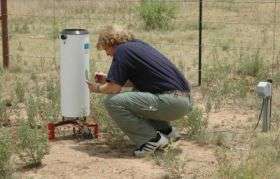
When rain settles the atmosphere and brings air pollutants to the ground, it can have a lasting effect on ecosystems, sometimes hundreds of miles away, according to a Texas AgriLife Research agricultural engineer.
Dr. Brent Auvermann, research engineer and Texas AgriLife Extension Service specialist in Amarillo, is working with the U.S. Department of Agriculture, the Environmental Protection Agency and other agencies to see what is settling from the skies above the Panhandle.
"The question we're trying to help answer is, are we altering ecosystems by dumping pollutants into the atmosphere that will come out in the form of wet or dry deposition?" Auvermann said.
"We have intensive agriculture of all forms and we'd like to know if the specific dominant land uses are contributing nutrients to ecosystems," he said.
Auvermann explained that all ecosystems receive some atmospheric inputs, such as nitrogen, phosphorus and sulfur. The plant and animal life dominant to that region thrives because it has adapted to a particular rate of those nutrients.
When the nutrient load changes, it can change the competitive ability of a species and allow different ones to thrive where they once were not competitive, he said. The effects extend from major animal life such as deer down to the smallest bacteria.
For instance, scientists know that the Rocky Mountain National Park has been home to wildflowers for many years, Auvermann said. But evidence from the last 20 years suggests that the ecosystem seems to be changing. The wildflowers are gradually being replaced by grasses and sedges.
"I don't know anyone who drives all the way to Estes Park to take pictures of sedges," he said.
Another change the Colorado scientists are noticing is acidification of the normally alkaline soils on the eastern side of the Continental Divide, Auvermann said. This can lead to changes in the surface water and streams.
"Scientists believe the emissions from around eastern Colorado and the bordering states have resulted in detectable changes in the high alpine ecosystems," he said.
Auvermann joined a network of scientists monitoring such emissions about a year ago when his research team set up a monitoring site southeast of Canyon with wet and dry deposition measuring equipment. Deposition is the process in which particles or gases in the air settle to the ground, vegetation or water surfaces.
The wet deposition measurements are made as a part of the National Atmospheric Deposition Program, he said. The wet proportion is that which happens as a result of precipitation and its scrubbing effect.
Dry deposition, measured as a part of the Clean Air Status and Trends Network, is all the other particles and gases that happen to settle out of the air, he said.
While they are two separate projects, by measuring both in the same location, Auvermann said scientists can measure the total deposition.
Both sets of equipment are filling a void in the organizations' nationwide networks, he said. The closest wet deposition measurements are being made at Muleshoe and Goodwell, Okla. The nearest dry deposition equipment is even farther away, in Big Bend National Park. The Canonceta site sits about midway between the sites at Muleshoe and Goodwell.
"We're looking for long-term trends and whether they are increasing or decreasing," Auvermann said. "Wet deposition increases in wet years and decreases during a drought, so we have to take a longer-term view."
The site located along the rim of Ceta Canyon is free from influence of any single source of air pollution, he said. The wet measurements can include ammonia, nitrate, calcium, sodium, potassium, phosphorus, sulfur and the acidity of rain or snow.
The major nutrients of concern are nitrogen and sulfur, Auvermann said. Based on the first year of monitoring data, the total deposition of inorganic nitrogen – ammonia plus nitrate – is between 3.5 or 4.5 pounds of nitrogen per acre per year.
"Compared to how much nitrogen we put on irrigated grain crops, it's not much, obviously," he said. "But on nutrient-poor rangeland, who knows?
"We don't know what an undisturbed background level would be in this region of the state," Auvermann said. "We can't really say without more information if a certain amount of deposition is good or bad. Right now we are getting the baseline and looking at how it relates to the surrounding sites that have been monitoring deposition for a lot longer than we have."
Auvermann is especially excited about using the Canonceta site as a living laboratory for science students from middle school to college.
"This kind of environmental monitoring is where it all comes together: meteorology, chemistry, physics, biology and ecology," he said. "It's all here."
Source: Texas A&M University


