Mars air once had moisture
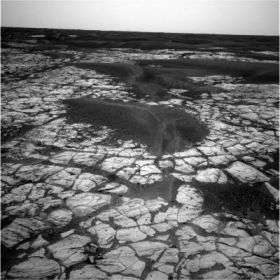
A new analysis of Martian soil data led by University of California, Berkeley, geoscientists suggests that there was once enough water in the planet's atmosphere for a light drizzle or dew to hit the ground, leaving tell-tale signs of its interaction with the planet's surface.
The study's conclusion breaks from the more dominant view that the liquid water that once existed during the red planet's infancy came mainly in the form of upwelling groundwater rather than rain.
To come up with their conclusions, the UC Berkeley-led researchers used published measurements of soil from Mars that were taken by various NASA missions: Viking 1, Viking 2, Pathfinder, Spirit and Opportunity. These five missions provided information on soil from widely distant sites surveyed between 1976 and 2006.
"By analyzing the chemistry of the planet's soil, we can derive important information about Mars' climate history," said Ronald Amundson, UC Berkeley professor of ecosystem sciences and the study's lead author. "The dominant view, put forward by many now working on the Mars missions, is that the chemistry of Mars soils is a mix of dust and rock that has accumulated over the eons, combined with impacts of upwelling groundwater, which is almost the exact opposite of any common process that forms soil on Earth. In this paper, we try to steer the discussion back by re-evaluating the Mars data using geological and hydrological principles that exist on Earth."
The final version of the study will appear online in Geochimica et Cosmochimica Acta, the journal of the International Geochemical Society, by the end of June, and in a print issue in August.
Martian soil has made headlines in recent weeks as NASA's Phoenix lander began sampling soil from the planet's north pole and analyzing its chemical elements. The goal of the tests is to determine whether Mars was once capable of supporting life, an idea that got a boost on Friday (June 20) when Phoenix scientists announced the discovery of ice underneath the Martian soil.
While the UC Berkeley-led study does not delve directly into evidence of life on Mars, it does suggest what kind of climate that life, if it existed, might have encountered.
The planet is currently too cold for water to exist in a liquid state, but scientists generally agree that during the planet's earliest geological period, known as the Noachian epoch and dating 4.6 billion to 3.5 billion years ago, there were enough atmospheric greenhouse gases to warm the air and support lakes and flowing rivers.
But unlike Earth, Mars does not have plate tectonics to help generate volcanoes and other terrestrial sources of greenhouse gases to sustain heat, explained Amundson. He said that many scientists believe that by the time the planet moved from the Noachian epoch to the Hesperian epoch, dating from 3.5 billion to 1.8 billion years ago, water on Mars had either frozen or evaporated. (The planet is now in its third geological time period, the Amazonian epoch, which started about 1.8 billion years ago.)
The new study, however, suggests that liquid water existed in the Martian atmosphere into the Hesperian era.
To support this view, the team showed that soil at the Viking, Pathfinder and Spirit landing sites had lost significant fractions of the elements that make up the rock fragments from which the soil was formed, a sign that water once moved downward through the dirt, carrying the elements with it. Amundson also pointed out that the soil records a long period of drying, as evidenced by surface patterns of the now sulfate-rich land. The distinctive accumulations of sulfate deposits are characteristic of soil in northern Chile's Atacama Desert, where rainfall averages approximately 1 millimeter per year, making it the driest region on Earth.
"The Atacama Desert and the dry valleys of Antarctica are where Earth meets Mars," said Amundson. "I would argue that Mars has more in common geochemically with these climate extremes on Earth than these sites have in common with the rest of our planet."
Amundson noted that sulfate is prevalent in Earth's oceans and atmosphere, and is incorporated in rainwater. However, it's so soluble that it typically washes away from the surface of the ground when it rains. The key for the distinctive accumulation in soil to appear is for there to be enough moisture to move it downward, but not so much that it is washed away entirely.
The researchers also noted that the distribution of the chemical elements in Martian soil, where sulfates accumulate on the surface with layers of chloride salt underneath, suggest atmospheric moisture.
"Sulfates tend to be less soluble in water than chlorides, so if water is moving up through evaporation, we would expect to find chlorides at the surface and sulfates below that," said Amundson. "But when water is moving downward, there's a complete reversal of that where the chlorides move downward and sulfates stay closer to the surface. There have been weak but long-term atmospheric cycles that not only add dust and salt but periodic liquid water to the soil surface that move the salts downward."
Amundson pointed out that there is still debate among scientists about the degree to which atmospheric and geological conditions on Earth can be used as analogs for the environment on Mars. He said the new study suggests that Martian soil may be a "museum" that records chemical information about the history of water on the planet, and that our own planet holds the key to interpreting the record.
"It seems very logical that a dry, arid planet like Mars with the same bedrock geology as many places on Earth would have some of the same hydrological and geological processes operating that occur in our deserts here on Earth," said Amundson. "Our study suggests that Mars isn't a planet where things have behaved radically different from Earth, and that we should look to regions like the Atacama Desert for further insight into Martian climate history."
Source: University of California - Berkeley


