Destruction of greenhouse gases over tropical Atlantic
June 25, 2008 The Cape Verde Atmospheric Observatory

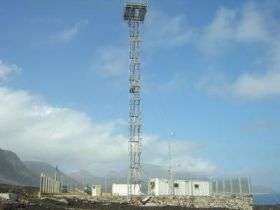
This image is of the Cape Verde Atmospheric Observatory, where instruments for monitoring the atmosphere are stationed. It has been operating for a year and the first year's data have shown vast ozone destruction across the tropical Atlantic. The instruments have also detected the reason for this loss. Credit: Dr Katie Read, University of York, UK.

Large amounts of ozone – around 50% more than predicted by the world's state-of-the-art climate models – are being destroyed in the lower atmosphere over the tropical Atlantic Ocean. Published today (26th June '08) in the scientific journal, Nature, this startling discovery was made by a team of scientists from the UK's National Centre for Atmospheric Science and Universities of York and Leeds. It has particular significance because ozone in the lower atmosphere acts as a greenhouse gas and its destruction also leads to the removal of the third most abundant greenhouse gas; methane.

The findings come after analysing the first year of measurements from the new Cape Verde Atmospheric Observatory, recently set up by British, German and Cape Verdean scientists on the island of Sγo Vicente in the tropical Atlantic. Alerted by these Observatory data, the scientists flew a research aircraft up into the atmosphere to make ozone measurements at different heights and more widely across the tropical Atlantic. The results mirrored those made at the Observatory, indicating major ozone loss in this remote area.

So, what's causing this loss? Instruments developed at the University of Leeds, and stationed at the Observatory, detected the presence of the chemicals bromine and iodine oxide over the ocean for this region. These chemicals, produced by sea spray and emissions from phytoplankton (microscopic plants in the ocean), attack the ozone, breaking it down. As the ozone is destroyed, a chemical is produced that attacks and destroys the greenhouse gas methane. Up until now it has been impossible to monitor the atmosphere of this remote region over time because of its physical inaccessibility. Including this new chemistry in climate models will provide far more accurate estimates of ozone and methane in the atmosphere and improve future climate predictions.

Professor Alastair Lewis, Director of Atmospheric Composition at the National Centre for Atmospheric Science and a lead scientist in this study, said: "At the moment this is a good news story – more ozone and methane being destroyed than we previously thought - but the tropical Atlantic cannot be taken for granted as a permanent 'sink' for ozone. The composition of the atmosphere is in fine balance here- it will only take a small increase in nitrogen oxides from fossil fuel combustion, carried here from Europe, West Africa or North America on the trade winds, to tip the balance from a sink to a source of ozone"

Professor John Plane, University of Leeds said: "This study provides a sharp reminder that to understand how the atmosphere really works, measurement and experiment are irreplaceable. The production of iodine and bromine mid-ocean implies that destruction of ozone over the oceans could be global".

Dr Lucy Carpenter, University of York and UK co-ordinator of the Observatory added: "This observatory is a terrific facility that will enable us to keep an eye on the chemical balance of the atmosphere and feed this information into global climate models to greatly improve predictions for this region in the future".

Source: The National Centre for Atmospheric Science


print this article email this article download pdf blog this article bookmark this article     Stumble it Digg this share on Facebook retweet share on Reddit add to delicious
Rate this story - 4.3 /5 (10 votes)

Rank Filter

Move the slider to adjust rank threshold, so that you can hide some of the comments.


Display comments: newest first

  • jeffsaunders - Jul 16, 2008
    • Rank: not rated yet
    If destroying ozone is a good thing then I better eat my hat. Less ozone means more cosmic rays as well as less methane.

    Looks like every cloud has a lot more than a silver lining.

June 25, 2008 all stories

Comments: 1

4.3 /5 (10 votes)
  • Stumble this up

  • Digg this

  • share this

  • hide
  • Related Stories


  • hide
  • Relevant PhysicsForums posts

  • Rocks
    created 17 hours ago
  • Himalayan glaciers
    created Nov 11, 2009
  • upcoming GRL paper shows CO2 fraction is constant
    created Nov 11, 2009
  • Is there a point to buying organic?
    created Nov 11, 2009
  • More from Physics Forums - Earth

Other News

Research gives new insights into 4 billion year-old meteorites

Research gives new insights into 4 billion year-old meteorites

Space & Earth / Astronomy

created 29 minutes ago | popularity not rated yet | comments 0

(PhysOrg.com) -- Scientists have gained new insight into the makeup of ancient meteorites called Carbonaceous Chondrites, in research published in the October edition of the journal Earth Science and Planetary Le ...


NASA to Begin Attempts to Free Sand-Trapped Mars Rover

NASA to Begin Attempts to Free Sand-Trapped Mars Rover

Space & Earth / Space Exploration

created 1hour ago | popularity not rated yet | comments 0

(PhysOrg.com) -- NASA will begin transmitting commands to its Mars exploration rover Spirit on Monday as part of an escape plan to free the venerable robot from its Martian sand trap.


First view of Earth as Rosetta approaches home

First view of Earth as Rosetta approaches home

Space & Earth / Space Exploration

created 53 minutes ago | popularity 3 / 5 (1) | comments 0

(PhysOrg.com) -- This spectacular image of our home planet was captured by the OSIRIS instrument on ESA's Rosetta comet chaser earlier today as the spacecraft approached Earth for the third and final swingby. ...


Rich countries 'should pay' to transfer low carbon technology

Rich countries 'should pay' to transfer low carbon technology, researchers says

Space & Earth / Environment

created 37 minutes ago | popularity not rated yet | comments 0

(PhysOrg.com) -- Rich countries need to pay the full incremental cost of low carbon technology for developing countries to avoid dangerous climate change, say Oxford University researchers.


Leonid meteor shower peaks Tuesday, Nov. 17

Leonid meteor shower peaks Tuesday, Nov. 17 (w/ Video)

Space & Earth / Space Exploration

created 13 minutes ago | popularity not rated yet | comments 0

(PhysOrg.com) -- The Leonid meteor shower best viewing this year will be in the hours before dawn on Nov. 17.