Protein discovery may bolster antibiotic development
June 25, 2008 Protein discovery may bolster antibiotic development

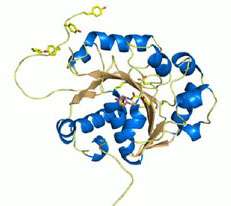
Biochemistry professor Zongchao Jia's lab has discovered the 3-D structure of an elusive bacterial enzyme. Courtesy: Queens University

A team of scientists from Queen’s University has discovered the first ever three-dimensional structure of a protein family that may help in developing more effective antibiotics.

Led by Biochemistry professor Zongchao Jia, an expert in protein crystallography, the team’s focus is on an enzyme called tyrosine kinase derived from bacteria. “For years, bacteria were thought to have less sophisticated signaling systems than those found in mammals,” says Dr. Jia, Canada Research Chair in Structural Biology. “But now we know that isn’t true.”

The findings are published in the prestigious journal, EMBO J, and are featured as an Editors’ Choice in the current edition of Science. Also on the team from the Queen’s Biochemistry Department are Daniel Lee and Jimin Zheng, and Dr. Yi-Min She from the Chemistry Department.

The Queen's team created a crystal that provided the first glimpse of the elusive kinase structure. This is considered a milestone as the bacterial enzyme shows a completely different structure from kinases found in mammals.

Kinases are enzymes responsible for regulating or controlling a protein's function, most often acting as a switch signal between "on" and "off". By adding the appropriate amount of phosphate to its own protein "tail" this particular enzyme will turn on. Using the same strategy, the enzyme regulates the assembly of the protective bacterial capsule, which also contributes to antibiotic resistance.

Finding the crystal that would explain this process proved to be a considerable challenge, the researchers acknowledge. A laboratory at the University of Michigan, pursuing the same crystal, sent a letter of congratulations when they learned the Queen’s lab had succeeded first. “That doesn’t always happen in our competitive world!” says Dr. Jia with a laugh.

Source: Queens University


print this article email this article download pdf blog this article bookmark this article     Stumble it Digg this share on Facebook retweet share on Reddit add to delicious
Rate this story - 5 /5 (3 votes)


June 25, 2008 all stories

Comments: 0

5 /5 (3 votes)
  • Stumble this up

  • Digg this

  • share this

  • hide
  • Related Stories


  • hide
  • Relevant PhysicsForums posts

  • Chemical Burns
    created 10 hours ago
  • How to prevent another stroke?
    created Nov 11, 2009
  • Swine flu vaccination
    created Nov 10, 2009
  • Improving the brain through chemistry
    created Nov 07, 2009
  • More from Physics Forums - Medical Sciences

Other News

Scientists put interactive flu tracking at public's fingertips

Scientists put interactive flu tracking at public's fingertips

Medicine & Health / Diseases

created 34 minutes ago | popularity 4 / 5 (1) | comments 0

New methods of studying avian influenza strains and visually mapping their movement around the world will help scientists more quickly learn the behavior of the pandemic H1N1 flu virus, Ohio State University ...


Migraine raises risk of most common form of stroke

Medicine & Health / Diseases

created 17 minutes ago | popularity not rated yet | comments 0

Pooling results from 21 studies, involving 622,381 men and women, researchers at Johns Hopkins have affirmed that migraine headaches are associated with more than twofold higher chances of the most common kind of stroke: ...


Early end to key study on benefits of niacin, a B vitamin, in keeping arteries open was premature

Medicine & Health / Research

created 53 minutes ago | popularity not rated yet | comments 0

Heart experts at Johns Hopkins are calling premature the early halt of a study by researchers at Walter Reed Army Medical Center and Washington Hospital Center on the benefits of combining extended-release niacin, a B vitamin, ...


Sexually spread diseases up, better testing cited

Medicine & Health / Diseases

created 17 minutes ago | popularity not rated yet | comments 0

(AP) -- Sexually spread diseases continue to rise, with reported chlamydia cases setting yet another record in 2008, government health officials said Monday.


Skin color gives clues to health

Medicine & Health / Research

created 17 minutes ago | popularity not rated yet | comments 0

Researchers from the universities of Bristol and St. Andrews in the UK have found that the color of a person's skin affects how healthy and therefore attractive they appear, and have found that diet may be crucial to achieving ...