Physicists Produce Quantum-Entangled Images
June 25, 2008
Physicists Produce Quantum-Entangled Images

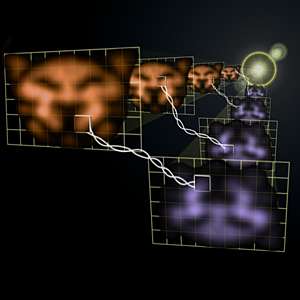
In this photo montage of actual quantum images, two laser beams coming from the bright glare in the distance transmit images of a cat-like face at two slightly different frequencies (represented by the orange and the purple colors). The twisted lines indicate that the seemingly random changes or fluctuations that occur over time in any part of the orange image are strongly interconnected or “entangled” with the fluctuations of the corresponding part in the purple image. Though false color has been added to the cats’ faces, they are otherwise actual images obtained in the experiment. Credit: NIST

Using a convenient and flexible method for creating twin light beams, researchers from the National Institute of Standards and Technology (NIST) and the University of Maryland (UM) have produced “quantum images,” pairs of information-rich visual patterns whose features are “entangled,” or inextricably linked by the laws of quantum physics.

In addition to promising better detection of faint objects and improved amplification and positioning of light beams, the researchers’ technique for producing quantum images—unprecedented in its simplicity, versatility, and efficiency—may someday be useful for storing patterns of data in quantum computers and transmitting large amounts of highly secure encrypted information. The research performed at the NIST/UM Joint Quantum Institute (JQI) was described in the June 12 edition of Science Express.*

Conventional photographic films or digital camera sensors only record the color and intensity of a light wave striking their surfaces. A hologram additionally records a light wave’s “phase”—the timing the crests and valleys in the wave. However, much more happens in a light wave. Even the most stable laser beam brightens and dims randomly over time because light has inherent quantum level “uncertainties” in its properties. Controlling these fluctuations—which represent a sort of “noise”—can improve detection of faint objects, produce better amplified images and allow workers to more accurately position laser beams. Researchers can’t completely eliminate the noise, but they can rearrange it to improve desired features in images. A quantum-mechanical technique called “squeezing” lets physicists reduce noise in one property—such as intensity—at the expense of increasing the noise in a complementary property, such as phase. In addition to noise reduction, the quantum manipulations open new applications for images—such as transferring heaps of encrypted data protected by the laws of quantum mechanics and performing parallel processing of information for quantum computers.

The quantum images produced by the JQI team are in “entangled” pairs, transmitted by two light beams originating from the same point. Look at one quantum image, and it displays random and unpredictable changes over time. Look at the other image, and it exhibits very similar random fluctuations at the same time, even if the two images are far apart and unable to transmit information to one another. Together, they are squeezed: Matching up both quantum images and subtracting their fluctuations, their noise is lower—and their information content potentially higher—than it is from any two classical images. Each image is made of up to 100 distinct regions, akin to the pixels forming a digital image, each with its own independent optical and noise properties. A pixel on one image forms a partnership with a pixel on the other image—one could predict many of the properties in the second pixel just by looking at the first.

Previous efforts at making quantum images have been limited to building them up with “photon counting”—collecting one photon at a time over a long period of time—or having very specialized “images” such as something that could only be constructed from a dot and a ring. In contrast, the new method produces an entire image at one time and can make a wide variety of images in any shape. A next goal for the researchers is to produce quantum images with slowed-down light; such slowed images could be used in information storage and processing as well as communications applications.

Source: NIST

4.1 /5 (34 votes)  

Filter


Move the slider to adjust rank threshold, so that you can hide some of the comments.


Display comments: newest first

Glis
Jun 25, 2008

Rank: not rated yet
Wasn't this posted a few weeks ago?
belmondo
Jun 26, 2008

Rank: not rated yet
that's correct
gmurphy
Jun 26, 2008

Rank: not rated yet
this happens occasionally and usually to stories about quantum mechanics.
thales
Jun 26, 2008

Rank: not rated yet
Yeah, this story got entangled with that story. What's strange is this one came FIRST. Spooky, huh?
hibiscus
Jun 30, 2008

Rank: not rated yet
there goes causality
holoman
Jun 30, 2008

Rank: not rated yet
Repeat news and the idea isn't even new.

http://www.coloss...gled.htm
Rank 4.1 /5 (34 votes)
Relevant PhysicsForums posts
  • Pure energy
    created4 hours ago
  • How to remove the magnetic property for screw driver?
    created7 hours ago
  • How to magnetize a concrete wall?
    created11 hours ago
  • Upward speed of an object in water
    created12 hours ago
  • flipping quarks
    created12 hours ago
  • partial derivation question
    created12 hours ago
  • More from Physics Forums - General Physics

More news stories

Australians risking skin cancer to avoid nanoparticles

More than three in five Australians are concerned enough about the health implications of nanoparticles in sunscreens to want to know more about their impact. And while the initial scientific information released suggests ...

Nanotechnology / Bio & Medicine

created 9 minutes ago | popularity not rated yet | comments 0

Inspired by steel, nanomanufacturing gets wear-resistant carbide tip

(PhysOrg.com) -- Scientists at the University of Pennsylvania, the University of Wisconsin-Madison and IBM Research - Zurich have fabricated an ultrasharp silicon carbide tip possessing such high strength ...

Nanotechnology / Nanophysics

created 1 hour ago | popularity not rated yet | comments 1 | with audio podcast

New kind of solar cell could capture significantly more energy than current cells

New solar cells could increase the maximum efficiency of solar panels by over 25%, according to scientists from the University of Cambridge.

Nanotechnology / Nanophysics

created 23 hours ago | popularity 4.3 / 5 (8) | comments 14 | with audio podcast

'Shish kebab' structure provides improved form of 'buckypaper'

Scientists are reporting development of a new form of buckypaper, which eliminates a major drawback of these sheets of carbon nanotubes -- 50,000 times thinner than a human hair, 10 times lighter than steel, ...

Nanotechnology / Nanomaterials

created 20 hours ago | popularity 1 / 5 (1) | comments 0 | with audio podcast

Will bubble-powered microrockets zoom through the human stomach?

Scientists have developed a new kind of tiny motor — which they term a "microrocket" — that can propel itself through acidic environments, such as the human stomach, without any external energy source, ...

Nanotechnology / Nanomaterials

created 21 hours ago | popularity 5 / 5 (1) | comments 0


New Zealand team finds early plant arrivers dominated landscape

(PhysOrg.com) -- It seems intuitive that not all plant species could have taken a foothold on land at the same time all those millions of years ago as conditions on Earth evolved to the point where they could survive; some ...

Black holes and star formation

(PhysOrg.com) -- It has long been recognized that galaxy mergers or even close interactions can play a vital role in shaping the morphology of galaxies. One way they can do so, it is thought, is by triggering ...

Deciding to go left or right: Researchers use device to determine that lower animals can navigate too

For decades, scientists have associated binary decision making — opting to go left or right — with higher-ranking animals, including humans. A team of Harvard researchers, however, is rewriting that ...

New target for Alzheimer's drugs

(Medical Xpress) -- Biomedical scientists at the University of California, Riverside have identified a new link between a protein called beta-arrestin and short-term memory that could open new doors for the ...

Chemists harvest light to create 'green' tool for pharmaceuticals

(PhysOrg.com) -- A team of University of Arkansas researchers, including an Honors College undergraduate student, has created a new, "green" method for developing medicines. The researchers used energy from ...

Researchers develop gene therapy to boost brain repair for demyelinating diseases

(Medical Xpress) -- Our bodies are full of tiny superheroes—antibodies that fight foreign invaders, cells that regenerate, and structures that ensure our systems run smoothly. One such structure is myelin—a ...