Avalanche photodiodes target bioterrorism agents
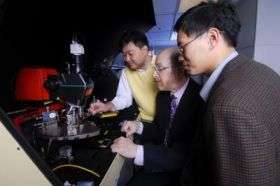
Researchers have shown that a new class of ultraviolet photodiode could help meet the U.S. military's pressing requirement for compact, reliable and cost-effective sensors to detect anthrax and other bioterrorism agents in the air.
"The military is currently using photomultiplier tubes, which are bulky, fragile and require a lot of power to run them, or silicon photodiodes that require a complex filter so that they only detect the desired ultraviolet light," said Russell Dupuis, Steve W. Chaddick Endowed Chair in Electro-Optics in Georgia Tech's School of Electrical and Computer Engineering (ECE) and a Georgia Research Alliance Eminent Scholar.
New research shows that ultraviolet avalanche photodiodes offer the high gain, reliability and robustness needed to detect these agents and help authorities rapidly contain an incident like the 2001 anthrax attacks. The fabrication methods and device characteristics were described at the 50th Electronic Materials Conference in Santa Barbara on June 25. Details of the photodiodes were also published in the February 14 issue of the journal Electronics Letters and the November 2007 issue of the journal IEEE Photonics Technology Letters.
ECE associate professor Douglas Yoder, assistant professor Shyh-Chiang Shen and senior research engineer Jae-Hyun Ryou collaborated on this research, which is funded by the Defense Advanced Research Projects Agency (DARPA) and the Georgia Research Alliance.
The team chose to develop avalanche photodiodes for this bioterrorism application because the devices can detect the signature fluorescence of biological molecules in a sample of air. Since most of the molecules of interest to the researchers emit ultraviolet light, they designed special photodiodes that detect the fluorescence in the ultraviolet region, but have no response to visible light.
"We built our photodiodes with gallium nitride, which is a semiconductor that can be used to create photodiodes that require no filters because this material has an inherent response to ultraviolet, but no response to visible light or solar flux," explained Dupuis.
To improve the sensitivity at ultraviolet wavelengths, the researchers designed the gallium nitride photodiodes to operate in a mode that employs avalanche multiplication. The avalanche multiplication phenomenon is used to multiply normally tiny currents by factors of up to one million, thus dramatically increasing the device gain.
Avalanche photodiodes can create much larger currents for each photon compared to normal photodiodes. Once the necessary electric field strength has been achieved inside the device, the avalanche effect starts with just one free electron. Since the illuminated photodiode will contain many free electrons, an avalanche will always occur if the electric field is large enough.
"One electron-hole pair that is produced by a photon absorption event creates a million other electron-hole pairs and the current becomes a pulse of current that you can detect with special electronics," added Dupuis.
The researchers fabricated high-performance gallium nitride ultraviolet avalanche photodiodes on bulk gallium nitride substrates that demonstrate optical gains of 100,000 at ultraviolet wavelengths from 280 to 360 nanometers.
The gallium nitride device structures were grown by metalorganic chemical vapor deposition, a technique for depositing thin layers of atoms onto a semiconductor wafer. Many layers can be built up, each of a precisely controlled thickness and composition, to create a material which has specific optical and electrical properties. This is the first time gallium nitride was successfully used in the fabrication of photodiodes having ultraviolet optical gains greater than 10,000.
Since demonstrating the feasibility of the photodiodes to exhibit the avalanche effect, the research team has been developing a more advanced structure capable of operating as a Geiger-mode detector, so that the photodiodes are sensitive enough to detect only one photon at a time. When the Geiger-mode detector is connected to the avalanche circuitry, a single electron-hole pair can trigger a strong avalanche current to flow from just one photon.
Yoder, who works on Georgia Tech's Savannah, Ga. campus, is developing computer models of the new photodiodes to calculate the detailed electronic and optical transport. Yoder's goal is to optimize the materials and design of the Geiger-mode avalanche detector to assure optimal, reproducible performance of the avalanche photodiodes.
"Doug's work is pivotal because these applications don't require one working detector, they might require thousands of uniform detectors in the same chip that all function the same way, so our ability to manufacture identical photodiodes and detectors is important," said Dupuis.
With proper manufacturing, these avalanche photodiodes can be used for more than detecting bioterrorism agents. They can also be used detect fires, gun muzzle flashes, missile propulsion flames and maybe even cancer cells, according to Dupuis.
Source: Georgia Institute of Technology Research News


