Exposing the Sensitivity of Extreme Ultraviolet Photoresists
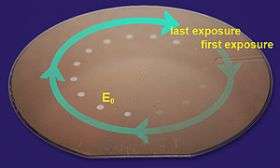
Researchers at the National Institute of Standards and Technology (NIST) have confirmed that the photoresists used in next-generation semiconductor manufacturing processes now under development are twice as sensitive as previously believed. This finding, announced at a workshop last month,* has attracted considerable interest because of its implications for future manufacturing. If the photoresists are twice as sensitive as previously thought, then they are close to having the sensitivity required for high volume manufacturing, but the flip side is that the extreme ultraviolet optical systems in the demonstration tools currently being used are only about half as effective as believed.
Extreme ultraviolet lithography (EUVL) is a process analogous to film photography. A silicon wafer is coated with photoresist and exposed to EUV light that reflects off a patterned “photomask.” Where the light strikes the resist it changes the solubility of the coating. When developed, the soluble portions wash away leaving the same pattern exposed on the silicon surface for the processing steps that ultimately create microcircuits.
The drive to make circuits with ever smaller features has pushed manufacturers to use shorter and shorter wavelengths of light. EUVL is the next step in this progression and requires developing both suitable light sources and photoresists that can retain the fine details of the circuit, balancing sensitivity, line edge roughness and spatial resolution. NIST researcher Steve Grantham says that optical lithography light sources in use today emit light with a wavelength of about 193 nanometers, which borders on optical wavelengths. EUVL sources produce light with wavelengths about an order of magnitude smaller, around 13.5 nanometers. Because this light does not travel through anything—including lenses—mirrors have to be used to focus it.
Until recently, EUV photoresist sensitivity was referenced to a measurement technique developed at Sandia National Labs in the 1990s. Late in 2007, scientists at the Advanced Light Source at Lawrence Berkeley National Laboratory in Berkeley, Calif., used a NIST-calibrated photodetector to check the standard. Their detector-based measurements indicated that the resist’s sensitivity was about twice that of the resist-based calibration standard.
Following on the intense interest that these results generated when the Berkeley group presented them at a conference in February, the Intel Corporation asked scientists at NIST to make their own independent determination of the EUVL resist sensitivity to validate the results. Measurements conducted at the NIST SURF III Synchrotron Ultraviolet Radiation Facility agreed with those of the Berkeley group. The fact that the photoresist is now known to be twice as sensitive to the EUV light implies that half as much light energy as had been expected is arriving at the wafer.
“These results are significant for a technology that faces many challenges before it is slated to become a high-volume manufacturing process in 2012,” Grantham says. “It should open the eyes of the industry to the need for accurate dose metrology and the use of traceable standards in their evaluations of source and lithography tool performance.”
Source: NIST


