Standards Set for Energy-Conserving LED Lighting
June 26th, 2008 Standards Set for Energy-Conserving LED Lighting

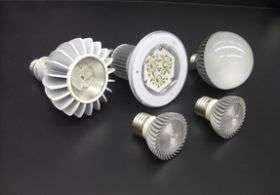
These solid-state lights are powered by energy-efficient light emitting diodes and are among the first ones of a new generation expected to cut energy needed for lighting by 50 percent by 2027. Credit: NIST

Scientists at the National Institute of Standards and Technology (NIST), in cooperation with national standards organizations, have taken the lead in developing the first two standards for solid-state lighting in the United States. This new generation lighting technology uses light-emitting diodes (LEDs) instead of incandescent filaments or fluorescent tubes to produce illumination that cuts energy consumption significantly.

Standards are important to ensure that products will have high quality and their performance will be specified uniformly for commerce and trade. These standards—the most recent of which published last month—detail the color specifications of LED lamps and LED light fixtures, and the test methods that manufacturers should use when testing these solid-state lighting products for total light output, energy consumption and chromaticity, or color quality.

Solid-state lighting is expected to significantly reduce the amount of energy needed for general lighting, including residential, commercial and street lighting. “Lighting,” explains NIST scientist Yoshi Ohno, “uses 22 percent of the electricity and 8 percent of the total energy spent in the country, so the energy savings in lighting will have a huge impact.”

Solid-state lighting is expected to be twice as energy efficient as fluorescent lamps and 10 times more efficient than incandescent lamps, although the current products are still at their early stages. Ohno chaired the task groups that developed these new standards.

In addition to saving energy, the new lighting, if designed appropriately, can produce better color rendering—how colors of objects look under the illumination—than fluorescent lamps or even incandescent lamps, Ohno says.

NIST is working with the U.S. Department of Energy (DOE) to support its goal of developing and introducing solid-state lighting to reduce energy consumption for lighting by 50 percent by the year 2025. The department predicts that phasing in solid-state lighting over the next 20 years could save more than $280 billion in 2007 dollars.

The Illuminating Engineering Society of North America (IESNA) published a documentary standard LM-79, which describes the methods for testing solid-state lighting products for their light output (lumens), energy efficiency (lumens per watt) and chromaticity. Details include the environmental conditions for the tests, how to operate and stabilize the LED sources for testing and methods of measurement and types of instruments to be used.

“More standards are needed, and this will be the foundation for all solid-state lighting standards,” Ohno says. The standard is available from the IESNA.

The solid-state lights being studied are intended for general illumination, but white lights used today vary greatly in chromaticity, or specific shade of white. The American National Standards Institute (ANSI) published the standard C78.377-2008, which specifies the recommended color ranges for solid-state lighting products using cool to warm white LEDs with various correlated color temperatures. The standard may be downloaded from ANSI’s Web site. http://www.nema.org/stds/ANSI-ANSLG-C78-377.cfm

DOE is launching the Energy Star program for solid-state lighting products this fall. NIST scientists assisted DOE by providing research, technical details and comments for the Energy Star specifications. The Energy Star certification assures consumers that products save energy and are high quality and also serves as an incentive for manufacturers to provide energy-saving products for consumers.

The solid-state lighting community is continuing to develop LED lighting standards for rating LED lamp lifetime and for measuring the performance of the individual high-power LED chips and arrays. NIST scientists are taking active roles in these continuing efforts.

Source: NIST


print this article email this article download pdf blog this article bookmark this article     Digg this Stumble it share on Facebook share on Reddit add to delicious save to Yahoo! bookmarks
4.6/5 after 20 votes

Rank Filter

Move the slider to adjust rank threshold, so that you can hide some of the comments.


Display comments: newest first

  • 1bigschwantz - Jun 26, 2008
    • Rank: 5 / 5 (1)
    Id rather go with an LED light than a CF.
    LED's should last al-lot longer than any other light. But cost is going to be a big factor.
  • earls - Jun 26, 2008
    • Rank: 4.7 / 5 (3)
    Com'on now, what's wrong with a little mercury poisoning? So you have a few crazy tea parties every now and then - who doesn't?!
  • Corvidae - Jun 27, 2008
    • Rank: 4 / 5 (2)
    They need to work on the cost of LED bulbs. Replacing the CF grow lights I use now with LED would only save me a hundred or so watts. Plus I'm doubting the LEDs are going to have even the intensity of CF bulbs, let alone a comparison to MH.
  • gopher65 - Jun 27, 2008
    • Rank: 4.5 / 5 (2)
    True Corvidae, but the advantages of LED over CFL bulbs aren't limited to energy savings. CFL bulbs have a poor colour temp, 1/5 the lifespan (at maximum), and they're extremely fragile. You could toss an LED down from orbit in an uncontrolled reentry, stop on it with an elephant, and then, get this, *use it under standard outdoor conditions*(!), and it would still work for 50 years:P.

    CFLs take 5 minutes to fully warm up, LEDs are faster than incandescents. CFLs can't be used outside in even a moderately cold climate, LEDs can (same with fridges and ovens). CFLs require a cool-down after you switch them off (else their lifetime is shot to heck; they often have a shorter lifespan than incandescent bulbs if used in a normal usage pattern rather than in a lab setting), while LEDs can be flipped on and off for their entire lifetime without damage.

    LEDs cost more, but they are superior to CFLs in every way imaginable. CFLs are a garbage technology that should never have been developed. I hope that LEDs come down in price, but even if they don't, they are still the better buy.
  • DGBEACH - Jun 27, 2008
    • Rank: 5 / 5 (2)
    Gopher you got it right, LEDs are the future, 'though I can imagine that they will be packaged alot differently than they are today.
    Alot of manufacturers are selling LEDs with ratings of tens-of-thousands of millicandelas, but with an effective aperture of only 15 degrees or so, which is totally useless for general lighting.
    They will have to match the illumination patterns of existing devices before they will be readily accepted. The latest 5-watt LEDs are pretty close to halogens in their lm/watts ratings, and I look forward to the next-gen 10 and even 50-watt LED.
  • DGBEACH - Jun 27, 2008
    • Rank: 5 / 5 (1)
    Dam...Edison Opto is selling a 20-watt LED now... The times they are a changing!
  • alarryone - Jun 28, 2008
    • Rank: 3 / 5 (1)
    The better quality CFLs have excellant CRI and come in a variety of color temps. I have been using enclosed CFLs outside sincs the late 1980s.To achieve a long life with any flourescent lamp requires a minimum of 3 hours of operation. Most LED that substitute for flourescent lamps right now are junk and that is why there needs to be standards created. I had one LED retro-fit salesman tell me that light output was not measured the same way as flourescent! Don't look for LED lamps in your oven too soon and they do use a power supply that is very heat sensitive. When the big manufacturers start selling reliable OLED lamps then we will have the best lighting in the world!
  • gopher65 - Jun 28, 2008
    • Rank: 4.5 / 5 (2)
    Naaa. The old magnetic fluorescents needed to be on for a long long time, but CFLs only need to be on for 5 minutes before they are shut off. But that's bad enough. Lets say I wander into my bathroom to wash my hands before supper. 30 seconds, tops. However, even so, which is better:

    CFL (minimum 5 minute run time): 300s*23watt = 6900ws consumed
    Incandescent: 30s*100watt = 3000ws consumed

    I have 2 lights which I leave on for long periods of time. These would do well as CFL bulbs. But every other light in my home gets flicked on and off like crazy, often just for a few seconds at a time.

    As I see it, any light which will be on for less than 90 seconds at a time, or which gets switched off and on a lot, shouldn't be a CFL. Having a government mandate that all lights should be CFLs really doesn't make sense because of that. Some lights should be, sure, but others shouldn't be.
  • bredmond - Jun 29, 2008
    • Rank: 5 / 5 (1)
    would LED lights be able to give me my daily dose of radiation? http://www.physor...673.html
    and help me with vitamin D?
    then i never have to go outside. i can just have everything delivered.
  • DGBEACH - Jun 30, 2008
    • Rank: 4.5 / 5 (2)
    Definately! In fact the latest models of "light box" (used for bouts of depression in Northern countries, such as here in Canada) are made with high-powered white LEDs. The beauty is that you can control the wavelengths alot easier than with incandescents.

    ..I am somewhat biased though -:)

    The sun beats'em all

June 26th, 2008 all stories
Electronics /

Comments: 10
Rank: 4.6/5 after 20 votes

  • Stumble this up

  • Digg this

  • Share it:
  • share on Facebook
  • share on MySpace
  • share on Slashdot
  • rss-newsfeed
  • share on Google
  • share on Reddit
  • add to delicious
  • save to Yahoo! bookmarks
  • share on Windows Live
  • Add to Mixx!
Rating: 4.6/5 after 20 votes

  • Related Stories

  • Breakthrough Technology Accelerates Solid-State Lighting
    created Apr 11, 2005 | popularity not rated yet | comments 0
  • Iconic skyscrapers find new luster by going green
    created Jul 05, 2009 | popularity not rated yet | comments 0
  • LED there be light
    created Jun 22, 2009 | popularity not rated yet | comments 0
  • Environmental program helps companies save energy
    created Jun 15, 2009 | popularity not rated yet | comments 0
  • Report: Bush admin's gas leases too close to parks
    created Jun 12, 2009 | popularity not rated yet | comments 0


  • Transform a ball into a rock -- or make it invisible -- using transformation optics
    Transform a ball into a rock -- or make it invisible -- using transformation optics
    Physics / General Physics
    created 8 hours ago | popularity 3 / 5 (2) | comments 0
  • Could a quantum motor do work?
    Physics / General Physics
    created Jul 07, 2009 | popularity 4 / 5 (12) | comments 0
  • Physicists Demonstrate Quantum Memory with Matter Qubits
    Physicists Demonstrate Quantum Memory with Matter Qubits
    Physics / General Physics
    created Jul 03, 2009 | popularity 4.5 / 5 (20) | comments 1
  • 'Holey' Nanosheets for Wastewater Dye Removal
    Nanotechnology / Nanomaterials
    created Jul 01, 2009 | popularity 5 / 5 (5) | comments 1
  • Jellyfish Robot Swims Like its Biological Counterpart
    Jellyfish Robot Swims Like its Biological Counterpart
    Electronics / Robotics
    created Jun 26, 2009 | popularity 4.4 / 5 (9) | comments 1
  • Other News

    Gadgets: Affordable, customized headphones that sound nice, too

    Electronics / Consumer & Gadgets

    created 19 hours ago | popularity not rated yet | comments 0

    You might think a customized set of headphones would cost an incredible amount of money, but that is not the case with iFrogz headphones.


    Robo-bats with metal muscles may be next generation of remote control flyers

    Robo-bats with metal muscles may be next generation of remote control flyers

    Electronics / Robotics

    created Jul 07, 2009 | popularity 4.4 / 5 (9) | comments 7

    Tiny flying machines can be used for everything from indoor surveillance to exploring collapsed buildings, but simply making smaller versions of planes and helicopters doesn't work very well. Instead, researchers ...


    A woman holds the new Amazon Kindle 2 at an unveiling event

    Amazon lowers Kindle e-book reader price to $299

    Electronics / Consumer & Gadgets

    created Jul 08, 2009 | popularity 5 / 5 (1) | comments 3

    (AP) -- Amazon.com Inc. has lowered the price of its Kindle electronic book reader by $60. It's now selling for $299, in an effort to attract more bookworms to the device.


    Netbooks now being sold like cell phones

    Electronics / Consumer & Gadgets

    created Jul 08, 2009 | popularity 4 / 5 (2) | comments 0

    If you walked into the right RadioShack store last weekend, you could get an Acer Aspire "netbook" computer for free. The catch: You would have to sign a two-year contract for mobile Internet service from AT&T, at $60 a month ...


    iPhone 3G S

    iPhone 3G S has slew of new features

    Electronics / Consumer & Gadgets

    created Jul 08, 2009 | popularity 3.3 / 5 (8) | comments 1

    If you've been thinking of buying an iPhone, the release of the iPhone 3G S makes it a lot easier to join Apple's telecom family. But if you already own an iPhone, deciding whether to buy this new model is ...