NASA Spacecraft Reveal Largest Crater in Solar System
June 26, 2008 Mars Reconnaissance Orbiter

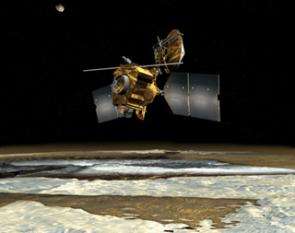
Mars Reconnaissance Orbiter reached its science orbit over Mars' poles on Sept. 11. The HiRISE camera and other experiments begin doing science in early November. (Artists' illustration: NASA)

New analysis of Mars' terrain using NASA spacecraft observations reveals what appears to be by far the largest impact crater ever found in the solar system

NASA's Mars Reconnaissance Orbiter and Mars Global Surveyor have provided detailed information about the elevations and gravity of the Red Planet's northern and southern hemispheres. A new study using this information may solve one of the biggest remaining mysteries in the solar system: why does Mars have two strikingly different kinds of terrain in its northern and southern hemispheres? The huge crater is creating intense scientific interest.

The mystery of the two-faced nature of Mars has perplexed scientists since the first comprehensive images of the surface were beamed home by NASA spacecraft in the 1970s. The main hypotheses have been an ancient impact or some internal process related to the planet's molten subsurface layers. The impact idea, proposed in 1984, fell into disfavor because the basin's shape didn't seem to fit the expected round shape for a crater. The newer data is convincing some experts who doubted the impact scenario.

"We haven't proved the giant-impact hypothesis, but I think we've shifted the tide," said Jeffrey Andrews-Hanna, a postdoctoral researcher at the Massachusetts Institute of Technology in Cambridge.

Andrews-Hanna and co-authors Maria Zuber of MIT and Bruce Banerdt of NASA's Jet Propulsion Laboratory in Pasadena, Calif., report the new findings in the journal Nature this week.

A giant northern basin that covers about 40 percent of Mars' surface, sometimes called the Borealis basin, is the remains of a colossal impact early in the solar system's formation, the new analysis suggests. At 5,300 miles across, it is about four times wider than the next-biggest impact basin known, the Hellas basin on southern Mars. An accompanying report calculates that the impacting object that produced the Borealis basin must have been about 1,200 miles across. That's larger than Pluto.

"This is an impressive result that has implications not only for the evolution of early Mars, but also for early Earth's formation," said Michael Meyer, the Mars chief scientist at NASA Headquarters in Washington.

This northern-hemisphere basin on Mars is one of the smoothest surfaces found in the solar system. The southern hemisphere is high, rough, heavily cratered terrain, which ranges from 2.5 to 5 miles higher in elevation than the basin floor.

Other giant impact basins have been discovered that are elliptical rather than circular. But it took a complex analysis of the Martian surface from NASA's two Mars orbiters to reveal the clear elliptical shape of Borealis basin, which is consistent with being an impact crater.

One complicating factor in revealing the elliptical shape of the basin was that after the time of the impact, which must have been at least 3.9 billion years ago, giant volcanoes formed along one part of the basin rim and created a huge region of high, rough terrain that obscures the basin's outlines. It took a combination of gravity data, which tend to reveal underlying structure, with data on current surface elevations to reconstruct a map of Mars elevations as they existed before the volcanoes erupted.

"In addition to the elliptical boundary of the basin, there are signs of a possible second, outer ring - a typical characteristic of large impact basins," Banerdt said.

Source: NASA


print this article email this article download pdf blog this article bookmark this article     Stumble it Digg this share on Facebook retweet share on Reddit add to delicious
Rate this story - 4.1 /5 (31 votes)

Rank Filter

Move the slider to adjust rank threshold, so that you can hide some of the comments.


Display comments: newest first

  • zevkirsh - Jun 26, 2008
    • Rank: 1 / 5 (1)
  • superhuman - Jun 26, 2008
    • Rank: 4 / 5 (2)
    How could Mars, itself 4250 miles in diameter, survive an impact of the body 1200 miles in diameter without being teared apart? And if it was teared apart then how was the crater rim preserved?
  • Corvidae - Jun 26, 2008
    • Rank: 4.3 / 5 (4)
    *Torn

    And I would suspect it would have to do with the majority of the core being molten or in some liquid state at the time. Impact velocity would also play a large part. It's a good question though, off the cuff it seems like a collision that would be on scale with the one that created our moon.
  • Mercury_01 - Jun 26, 2008
    • Rank: 4 / 5 (2)
    This may have been the disaster that caused the cooling of the planet and the stripping of it's atmosphere. It must have been a devistating display of power. An impact like that could likely alter mars' orbit and even it's electromagnetic field. I wonder if mars' moons origins have anything to do with this.
  • albert - Jun 26, 2008
    • Rank: not rated yet
    No Way! There must be a typo in this text. From Shoemaker's calculations of impact craters, I would guess that a 12 mile wide asteroid would do the trick, traveling at about 50,000 mph. I am certain this text is wrong.
  • brant - Jun 26, 2008
    • Rank: 2.3 / 5 (3)
    Not a meteor....

    An electric arc between 2 planetary bodies would do the trick.....

    Boy, that thing would be BIG......
  • Arikin - Jun 27, 2008
    • Rank: not rated yet
    3.9 billion years ago... Was Mars done forming at that time? Mostly solidified? If not would this affect the size of the crater?
  • Mercury_01 - Jun 27, 2008
    • Rank: not rated yet

    "An electric arc between 2 planetary bodies would do the trick...."

    Whoa, what??


  • seanpu - Jun 30, 2008
    • Rank: not rated yet
    "An electric arc between 2 planetary bodies would do the trick...."

    Probably.

    "We haven't proved the giant-impact hypothesis, but I think we've shifted the tide,"

    Science these days is all about *opinion* which makes it akin to a religion, not something based on facts.

June 26, 2008 all stories

Comments: 9

4.1 /5 (31 votes)
  • Stumble this up

  • Digg this

  • share this

  • hide
  • Related Stories

  • Mars: Chaotic terrain between Kasei Valles and Sacra Fossae
    created Nov 06, 2009 | popularity not rated yet | comments 0
  • Channels from Mars Hale Crater
    created Oct 28, 2009 | popularity not rated yet | comments 0
  • Searching for Alien Life, on Earth
    created Oct 05, 2009 | popularity not rated yet | comments 0
  • MESSENGER discovers an unusual impact basin on Mercury
    created Apr 30, 2009 | popularity not rated yet | comments 0
  • Scientists monitor developing Mars dust storm
    created Apr 20, 2009 | popularity not rated yet | comments 0


  • hide
  • Relevant PhysicsForums posts

  • The shape of our solar system's orbits.
    created Nov 07, 2009
  • Above or Below the Line of Nodes
    created Nov 07, 2009
  • Supernova vs. Nova?
    created Nov 07, 2009
  • Supernova's Gamma Rays and Comets
    created Nov 06, 2009
  • More from Physics Forums - General Astronomy

Other News

Antarctica glacier retreat creates new carbon dioxide store

Antarctica glacier retreat creates new carbon dioxide store

Space & Earth / Earth Sciences

created 2 hours ago | popularity 5 / 5 (1) | comments 1

Large blooms of tiny marine plants called phytoplankton are flourishing in areas of open water left exposed by the recent and rapid melting of ice shelves and glaciers around the Antarctic Peninsula. This ...


Success in 'space elevator' competition (AP)

Success in 'space elevator' competition (Update 3)

Space & Earth / Space Exploration

created Nov 05, 2009 | popularity 4.3 / 5 (33) | comments 53

(AP) -- A robot powered by a ground-based laser beam climbed a long cable dangling from a helicopter on Wednesday to qualify for prize money in a $2 million competition to test the potential reality of the ...


In a Galaxy Far, Far Away...

In a Galaxy Far, Far Away...

Space & Earth / Astronomy

created Nov 06, 2009 | popularity 4.8 / 5 (5) | comments 15

(PhysOrg.com) -- Astronomers have published the discovery of the farthest known object in the cosmos: a star that exploded when the universe was only 630 million years old -- only 4.6% of its current age. ...


'Dropouts' pinpoint earliest galaxies

'Dropouts' pinpoint earliest galaxies

Space & Earth / Astronomy

created Nov 06, 2009 | popularity 4.2 / 5 (10) | comments 13

Astronomers, conducting the broadest survey to date of galaxies from about 800 million years after the Big Bang, have found 22 early galaxies and confirmed the age of one by its characteristic hydrogen signature ...


Space hotel taking bookings for 2012 opening

Space hotel taking bookings for 2012 opening

Space & Earth / Space Exploration

created Nov 05, 2009 | popularity 4.4 / 5 (21) | comments 11

(PhysOrg.com) -- The first orbiting space hotel is on track to open for its first customers in 2012, but hurry, as bookings are filling fast.