Airless tire project may prove a lifesaver in military combat
Rarely does one come across a business where the phrase “reinventing the wheel” is not just a metaphor, it’s an operating principle.
An ambitious startup company in this central Wisconsin city is exploring that very challenge with a project to develop tires that can withstand extreme punishment, even those meted out in military combat zones.
Resilient Technologies, LLC is working on a four-year, $18 million project with the U.S. Department of Defense and the University of Wisconsin–Madison to research and develop a non-pneumatic tire for use on heavy-grade military vehicles such as Humvees. The project could literally be a lifesaver for the military: In many situations in Iraq, tires have proven to be weak links in Humvees that enemies target with improvised explosive devices (IEDs).
“You see reports all the time of troops who were injured by an IED or their convoys got stranded because their tires were shot out,” says Mike Veihl, general manager of Resilient. “There’s all sorts of armor on the vehicle, but if you’re running in the theater and get your tire shot out, what have you got? You’ve got a bunch of armor in the middle of a field.”
The company has made remarkable strides in just over two years of operations, cycling through literally hundreds of prototypes, developing subscale airless tires for lawn tractors, and finally the featured product: In April, Resilient installed a set of their creations on a Wausau-based National Guard Humvee, where it is undergoing rigorous on- and off-road tests.
Company reps say that Resilient’s partnership with UW–Madison’s Polymer Engineering Center (PEC) has played a major role in setting the high-speed development pace. The center serves as a subcontractor in the project and provides two graduate students under the general direction of mechanical engineering professor Tim Osswald.
In addition to conducting basic polymer research, the PEC works with dozens of companies, big and small, on materials testing and product development, says Osswald. The Resilient project presented one of the more complicated challenges his lab has seen, given the complete rethinking taking place in the design and the high levels of performance the tire must meet.
The Wisconsin design breakthrough, first developed by Resilient’s in-house design and development team, takes a page from nature. “The goal was to reduce the variation in the stiffness of the tire, to make it transmit loads uniformly and become more homogenous,” Osswald says. “And the best design, as nature gives it to us, is really the honeycomb.”
Osswald and graduate students Nick Newman and Eric Foltz ran tests and simulations that helped Resilient confirm the quality of its unique design concept. They also studied other airless tire designs, including Michelin’s “Tweel,” to determine their properties compared to the Resilient design.
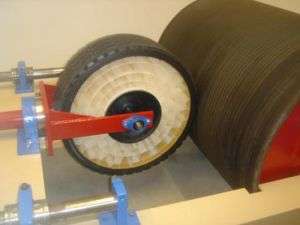
The patent pending Resilient design relies on a precise pattern of six-sided cells that are arranged, like a honeycomb, in a way that best mimics the “ride feel” of pneumatic tires. The honeycomb geometry also does a great job of reducing noise levels and reducing heat generated during usage - two common problems with past applications. “We definitely brainstormed,” says Foltz. “We wanted to create more of a matrix of cells within the tire, and it seemed kind of natural to go with the honeycomb’s hexagon shape. We tried some other shapes, such as diamond shapes, and they didn’t perform as well.”
Adds Newman: “Now that we’ve done this, it’s amazing to think that we were going from literally sketching designs on a piece of paper in June 2006 to having actual Humvees riding around on prototype tires in April 2008. In under two years, really functional tires were created.”
Earlier this month, Newman defended his master’s thesis that is based on his two years of research with Resilient.
Veihl says Resilient has developed into a full-service operation, with in-house facilities that can develop new materials and run them through a battery of physical and environmental tests. This month, the company is in the process of installing a massive flywheel device called an Akron Standard road wheel, which can inflict wear and tear on prototype tires, simulating hundreds of thousands of miles at interstate speeds.
But the UW–Madison experience is vital to the continuing project, Veihl says. The group holds weekly teleconferences, and Osswald has spent time at the company providing high-level polymer course work for Resilient’s engineers. Many of the same tests done in Wausau were done in parallel at UW–Madison to further validate outcomes.
“Number one, you have students who are fresh thinkers, they have no preconceived notion about what is the right answer or wrong answer,” he says. “And (Osswald) has given us the ability to dive into a lot of things much more quickly, because he’s seen so many things that we haven’t in working with these materials.”
With Foltz and Newman graduating, Osswald will continue the partnership this fall with two new graduate students. One project will be to evaluate sidewall designs, which will give the tire a more conventional look.
Veihl shares a strong enthusiasm for the company and what it could mean to the Wisconsin economy. Although the military application is the most urgent primary market, Veihl says the tire has potential for virtually any vehicle where a flat tire causes significant headaches. That includes ATVs, mining equipment, farm machinery and construction equipment. The passenger automobile industry may be on the horizon as well.
But right now, Veihl is concentrating on his customers at the National Guard, many of whom have seen tours of duty in Iraq and offer invaluable advice. “They will tell you the real deal, and they’re not shy about it. If we can develop a product that satisfies their requirements, then we’ve done our job.”
U.S. Rep. Dave Obey, D-Wis., was instrumental in getting Department of Defense support for the company, which is affiliated with another company in his district, WADAL Plastics, Inc.
“Developing tires that will allow vehicles to continue to roll no matter what is thrown at them — even roadside bombs — is a real priority for the military and could be the difference between life and death for our troops in the field,” says Obey.
Source: University of Wisconsin


