New nano technique significantly boosts boiling efficiency
June 26, 2008 New Nano Technique Significantly Boosts Boiling Efficiency

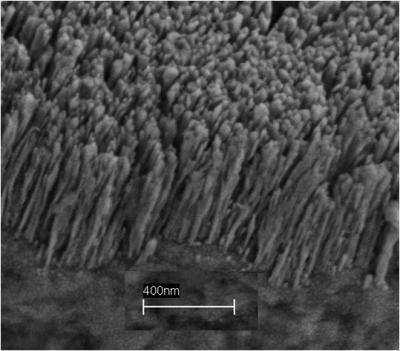
A scanning electron microscope shows copper nanorods deposited on a copper substrate. Air trapped in the forest of nanorods helps to dramatically boost the creation of bubbles and the efficiency of boiling, which in turn could lead to new ways of cooling computer chips as well as cost savings for any number of industrial boiling application. Credit: Rensselaer Polytechnic Institute/ Koratkar

Whoever penned the old adage "a watched pot never boils" surely never tried to heat up water in a pot lined with copper nanorods.

A new study from researchers at Rensselaer Polytechnic Institute shows that by adding an invisible layer of the nanomaterials to the bottom of a metal vessel, an order of magnitude less energy is required to bring water to boil. This increase in efficiency could have a big impact on cooling computer chips, improving heat transfer systems, and reducing costs for industrial boiling applications.

"Like so many other nanotechnology and nanomaterials breakthroughs, our discovery was completely unexpected," said Nikhil A. Koratkar, associate professor in the Department of Mechanical, Aerospace, and Nuclear Engineering at Rensselaer, who led the project. "The increased boiling efficiency seems to be the result of an interesting interplay between the nanoscale and microscale surfaces of the treated metal. The potential applications for this discovery are vast and exciting, and we're eager to continue our investigations into this phenomenon."

Bringing water to a boil, and the related phase change that transforms the liquid into vapor, requires an interface between the water and air. In the example of a pot of water, two such interfaces exist: at the top where the water meets air, and at the bottom where the water meets tiny pockets of air trapped in the microscale texture and imperfections on the surface of the pot. Even though most of the water inside of the pot has reached 100 degrees Celsius and is at boiling temperature, it cannot boil because it is surrounded by other water molecules and there is no interface — i.e., no air — present to facilitate a phase change.

Bubbles are typically formed when air is trapped inside a microscale cavity on the metal surface of a vessel, and vapor pressure forces the bubble to the top of the vessel. As this bubble nucleation takes place, water floods the microscale cavity, which in turn prevents any further nucleation from occurring at that specific site.

Koratkar and his team found that by depositing a layer of copper nanorods on the surface of a copper vessel, the nanoscale pockets of air trapped within the forest of nanorods "feed" nanobubbles into the microscale cavities of the vessel surface and help to prevent them from getting flooded with water. This synergistic coupling effect promotes robust boiling and stable bubble nucleation, with large numbers of tiny, frequently occurring bubbles.

"By themselves, the nanoscale and microscale textures are not able to facilitate good boiling, as the nanoscale pockets are simply too small and the microscale cavities are quickly flooded by water and therefore single-use," Koratkar said. "But working together, the multiscale effect allows for significantly improved boiling. We observed a 30-fold increase in active bubble nucleation site density — a fancy term for the number of bubbles created — on the surface treated with copper nanotubes, over the nontreated surface."

Boiling is ultimately a vehicle for heat transfer, in that it moves energy from a heat source to the bottom of a vessel and into the contained liquid, which then boils, and turns into vapor that eventually releases the heat into the atmosphere. This new discovery allows this process to become significantly more efficient, which could translate into considerable efficiency gains and cost savings if incorporated into a wide range of industrial equipment that relies on boiling to create heat or steam.

"If you can boil water using 30 times less energy, that's 30 times less energy you have to pay for," he said.

The team's discovery could also revolutionize the process of cooling computer chips. As the physical size of chips has shrunk significantly over the past two decades, it has become increasingly critical to develop ways to cool hot spots and transfer lingering heat away from the chip. This challenge has grown more prevalent in recent years, and threatens to bottleneck the semiconductor industry's ability to develop smaller and more powerful chips.

Boiling is a potential heat transfer technique that can be used to cool chips, Koratkar said, so depositing copper nanorods onto the copper interconnects of chips could lead to new innovations in heat transfer and dissipation for semiconductors.

"Since computer interconnects are already made of copper, it should be easy and inexpensive to treat those components with a layer of copper nanorods," Koratkar said, noting that his group plans to further pursue this possibility.

Source: Rensselaer Polytechnic Institute


print this article email this article download pdf blog this article bookmark this article     Stumble it Digg this share on Facebook retweet share on Reddit add to delicious
Rate this story - 4 /5 (47 votes)

Rank Filter

Move the slider to adjust rank threshold, so that you can hide some of the comments.


Display comments: newest first

  • superhuman - Jun 26, 2008
    • Rank: 2.6 / 5 (7)
    >"Like so many other nanotechnology and nanomaterials breakthroughs, our discovery was completely unexpected..."

    Only to complete ignorants. Molecular sieves and other highly porous materials has been used for precisely the same purpose for centuries.

    And no it wont revolutionize the process of cooling computer chips cause no one wants to have boiling pressurized water in their computer, especially when normal single phase water cooling is more then enough.

    >"If you can boil water using 30 times less energy, that's 30 times less energy you have to pay for,"

    And this is another appalling manipulation cause
    1. 30 times more bubble nucleation doesn't mean 30 times less energy needed for the water to boil,
    2. The energy needed for boiling (= final phase transition) of water is marginal comparable to the energy needed to heat the water to boiling temperature.

    And to think that this nano charlatan is an "associate professor in the Department of Mechanical, Aerospace, and Nuclear Engineering at Rensselaer"!
    Either he is SEVERELY misquoted or he is suffering from dementia and should be promptly fired.
  • gmurphy - Jun 27, 2008
    • Rank: not rated yet
    superhuman, I've found no reference to molecular sieves being used to reduce the energy needed to bring liquids to the boil. Please provide some evidence for this claim. Your point about the energy factor is quite valid but all scientists and academics are guilty of shameless self promotion, its human nature. You ought to chill out man.
  • superhuman - Jun 27, 2008
    • Rank: 1 / 5 (1)
    A common molecular sieve material - zeolite is even named after that effect.

    From http://en.wikiped.../Zeolite :
    "Zeolites (Greek, zein, "to boil"; lithos, "a stone") are hydrated aluminosilicate minerals and have a micro-porous structure.
    The term was originally coined in the 18th century by a Swedish mineralogist named Axel Fredrik Cronstedt who observed, upon rapidly heating a natural mineral, that the stones began to dance about as the water evaporated. Using the Greek words which mean "stone that boils," he called this material zeolite."

    The dancing is due to rapid bubble nucleation on the highly porous surface of zeolite.

    What pisses me off is that the role of science is to educate people and this site is doing exactly the opposite - it spreads misinformation and lies.
    By publishing such nonsense stories this supposedly pro-scientific site gives science a very bad reputation which is in my opinion undeserved.
  • Graeme - Jul 03, 2008
    • Rank: not rated yet
    And there have been boiling stone chips added to nucleate boiling in test tubes, they give off a stream on bubbles, rather than having the whole lot get pushed out by one huge expanding bubble when the water is overheated.

June 26, 2008 all stories

Comments: 4

4 /5 (47 votes)
  • Stumble this up

  • Digg this

  • share this

  • hide
  • Related Stories


  • hide
  • Relevant PhysicsForums posts

  • Some Explanation with Rigid Rotator
    created 1hour ago
  • How to Make a Ferrofluid?
    created 4 hours ago
  • avoidance of admitting that we dont know somethin
    created 10 hours ago
  • Speed of light : missing energy
    created 13 hours ago
  • Can light produce darkness and can noise procude quiteness 4
    created 16 hours ago
  • Magnetic Oscillation Equations
    created 22 hours ago
  • More from Physics Forums - General Physics

Other News

Nanoparticles used in common household items caused genetic damage in mice

Nanotechnology / Bio & Medicine

created Nov 16, 2009 | popularity 4.7 / 5 (22) | comments 11

Titanium dioxide (TiO2) nanoparticles, found in everything from cosmetics to sunscreen to paint to vitamins, caused systemic genetic damage in mice, according to a comprehensive study conducted by researchers at UCLA's Jonsson ...


Using superconducting probes to get a picture of what it's like inside CNTs

Nanotechnology / Nanophysics

created Nov 20, 2009 | popularity 4.9 / 5 (7) | comments 0

(PhysOrg.com) -- "Carbon nanotubes are exciting for fundamental physics, and for potential technological applications," Nadya Mason tells PhysOrg.com. "However, we are generally limited in the way that we can study them. ...


Nanotube defects equal better energy and storage systems

Nanotube defects equal better energy and storage systems

Nanotechnology / Nanomaterials

created Nov 19, 2009 | popularity 4.4 / 5 (9) | comments 2

(PhysOrg.com) -- Most people would like to be able to charge their cell phones and other personal electronics quickly and not too often. A recent discovery made by UC San Diego engineers could lead to carbon ...


When It Comes to Drug Delivery, Size Matters

Nanotechnology / Bio & Medicine

created Nov 20, 2009 | popularity 5 / 5 (1) | comments 0

(PhysOrg.com) -- One of the great promises of nanotechnologies lies in its ability to create drug-containing nanoparticles decorated with targeting molecules that recognize and bind to cancer cells, providing drug delivery ...


Scientists synthesize graphene-like material: Polymer with honeycomb structure

Scientists synthesize graphene-like material: Polymer with honeycomb structure

Nanotechnology / Nanomaterials

created Nov 19, 2009 | popularity 4.5 / 5 (6) | comments 1

Two-dimensional carbon layers, so-called graphenes, are regarded as a possible substitute for silicon in the semiconductor industry. The electronic properties of these layers can be varied by "building in" ...