Researchers create mercury-absorbent container linings for broken CFLs
June 27, 2008
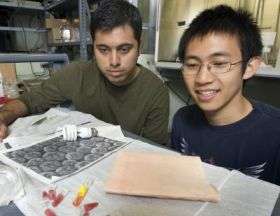
Brown University engineering students Love Sarin (left) and Brian Lee display a nanoselenium-enriched cloth that can capture mercury vapor from broken compact fluorescent lamps. Brown has applied for federal patents covering the invention and plans soon to begin commercial negotiations. Credit: John Abromowski, Brown University
With rising energy prices and greater concern over global warming, compact fluorescent lamps (CFLs) are having a successful run. Sales of the curlicue, energy-sipping bulbs, which previously had languished since they were introduced in the United States in 1979, reached nearly 300 million last year. Experts expect that figure to rise steeply by 2012, when a federal law requiring energy-efficient lighting goes into effect.
There's just one catch to this energy conservation story: Each CFL contains a small amount (3 to 5 milligrams) of mercury, a neurotoxin that can be released as vapor when a bulb is broken. The gas can pose a minor risk to certain groups, such as infants, small children and pregnant women. Mercury can escape from plastic bags containing discarded bulbs, which makes long-term storage, disposal or recycling tricky.
The obstacles have led to a debate over CFLs, illustrated by recent studies by the state of Maine and the nonprofit Mercury Policy Project over CFL use and safe levels of mercury in the bulbs. Now, a team of researchers at Brown University led by Robert Hurt, professor of engineering, and engineering student Natalie Johnson may have found a solution to the environmental conundrum.
The scientists, along with other Brown engineering students and Steven Hamburg, associate professor of environmental studies, have invented mercury-absorbent materials for commercial use. The team has created a prototype a mercury-capturing lining attached to the inside of store-bought CFL packaging. The packaging can be placed over the area where a bulb has been broken to absorb the mercury vapor emanating from the spill, or it can capture the mercury of a bulb broken in the box.
The researchers also have created a specially designed lining for plastic bags that soaks up the mercury left over from the CFL shards that are thrown away.
The mercury-absorbent packaging and the lined plastic bags can be safely discarded and recycled, the researchers say, alleviating concerns about contamination or other unwanted environmental consequences.
"It's a complete management system to deal with a bulb broken in the home," says Hurt, director of Brown's Institute for Molecular and Nanoscale Innovation, which concentrates on the study and commercial application of nanotechnology.
Brown applied earlier this year for federal patents covering the mercury-absorption packaging and the absorbent material, and the university expects soon to begin discussions with companies on manufacturing the new technology.
"These patents represent how Brown University translates fundamental research into an application that can have an impact on society in this case, a technology that could protect households from mercury exposure and that could also energize green business growth," says Clyde Briant, vice president for research at Brown.
The inspiration for the invention followed the discovery by Hurt, Johnson and fellow Brown researchers that a variant of a substance called nanoselenium a form of selenium, a trace element used in diet supplements, among other products absorbed virtually all the mercury emitted from a broken CFL. That finding appears this week in the online edition of Environmental Science & Technology. It is the first scientific paper that measures the timing and extent of mercury released from broken CFLs and that reveals the mercury-absorption potential of various nanomaterials, the researchers say.
The engineers tested 28 substances in all. Their experiments showed that one type of nanoselenium absorbed mercury vapor the most effectively. The selenium atoms bond with the mercury atoms to form mercury selenide (HgSe), a stable, benign nanoparticle compound, Hurt says.
The nanoselenium "just loves mercury," Hurt adds.
In controlled experiments, the scientists found that 99 percent of mercury vapor from a CFL broken in a sealed chamber was mopped up by nanoselenium in concentrations ranging from 1 to 5 milligrams.
The small amount needed to capture the mercury vapor bodes well for manufacturing mercury-absorbent cloths or lining at a low cost, Hurt says. The precise manufacturing costs will need to be determined by interested companies.
The National Institute of Environmental Health Sciences Superfund Basic Research Program funded the research.
The first prototype created by the Brown team is a three-layered cloth that is attached to the packaging or box containing the CFLs. The nanoselenium-coated layer would be sandwiched between the cardboard packaging and a cloth on the inside of the box containing the bulbs. The extra layers prevent people from coming into contact with the nanoselenium layer.
If a bulb breaks, the user simply undoes the packaging and lays it on the spot where the break occurred. The absorbent material is effective on different surfaces, including carpets and hardwood floors. "It works like a charm," Hurt says.
The second prototype incorporates the same layering and is fitted into a small, sealable plastic bag. The lining absorbs the mercury in the sealed bag, preventing it from escaping.
"More work is needed," Hurt says, "but this appears to be an inexpensive solution that can remove most of the safety concerns associated with CFL bulbs."
Source: Brown University
-
OpenDNS service is an alternative to major Internet providers
Apr 15, 2009 |
4 / 5 (4) |
1
-
Alternative LED lighting combats energy crisis
Nov 17, 2011 |
5 / 5 (5) |
8
-
Whitman faces big challenges at HP
Sep 28, 2011 |
not rated yet |
0
-
Future for incandescent light bulbs looking dim
Jul 22, 2011 |
5 / 5 (1) |
66
-
One reporter's look back at the space shuttle era
Jul 07, 2011 |
5 / 5 (1) |
0
-
Engineers build first sub-10-nm carbon nanotube transistor
Feb 01, 2012 |
4.9 / 5 (30) |
30
-
Something old, something new: Evolution and the structural divergence of duplicate genes
Jan 31, 2012 |
4.6 / 5 (7) |
1
-
The hidden nanoworld of ice crystals: Revealing the dynamic behavior of quasi-liquid layers
Jan 30, 2012 |
5 / 5 (3) |
1
-
Stock market network reveals investor clustering
Jan 27, 2012 |
3.9 / 5 (23) |
8
-
Of microchemistry and molecules: Electronic microfluidic device synthesizes biocompatible probes
Jan 26, 2012 |
5 / 5 (1) |
0
-
excited U-236 decay time in the U235 fission chain
18 hours ago
-
Polar catastrophe?
21 hours ago
-
Large scale field sonication
Feb 09, 2012
-
states and energy of paired electrons in BCS
Feb 08, 2012
-
difference between longitudinal and transverse refractive indices
Feb 08, 2012
-
Monte Carlo simulation
Feb 07, 2012
- More from Physics Forums - Atomic, Solid State, Comp. Physics
More news stories
Hovering not hard if you're top-heavy, researchers find
Top-heavy structures are more likely to maintain their balance while hovering in the air than are those that bear a lower center of gravity, researchers at New York University's Courant Institute of Mathematical Sciences ...
just added |
not rated yet |
0
|
SLAC, Stanford team focuses on high-energy electrons to treat cancer
Accelerator physicists at SLAC and cancer specialists from Stanford are working on a new technology that could dramatically reduce the time needed for cancer radiation treatments. The team ran an initial experiment ...
3 hours ago |
not rated yet |
0
Measurements from high-energy collisions lead to better understanding of why meson particles disappear
For several years, physicists at the Relativistic Heavy Ion Collider (RHIC) at Brookhaven National Laboratory (BNL), USA, have studied an unusual state of matter called the quarkgluon plasma, which they ...
3 hours ago |
not rated yet |
0
Quantum physicist explains $100K offer for proof scaled-up quantum computing is impossible
(PhysOrg.com) -- MIT researcher Scott Aaronson has certainly riled the physics community with his offer this past Friday, of $100,000 to anyone who can prove that scaled-up quantum computing is impossible. ...
Explained: Sigma
It's a question that arises with virtually every major new finding in science or medicine: What makes a result reliable enough to be taken seriously? The answer has to do with statistical significance -- but ...
Feb 09, 2012 |
5 / 5 (14) |
26
New understanding of DNA repair could eventually lead to cancer therapy
A research group in the Faculty of Medicine & Dentistry at the University of Alberta is hoping its latest discovery could one day be used to develop new therapies that target certain types of cancers.
Zuckerberg's focus drives Facebook's ascent
When Mark Zuckerberg showed up to rent Judy Fusco's Los Altos, Calif., house in the fall of 2004, soon after he'd arrived in Silicon Valley, the landlord was immediately struck by his confidence.
Both maternal and paternal age linked to autism
Older maternal and paternal age are jointly associated with having a child with autism, according to a recently published study led by researchers at The University of Texas Health Science Center at Houston (UTHealth).
Night, weekend delivery OK for babies with birth defects
Weekday delivery is no better than night or weekend delivery for infants with birth defects, according to a new study presented today at The Pregnancy Meeting, the Society for Maternal-Fetal Medicine's annual conference. ...
Sonic Cradle lands spot in TED exhibition
A Simon Fraser University graduate student project that melds music, meditation and modern technology has landed a rare spot as an exhibit at TEDActive 2012 in Palm Springs, California this month.
Drug halts organ damage in inflammatory genetic disorder
A new study shows that Kineret (anakinra), a medication approved for the treatment of rheumatoid arthritis, is effective in stopping the progression of organ damage in people with neonatal-onset multisystem inflammatory disease ...
Jun 27, 2008
Rank: 4 / 5 (4)
(And CFLs do NOT last 10x longer than incandescents in normal use, so replacement is not infrequent.)
Jun 27, 2008
Rank: 4.8 / 5 (4)
The following should be on the packaging. You can find it on a Fed website
http://www.ct.gov...p?a=2708&q=378846&depNav_GID=1763
Jun 27, 2008
Rank: 5 / 5 (3)
I hope LED bulbs come down in price soon.
Jun 27, 2008
Rank: 5 / 5 (3)
Agreed, this entire campaign of CFL "energy saving" bulbs has been a complete disaster since its inception.
But hey, at least it "feels good."
A very merry unbirthday to me...!
Jun 27, 2008
Rank: 4.3 / 5 (3)
Jun 27, 2008
Rank: 4 / 5 (2)
Great idea. I think coating the inside might impact the ionization of the gas by contaminating the partial vacuum. Coating the outside of the bulb would be better. It could be done by dipping the bulb into a vat of resin. This would not interfere with the ionization on the inside. The trade off is reduced luminosity of the bulb and added cost. Another idea would be to put a transparent airbag around the bulb. Airbags are great shock absorbers. The problem here is keeping the airbag pressurized. Most balloons allow seepage of the gas. The envelope could be made of Tedlar which is transparent and doesn't leak (used in airships). Heck if they can keep a bag of chips and soda bottle pressurized I think it should be possible using cheap soda bottle plastic. A pressue seal would be needed between the plastic envelope and the stem of the glass bulb.
Jun 27, 2008
Rank: 3.8 / 5 (4)
Jun 27, 2008
Rank: 4.5 / 5 (2)
Coating isn't a bad idea, but as mentioned, it would reduce the amount of light thereby requiring more energy.
Also, although they would excel in household scenarios, the coating may not survive improper disposal there by still leading to contamination.
It may in fact suggest the bulbs are now "safe" to "just throw away" leading to even greater nonchalant attitude towards the risk they pose.
Jun 27, 2008
Rank: 4 / 5 (2)
I can't stand CFLs. As soon as LED bulbs start appearing in supermarkets, I'm there, even if they cost way more.
Jun 28, 2008
Rank: 4 / 5 (3)
Then stop buying no-name shit CFLs. I've never had a CFL "burn out", ever. They just get dimmer with time and after a few years(about 10-20 k hours) when they start to get too dim you replace them.
Jun 28, 2008
Rank: 3.3 / 5 (3)
Here's a fun fact, you coal burning yanks release more mercury over the life of a CFL if you use incandecents.
Jun 28, 2008
Rank: 4 / 5 (1)
Second, most of the power around here is provided by either hydro or natural gas, with a proposed nuclear plant in the future. So there are no mercury emissions happening here. But yeah, if you use coal power, they you should do everything you can to decrease power consumption. Coal is truly disgusting stuff 0_0.
However. Coal plants don't get throttled. They burn at full steam all the time. So the only way a CFL actually causes less coal to be burned is if it stops another coal plant from being built. I have another solution to that one that doesn't involve using poison bulbs: stop the unnecessary construction of coal power plants. In most areas it is possible to construct something other than a coal plant. If it is, do so. Only build those nasty, dirty, dangerous coal plants when there is no other choice.
Jun 28, 2008
Rank: 4 / 5 (1)
In reality only 25% of the world's energy needs come from coal, and that includes the ginormous number of coal plants in places like China. So take that graph you always see and divide the incandescents' mercury output by 4. Reality looks a little bit different than the spin these companies are putting on their product, doesn't it?
Oh, I forgot to say this in my pervious post about this stuff: you're right about low quality CFLs. They definately "burn out" (dim to uselessness) faster than brandname ones. My most recent bulb is a 14 dollar bulb. Ouch, heh. 14 bucks for one bulb. LEDs can't be much more than that, even today:P.
Jun 28, 2008
Rank: 4 / 5 (2)
Jun 29, 2008
Rank: 3.7 / 5 (3)
That's not burning out; that's a slow and predictable loss of luminance and they clearly fulfill their rated life at acceptable output.
Electric power consumption is still heading upwards and looks set to increase faster now that oil is getting uncomfortably expensive(e.g. substitute for heating oil with heat pumps).
Under a climate of increasing electric power use it will be difficult to decommission the dirtiest, grandfathered coal plants which are far outside current regulations. If the power is really needed people are a lot less reticent to allow non-sequestering new coal-fired generation.
Coal power is still the cheapest source as long as it gets a license to kill(about 20k people from COPD and lung cancer on average 14 years in advance according to the EPA) and a license to pollute; call me a cynic, but I don't think this is about to change even if nuclear is only slighty more expensive and takes good care of its waste.
Jun 29, 2008
Rank: 3.5 / 5 (2)
That may as well be, but it is still true at the 50% coal mix as used in the US with decent CFLs; and this is before you account for the fact that much of the mercury goes into the land-fills instead of being dispersed into the air(which I believe is a modest improvement) and before you count cadmium, coal particulates and other nastiness.
That's not electric power generation, that's all use including vehicles, which don't use coal at all, and process heat, which mostly uses natural gas.
Coal-fired generation accounted for over 40% of electricity generation world wide in 2004 and I believe it has increased since, along with natural gas turbines.
Where can I pick up LEDs with a 5800 K colour temperature to replace my (not compact) flourescents? I can't stand that awful yellow crap.
Jun 29, 2008
Rank: 5 / 5 (3)
I think if people knew just how bad coal *really* was in comparison to nuclear, there wouldn't be a coal plant around. Nuclear just has an unfairly bad rep unfortunately.
_________________________________
I don't know if any 5800K LEDs exist yet. Residential LEDs just started coming out. It will be a few years before they're decent I'd imagine. The closest thing to a "warm" white LED that I've seen was a 3050K lamp, which had an equivalent brightness to a standard 20watt halogen bulb.
Quick question: how do I quote on this message board?
Jul 01, 2008
Rank: 4.5 / 5 (2)
without the dots ofc
Jul 01, 2008
Rank: 4.3 / 5 (3)
http://www.mouser...nductor/
Jul 01, 2008
Rank: 3.5 / 5 (2)
Jul 01, 2008
Rank: 5 / 5 (1)
Good post. I have been hoping that more people become aware aware of this. Why-o-why don't they just put a scrubber on the stack! Coal would be a wonderful source of fuel if only then put a filter on it. The scrubber could operate like a refinery yielding multiple by products.
Jul 01, 2008
Rank: not rated yet