Phoenix Returns Treasure Trove for Science
June 27, 2008 Phoenix Mars Lander

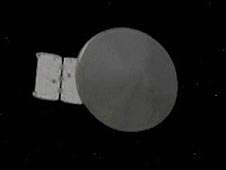
This artist's concept shows NASA's Phoenix spacecraft en route to Mars. Image credit: NASA/JPL-Calech/University of Arizona

NASA's Phoenix Mars Lander performed its first wet chemistry experiment on Martian soil flawlessly yesterday, returning a wealth of data that for Phoenix scientists was like winning the lottery.

We are awash in chemistry data," said Michael Hecht of NASA's Jet Propulsion Laboratory, lead scientist for the Microscopy, Electrochemistry and Conductivity Analyzer, or MECA, instrument on Phoenix. "We're trying to understand what is the chemistry of wet soil on Mars, what's dissolved in it, how acidic or alkaline it is. With the results we received from Phoenix yesterday, we could begin to tell what aspects of the soil might support life."

"This is the first wet-chemical analysis ever done on Mars or any planet, other than Earth," said Phoenix co-investigator Sam Kounaves of Tufts University, science lead for the wet chemistry investigation.

About 80 percent of Phoenix's first, two-day wet chemistry experiment is now complete. Phoenix has three more wet-chemistry cells for use later in the mission.

"This soil appears to be a close analog to surface soils found in the upper dry valleys in Antarctica," Kouvanes said. "The alkalinity of the soil at this location is definitely striking. At this specific location, one-inch into the surface layer, the soil is very basic, with a pH of between eight and nine. We also found a variety of components of salts that we haven't had time to analyze and identify yet, but that include magnesium, sodium, potassium and chloride."

"This is more evidence for water because salts are there. We also found a reasonable number of nutrients, or chemicals needed by life as we know it," Kounaves said. "Over time, I've come to the conclusion that the amazing thing about Mars is not that it's an alien world, but that in many aspects, like mineralogy, it's very much like Earth."

Another analytical Phoenix instrument, the Thermal and Evolved-Gas Analyzer (TEGA), has baked its first soil sample to 1,000 degrees Celsius (1,800 degrees Fahrenheit). Never before has a soil sample from another world been baked to such high heat.

TEGA scientists have begun analyzing the gases released at a range of temperatures to identify the chemical make-up of soil and ice. Analysis is a complicated, weeks-long process.

But "the scientific data coming out of the instrument have been just spectacular," said Phoenix co-investigator William Boynton of the University of Arizona, lead TEGA scientist.

"At this point, we can say that the soil has clearly interacted with water in the past. We don't know whether that interaction occurred in this particular area in the northern polar region, or whether it might have happened elsewhere and blown up to this area as dust."

Leslie Tamppari, the Phoenix project scientist from JPL, tallied what Phoenix has accomplished during the first 30 Martian days of its mission, and outlined future plans.

The Stereo Surface Imager has by now completed about 55 percent of its three-color, 360-degree panorama of the Phoenix landing site, Tamppari said. Phoenix has analyzed two samples in its optical microscope as well as first samples in both TEGA and the wet chemistry laboratory. Phoenix has been collecting information daily on clouds, dust, winds, temperatures and pressures in the atmosphere, as well as taking first nighttime atmospheric measurements.

Lander cameras confirmed that white chunks exposed during trench digging were frozen water ice because they sublimated, or vaporized, over a few days. The Phoenix robotic arm dug and sampled, and will continue to dig and sample, at the 'Snow White' trench in the center of a polygon in the polygonal terrain.

"We believe this is the best place for creating a profile of the surface from the top down to the anticipated icy layer," Tamppari said. "This is the plan we wanted to do when we proposed the mission many years ago. We wanted a place just like this where we could sample the soil down to the possible ice layer."

Source: NASA


print this article email this article download pdf blog this article bookmark this article     Stumble it Digg this share on Facebook retweet share on Reddit add to delicious
Rate this story - 4.8 /5 (31 votes)

Rank Filter

Move the slider to adjust rank threshold, so that you can hide some of the comments.


Display comments: newest first

  • superhuman - Jun 27, 2008
    • Rank: 3 / 5 (3)
    So It seems that the biggest discovery of the phoenix probe to date is that "frozen water is the only white substance which can sublimate or vaporise".
  • MKS - Jun 27, 2008
    • Rank: 2.5 / 5 (4)
    great going... hope we can meet and talk to people over there who travel to earth in UFOs:)
  • weewilly - Jun 28, 2008
    • Rank: 5 / 5 (2)
    Human history proves that man is always the explorer at heart and soul. One will never know what can be found unless you explore. Hopefully something could be found that could help us here on earth. I already see a great opportunity there on Mars for a junk yard dealing in used experimental robotic explorers. Another thought would be, do we have the right to pollute the Martian lanscape with our brand of science instruments? Maybe Star Wars was not so very far fetched?

June 27, 2008 all stories

Comments: 3

4.8 /5 (31 votes)
  • Stumble this up

  • Digg this

  • share this

  • hide
  • Related Stories

  • Biosphere 2 Opens Phoenix Mars Lander Exhibit
    created Sep 18, 2009 | popularity not rated yet | comments 0
  • Mars data published in Science this week
    created Jul 02, 2009 | popularity not rated yet | comments 0
  • Mars explorer says we'll find life on other planets within 10 years
    created Apr 21, 2009 | popularity not rated yet | comments 0
  • Liquid saltwater is likely present on Mars, new analysis shows
    created Mar 17, 2009 | popularity not rated yet | comments 0
  • Phoenix Site on Mars May be in Dry Climate Cycle Phase
    created Dec 15, 2008 | popularity not rated yet | comments 0


  • hide
  • Relevant PhysicsForums posts

  • The shape of our solar system's orbits.
    created 16 hours ago
  • Above or Below the Line of Nodes
    created 20 hours ago
  • Supernova vs. Nova?
    created Nov 07, 2009
  • Supernova's Gamma Rays and Comets
    created Nov 06, 2009
  • More from Physics Forums - General Astronomy

Other News

Deep creep means milder, more frequent earthquakes along Southern California's San Jacinto fault

Deep creep means milder, more frequent earthquakes along Southern California's San Jacinto fault

Space & Earth / Earth Sciences

created 1hour ago | popularity 4 / 5 (1) | comments 0

With an average of four mini-earthquakes per day, Southern California's San Jacinto fault constantly adjusts to make it a less likely candidate for a major earthquake than its quiet neighbor to the east, the ...


Success in 'space elevator' competition (AP)

Success in 'space elevator' competition (Update 3)

Space & Earth / Space Exploration

created Nov 05, 2009 | popularity 4.3 / 5 (33) | comments 50

(AP) -- A robot powered by a ground-based laser beam climbed a long cable dangling from a helicopter on Wednesday to qualify for prize money in a $2 million competition to test the potential reality of the ...


'Dropouts' pinpoint earliest galaxies

'Dropouts' pinpoint earliest galaxies

Space & Earth / Astronomy

created Nov 06, 2009 | popularity 4.1 / 5 (9) | comments 12

Astronomers, conducting the broadest survey to date of galaxies from about 800 million years after the Big Bang, have found 22 early galaxies and confirmed the age of one by its characteristic hydrogen signature ...


Space hotel taking bookings for 2012 opening

Space hotel taking bookings for 2012 opening

Space & Earth / Space Exploration

created Nov 05, 2009 | popularity 4.4 / 5 (20) | comments 11

(PhysOrg.com) -- The first orbiting space hotel is on track to open for its first customers in 2012, but hurry, as bookings are filling fast.


In a Galaxy Far, Far Away...

In a Galaxy Far, Far Away...

Space & Earth / Astronomy

created Nov 06, 2009 | popularity 4.8 / 5 (4) | comments 11

(PhysOrg.com) -- Astronomers have published the discovery of the farthest known object in the cosmos: a star that exploded when the universe was only 630 million years old -- only 4.6% of its current age. ...