Passports for penguins
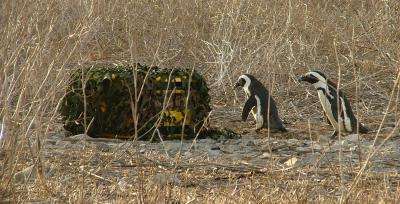
Ground-breaking technology that will enable biologists to identify and monitor large numbers of endangered animals, from butterflies to whales, without being captured, will be shown to the public for the first time at this year's Royal Society Summer Science exhibition [30 June to 3 July].
Scientists at the University of Bristol, working on Robben Island in South Africa, have devised an intelligent, visual surveillance system that can be integrated into wildlife habitats as a non-intrusive means of capturing detailed and reliable data on the population dynamics and social behaviour of endangered species.
The research advances techniques that originated in computer vision and human biometrics in order to help field biology and to better understand and conserve endangered species, in particular, the African penguin (Spheniscus demersus).
The project, called the 'Penguin Recognition Project', supported by the Earthwatch, the international environmental charity, and the Leverhulme Trust, has focused on the African penguin because their numbers have declined from more than a million at the start of the last century to fewer than 170,000 today. The penguin population, on Robben Island, South Africa, is a population of nearly 20,000 and conventional tagging techniques can only monitor a few percent of the population. The aim of the Penguin Recognition Project is to develop a system capable of doing automatic monitoring and which, more generally, could be the solution to a real-world problem facing many ecologists.
African penguins carry a pattern of black spots on their chests that does not change from season to season during their adult life. As far as scientists can tell, no two penguins have exactly the same pattern. The researchers have developed a real-time system that can locate African penguins whose chests are visible within video sequences or still images. An extraction of the chest spot pattern allows the generation of a unique biometrical identifier for each penguin. These biometric data can then be used to identify individual, African penguins from video or photographic images by comparison with a population database.
Dr Tilo Burghardt, RCUK Fellow in Exabyte Informatics in the Department of Computer Science at Bristol University, said: "We believe the new technology developed will enable biologists to identify and monitor large numbers of diverse species cheaply, quickly and automatically."
Peter Barham, Professor of Physics at Bristol University and penguin fanatic, who originated the project added: "Once achieved, these systems will revolutionise the precision, quantity and quality of population data available to ecologists and conservationists. There will also be an animal welfare benefit since there is no need to expose the animals to the stress of capture, or side-effects of being marked."
Provided that a good image of a penguin can be extracted, the system can correctly identify the individual with around 98 per cent reliability. The current limitation of the system, based on one camera, is that some passing penguins are hidden behind others, or the lighting is poor. The researchers are currently working to overcome these limitations both by combining images from intelligent pan-tilt-zoom cameras, and by using infra-red imaging to provide data both day and night. The basic image-recognition system has also been trialled with zebras, sharks and, in principle, can be extended to any species with complex surface patterns.
Source: University of Bristol


