China quake rare and unexpected, new study says
June 30, 2008
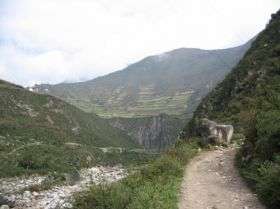
The mountains near the Min River south of Wenchuan City, close to the epicenter of the recent earthquake in China that has killed more than 65,000 people to date. Photo / Kristen Cook, MIT
A new analysis of the setting for last month's devastating earthquake in China by a team of geoscientists at MIT shows that the quake resulted from faults with little seismic activity, and that similar events in that area occur only once in every 2,000 to 10,000 years, on average.
However, the researchers caution that because earthquakes can sometimes occur in clusters, people should still be wary of another possible large-scale earthquake.
The magnitude 7.9 quake struck Sichuan province on May 12 at around noontime, which may have increased the human death toll because many people were at school, and the school buildings turned out to be especially vulnerable to collapse because of poor construction. More than 69,000 people have been confirmed dead so far, and more than 374,000 injured, with fears of further casualties because several lakes created by rockfall dams may give way and cause sudden flooding.
Clark Burchfiel, Schlumberger Professor of Geology, and Leigh Royden, professor of geology and geophysics in the Department of Earth, Atmospheric and Planetary Sciences at MIT, have been doing extensive research in that region of China and the Tibetan plateau for more than two decades, but had found no hints that suggested such a large earthquake might strike the area. They and several colleagues, including MIT's Robert D. van der Hilst and Bradford H. Hager, who are both Cecil and Ida Green Professors of Earth Sciences, have published a paper analyzing the causes of the quake that appears in the July issue of GSA Today, a publication of the Geological Society of America.
The team operated an array of 25 broadband seismograph stations in this region of western Sichuan for more than a year. "Nobody was thinking there would be a major seismological event" in that area, Royden says. "This earthquake was quite unusual," and may have involved a simultaneous rupture of two separate but contiguous faults, she continued.
The region is extremely unusual geologically, Royden says, because of the very steep slopes at the boundary between the Sichuan Basin to the east and the Tibetan plateau to the west. The elevation rises sharply by about 3,500 meters (more than two miles) over a span of only about 50 kilometers (about 30 miles).
The area where the quake occurred is part of the boundary between two of the Earth's tectonic plates, where the Indian and Asian plates converge in an ongoing collision that has created the Himalayan mountains and the Tibetan plateau. But in central and eastern Tibet, unlike most other areas of continental collision, much of the movement of crust is hidden from view. Instead of thickening the entire crust by folding and faulting, the surface of the eastern Tibetan plateau is undeformed and is being lifted upward by thickening of a weak crustal layer more than 15 km below the surface.
The crust in this deep weak layer is flowing eastward away from central Tibet to escape from the area directly north of the Indian plate. But, in the area where the earthquake occurred, this rapidly flowing material is obstructed by a major obstacle, the Sichuan Basin. "The crust and mantle beneath the basin appears to form a hard, cold knot" that extends to 250 km depth, Royden says, that forces the flow to "wrap around the knot." The huge elevation difference between the surface of the plateau and the Sichuan Basin provides the underlying stress that led to the quake, she says.
As the surface of the eastern plateau has risen, it has become increasingly incised by rivers. Four of the world's 10 largest rivers, including the Yangtze, flow through the region, Royden says. "There are gorges two and a half to three kilometers deep, and hundreds of kilometers longâ€"they dwarf the Grand Canyon," she says.
The steep slopes within the river gorges make the region especially vulnerable when earthquakes occur, she says. "When you shake those valleys, everything just slides down into the river gorges and eventually washes out to sea," she says.
Because of the extreme geological environment of this region, Royden says, it may be possible to learn about mechanisms taking place there that may also occur, at a smaller scale, in other places. In this way, it may reveal processes that are also relevant in other parts of the world but that would be much harder to discover in these other locations because they would be more subtly expressed.
Source: Massachusetts Institute of Technology
-
Long Wait Before Next China Quake?
Jul 10, 2008 |
5 / 5 (2) |
0
-
Deforestation threatens Brazil's wetland sanctuary
Feb 03, 2012 |
5 / 5 (3) |
0
-
Some earthquakes expected along Rio Grande Rift in Colorado and New Mexico, new study says
Jan 12, 2012 |
3.7 / 5 (3) |
3
-
By the light of January's Wolf Moon
Jan 11, 2012 |
3.5 / 5 (2) |
0
-
LRO lets you stand on the rim of Aristarchus crater
Dec 30, 2011 |
5 / 5 (5) |
3
-
Engineers build first sub-10-nm carbon nanotube transistor
Feb 01, 2012 |
4.9 / 5 (33) |
30
-
Something old, something new: Evolution and the structural divergence of duplicate genes
Jan 31, 2012 |
4.6 / 5 (7) |
1
-
The hidden nanoworld of ice crystals: Revealing the dynamic behavior of quasi-liquid layers
Jan 30, 2012 |
5 / 5 (4) |
1
-
Stock market network reveals investor clustering
Jan 27, 2012 |
3.9 / 5 (23) |
8
-
Of microchemistry and molecules: Electronic microfluidic device synthesizes biocompatible probes
Jan 26, 2012 |
5 / 5 (2) |
0
-
Do some geologists actually act a lot like Randy Marsh?
Feb 11, 2012
-
Discrepancy between oxygen and carbon-dioxide levels
Feb 09, 2012
-
where gems are found in the world
Feb 09, 2012
-
Wind Waves in Reservoir ~ Wind run-up and Wind set-up
Feb 08, 2012
-
Balance of oxygen in the atmosphere
Feb 01, 2012
-
The case for a methanol-based economy
Jan 30, 2012
- More from Physics Forums - Earth
More news stories
Salvage workers begin pumping fuel from Italian shipwreck
Salvage workers Sunday began pumping fuel from the shipwrecked Italian cruise liner Costa Concordia, a day ahead of schedule, officials said.
10 hours ago |
5 / 5 (2) |
0
Latin America mining boom clashes with conservation
Latin America is experiencing a mining boom as prices rise fuelled by a hike in global demand, but the region is also being hit by a wave of violent protests, strikes and rallies by environmentalists.
18 hours ago |
5 / 5 (1) |
1
Political leaders play key role in how worried Americans are by climate change: study
More than extreme weather events and the work of scientists, it is national political leaders who influence how much Americans worry about the threat of climate change, new research finds.
Feb 06, 2012 |
5 / 5 (8) |
75
NASA budget will axe Mars deal with Europe: scientists
US President Barack Obama's budget proposal to be submitted next week for 2013 will cut NASA's budget by 20 percent and eliminate a major partnership with Europe on Mars exploration, scientists said Thursday.
Space & Earth / Space Exploration
Feb 10, 2012 |
5 / 5 (3) |
58
Humans may have helped the decline of African rainforests 3000 years ago
(PhysOrg.com) -- Large areas of rainforests in Central Africa mysteriously disappeared over three thousand years ago, to be replaced by savannas. The prevailing theory has been that the cause was a change ...
Scientists discover molecular secrets of 2,000-year-old Chinese herbal remedy
For roughly two thousand years, Chinese herbalists have treated Malaria using a root extract, commonly known as Chang Shan, from a type of hydrangea that grows in Tibet and Nepal. More recent studies suggest that halofuginone, ...
New method to examine batteries -- MRI from the inside
There is an ever-increasing need for advanced batteries for portable electronics, such as phones, cameras, and music players, but also to power electric vehicles and to facilitate the distribution and storage of energy derived ...
Google might launch Drive for cloud storage soon
(PhysOrg.com) -- Google's next big move, according to the Wall Street Journal, is a cloud storage service called Drive. Hardly first to the plate, Google is simply catching up to introducing its cloud reposi ...
A mitosis mystery solved: How chromosomes align perfectly in a dividing cell
Although the process of mitotic cell division has been studied intensely for more than 50 years, Whitehead Institute researchers have only now solved the mystery of how cells correctly align their chromosomes during symmetric ...
Lab study raises questions over nano-particle impact
Tests involving chickens have raised questions about the impact on health from engineered nano-particles, the ultra-fine grains commonly used in drugs and processed foods, scientists said on Sunday.
Starve a virus, feed a cure? Findings show how some cells protect themselves against HIV
A protein that protects some of our immune cells from the most common and virulent form of HIV works by starving the virus of the molecular building blocks that it needs to replicate, according to research published online ...