More Evidence for a Revolutionary Theory of Water
June 30, 2008 More Evidence for a Revolutionary Theory of Water

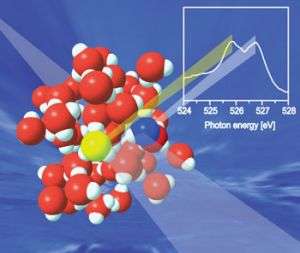
Recent X-ray Spectroscopy studies have revealed that modern theories of the structure of liquid water are incorrect. (Courtesy: Stanford Linear Accelerator Center)

The traditional picture of how liquid water behaves on a molecular level is wrong, according to new experimental evidence collected by a collaboration of researchers from the Department of Energy's Stanford Linear Accelerator Center (SLAC) in California, RIKEN SPring-8 synchrotron and Hiroshima University in Japan and Stockholm University in Sweden.

The team, involving SLAC scientist Anders Nilsson, used advanced X-ray spectroscopy techniques to create a more detailed picture of water's molecular behavior. Published as the cover story in the June 30 edition of the journal Chemical Physics Letters, the findings could soon help overturn the established orthodoxy surrounding the substance most essential to life.

Water, by any measure, is strange stuff. It behaves unlike any other liquid. It has a tremendous capacity for carrying heat—which is why the Gulf Stream keeps Europe warm. Water's solid phase —ice— is less dense than the liquid, which is why ice floats; life on Earth could never have formed if oceans and lakes froze from the bottom up. Water also has unusually strong surface tension—a property essential for the capillary action at work in the roots of plants and within our cells. These strange properties are what make water such an essential substance to the existence of life.

But despite its prevalence and importance, liquid water is not well understood, and its molecular structure has been the subject of intense debate for decades. Ice, whose structure was long ago well established, forms a tight "tetrahedral" lattice of molecules each binding to four others. The prevailing model of liquid water holds that as ice melts, the molecules loosen their grip but remain generally arranged in the same tetrahedral groups.

In the recent study, Nilsson and colleagues probed the structure of liquid water using X-ray Emission Spectroscopy and X-ray Absorption Spectroscopy. These techniques use powerful X-rays, generated by a synchrotron light source, to excite electrons within a water molecule's single oxygen atom. Tuning the X-rays to a specific range of energies can reveal with tremendous precision the location and arrangement of the water molecules. In this way Nilsson's team found that water is indeed made up of tetrahedral groups, but clear evidence also emerged for the dominance of a second, less defined structure in the mix.

The idea that liquid water is made up of two structures is not new. German physicist Willhelm Conrad Röntgen, who discovered X-rays in the late 19th century, published a paper proposing that liquid water comprised two different structures—one tetrahedral "ice-like" structure, and another more loosely arranged structure, which helped explain why water behaves in such unusual ways. Now, more than a century later, the current study is giving new life to Röntgen's "two structure" model.

"It is amazing that the modern usage of X-rays demonstrates that Röntgen, more than 100 years ago, was on the right path," said Nilsson. "Water is still not fully understood, although it is the basis of our existence. I expect more surprises to be discovered in the future."

Settling the debate about water's molecular structure holds tremendous importance for a range of fields including medicine, chemistry and biology. Current molecular dynamics models, which are used to understand chemical and biological processes, are notoriously limited in their ability to predict water's behavior.

The current study is the most recent addition to a growing body of evidence for a new theory about the structure of liquid water. In 2004, Nilsson and colleagues sparked controversy with a paper published in Science that suggested the tetrahedral model of water was incorrect. Nilsson agrees that the debate is far from settled and that much work remains before a clear picture of liquid water emerges.

"Over the last decade or so we have discovered that materials once considered homogeneous exhibit complex nanoscale order," said Stanford Synchrotron Radiation Laboratory director Jo Stöhr. "In my view, the work on water is yet another example of the actual complexity of matter, this time within a simple liquid. Modern X-ray work appears to be triggering a new understanding of liquids and we may have only seen the beginning of a paradigm shift in our understanding."

But despite its prevalence and importance, liquid water is not well understood, and its molecular structure has been the subject of intense debate for decades. Ice, whose structure was long ago well established, forms a tight "tetrahedral" lattice of molecules each binding to four others. The prevailing model of liquid water holds that as ice melts, the molecules loosen their grip but remain generally arranged in the same tetrahedral groups.

In the recent study, Nilsson and colleagues probed the structure of liquid water using X-ray Emission Spectroscopy and X-ray Absorption Spectroscopy. These techniques use powerful X-rays, generated by a synchrotron light source, to excite electrons within a water molecule's single oxygen atom. Tuning the X-rays to a specific range of energies can reveal with tremendous precision the location and arrangement of the water molecules. In this way Nilsson's team found that water is indeed made up of tetrahedral groups, but clear evidence also emerged for the dominance of a second, less defined structure in the mix.

The idea that liquid water is made up of two structures is not new. German physicist Willhelm Conrad Röntgen, who discovered X-rays in the late 19th century, published a paper proposing that liquid water comprised two different structures—one tetrahedral "ice-like" structure, and another more loosely arranged structure, which helped explain why water behaves in such unusual ways. Now, more than a century later, the current study is giving new life to Röntgen's "two structure" model.

"It is amazing that the modern usage of X-rays demonstrates that Röntgen, more than 100 years ago, was on the right path," said Nilsson. "Water is still not fully understood, although it is the basis of our existence. I expect more surprises to be discovered in the future."

Settling the debate about water's molecular structure holds tremendous importance for a range of fields including medicine, chemistry and biology. Current molecular dynamics models, which are used to understand chemical and biological processes, are notoriously limited in their ability to predict water's behavior.

The current study is the most recent addition to a growing body of evidence for a new theory about the structure of liquid water. In 2004, Nilsson and colleagues sparked controversy with a paper published in Science that suggested the tetrahedral model of water was incorrect. Nilsson agrees that the debate is far from settled and that much work remains before a clear picture of liquid water emerges.

"Over the last decade or so we have discovered that materials once considered homogeneous exhibit complex nanoscale order," said Stanford Synchrotron Radiation Laboratory director Jo Stöhr. "In my view, the work on water is yet another example of the actual complexity of matter, this time within a simple liquid. Modern X-ray work appears to be triggering a new understanding of liquids and we may have only seen the beginning of a paradigm shift in our understanding."

Citation: Chemical Physics Letters, DOI: 10.1016/j.cplett.2008.04.077; T. Tokushima, Y. Harada, O. Takahashi, Y. Senba, H. Ohashi, L.G.M. Pettersson, A. Nilsson, S. Shin; "High resolution X-ray emission spectroscopy of liquid water: The observation of two structural motifs".

Source: Stanford Linear Accelerator Center


Rate this story - 4.4 /5 (149 votes)

Rank Filter

Move the slider to adjust rank threshold, so that you can hide some of the comments.


Display comments: newest first

  • thales - Jun 30, 2008
    • Rank: 2.3 / 5 (3)
    I'll be the first to say it...

    Polywater!
  • Ragtime - Jun 30, 2008
    • Rank: 2.4 / 5 (7)
    Polywater was a hoax probably, but some (unconfirmed yet) indicia still persists here: http://arxiv.org/...46v1.pdf
  • Glis - Jun 30, 2008
    • Rank: 4.8 / 5 (10)
    Anyone else notice that half of the article is repeated? I thought I was going insane for a second...

    'In the recent study...shift in our understanding.'
  • thales - Jun 30, 2008
    • Rank: 4.6 / 5 (9)
    I didn't notice anything weird, Glis. Maybe you ARE going crazy.

    I didn't notice anything weird, Glis. Maybe you ARE going crazy.
  • nilbud - Jun 30, 2008
    • Rank: 4.3 / 5 (9)
    .yzarc gniog ERA uoy ebyaM .silG ,driew gnihtyna eciton t'ndid I

    .yzarc gniog ERA uoy ebyaM .silG ,driew gnihtyna eciton t'ndid I
  • Chroma - Jul 01, 2008
    • Rank: 1.7 / 5 (11)
    Ragtime, I am also interested in Sacred Geometry. As I was reading this article I was thinking of the Tao de Ching and its many references to water as a metaphor for the Tao. The 2 forces of yin and yang would surprisingly (or maybe not so surprisingly) coincide with 2 structures within water, working together, and continue the water metaphor very neatly. So, would/could an icosahedron be made of tetrahedrons? Or octahedrons? This article also got me wondering about the second structure. Is it too loose to find a structure yet?
  • DGBEACH - Jul 01, 2008
    • Rank: 3.5 / 5 (8)
    ok, we get it...liquid water is not well understood
  • Nikola - Jul 01, 2008
    • Rank: 3.2 / 5 (9)
    Wow. This article told me almost nothing.
  • apotekaris - Jul 03, 2008
    • Rank: 5 / 5 (2)
    article = copy pasta pasta
  • whiterosealchemist - Jul 03, 2008
    • Rank: 4 / 5 (1)
    Think this might explain the infinite dilution theory that i keep reading about?
  • Ragtime - Jul 03, 2008
    • Rank: 1.5 / 5 (4)
    Infinite dilution isn't feasible from practical reason due the adsorption of many organic molecules on vessels used for dissolution. Above certain limit the concentration of molecules decreases quite slowly with further dilution.

    But here are many indicia, the water clusters are behaving like plastic balls, i.e. they've memory shape effect. They can reflect the structure of dissolved molecules and to replicate it during further dilution, thus keeping some biological properties of solution (like molecular shape dependent imunologic response). Here exists an interesting mechanism, simmilar to "quantum mirage" phenomena, which enables the water clusters to keep their size despite the fast motion of individual water molecules.

    http://superstrun...mory.gif

    The problem is, the homeopathy and cluster medicine has discredited a serious research of water behavior, so that most of these boundary phenomena aren't accepted well with mainstream scientific community, by the simmilar way, like Aether theory or cold fusion, etc.
  • earls - Jul 04, 2008
    • Rank: 2 / 5 (4)
    Homeopathy and self healing and crystal medicine and acupuncture and all that happy horseshit is ABSOLUTELY TRUE and ABSOLUTE CORRECT.

    The problem is, they don't take their results, apply the scientific method and evolve their studies and theories and it remains the same failure it has been and is today. Simply lazy people. They know they can get $X amount of dollars peddling pseudo-snake oil and they win at the life, so they do. But with true study and refinement the underlying and truly beneficial aspect will shine through.

    Take crystal balls for the example. You know how they're associated with gypsy and weird folk and idiots, and cracks, but what are crystal balls made of? QUARTZ!! You cannot BEGIN to understand the myriad dimension of quartz.
  • Ragtime - Jul 05, 2008
    • Rank: 2.7 / 5 (3)
    Nothing is absolutely true. For example, the cold fusion requires the co-existence of many subtle conditions, so it cannot become so reproducible, as many scientifically educated people are believing.

    Do you know for example, the efficiency of production of highly complex electronic chips falls bellow 5%? The production of such chips apparently violates the reproducibility criterions of every scientific method. Such chips couldn't be considered really existing by such approach.

    It sounds funny, but this is exactly, how the contemporary science is working in many boundary cases.
  • jibbguy - Jul 05, 2008
    • Rank: 3.3 / 5 (3)
    This substantiates the work that many people in the Free Energy Open Source movement have been doing: Exploding water with plasma spark... Something claimed "impossible" for years but it is now proven easily reproducible via a combination of HV produced by ignition coils and low-voltage DC current; propagated across a spark gap. In fact the energy needed to explode the water is quite low.. Low enough that a car running on nothing but water could provide it via alternator.

    Water is a fuel, and a very potent one. Its time that the mainstream scientific community accepts this fact. For those legitimately interested in this subject, check this out:

    http://www.overun...c=5024.0

    It is just one of many projects going on in the Open Source Energy movement regarding plasma explosion of water.... With the ultimate goal of fueling internal combustion engines with it.

June 30, 2008 all stories

Comments: 14

4.4 /5 (149 votes)

  • hide
  • Related Stories

  • Repulsive interactions
    created Feb 05, 2010 | popularity not rated yet | comments 0
  • Powering cube satellites
    created Feb 03, 2010 | popularity not rated yet | comments 0
  • Engineers explore environmental concerns of nanotechnology
    created Feb 01, 2010 | popularity not rated yet | comments 0
  • A Venus flytrap for nuclear waste
    created Jan 26, 2010 | popularity not rated yet | comments 0
  • Neuron connections seen in 3-D
    created Jan 22, 2010 | popularity not rated yet | comments 0


  • hide
  • Relevant PhysicsForums posts

  • mass and weight
    created 2 hours ago
  • final velocity
    created 3 hours ago
  • Density of water
    created 4 hours ago
  • Pressure and stress
    created 9 hours ago
  • Fizzy drinks in zero gravity
    created 10 hours ago
  • Difference?
    created 14 hours ago
  • More from Physics Forums - General Physics

Other News

Scientist explore future of high-energy physics

Scientist explore future of high-energy physics

Physics / General Physics

created 5 hours ago | popularity 4.9 / 5 (8) | comments 4 | with audio podcast

In a 1954 speech to the American Physical Society, the University of Chicago's Enrico Fermi fancifully envisioned a particle accelerator that encircled the globe. Such would be the ultimate theoretical outcome, ...


Leaf veins inspire a new model for distribution networks (w/ Video)

Physics / General Physics

created 2 hours ago | popularity not rated yet | comments 0 | with audio podcast

(PhysOrg.com) -- Following the straight and narrow may be good moral advice, but it’s not a great design principle for a distribution network. In new research, a team of biophysicists describe a complex netting of interconnected ...


New magnetic tuning method enhances data storage

New magnetic tuning method enhances data storage

Physics / General Physics

created 6 hours ago | popularity 4 / 5 (2) | comments 0 | with audio podcast

Researchers in Chicago and London have developed a method for controlling the properties of magnets that could be used to improve the storage capacity of next-generation computer hard drives.


New method for measuring fluid flow in algae could herald revolution for fluid mechanics

Physics / General Physics

created 8 hours ago | popularity 5 / 5 (2) | comments 0 | with audio podcast

In the words of Todd Squires, of the University of California, Santa Barbara "Nature has long inspired researchers in fluid mechanics to explore the mechanical strategies used by living creatures. Where better to look for ...


Physicists investigate structural properties of spider webs

Physicists investigate structural properties of spider webs

Physics / General Physics

created Feb 08, 2010 | popularity 4.7 / 5 (20) | comments 2 | with audio podcast feature

(PhysOrg.com) -- "Although the orb web of a spider is a lightweight structure, it seems to be a highly optimized structure, presumably as a result of evolution from the Jurassic period or earlier," explain ...