Rocketing Through Water
June 30, 2008
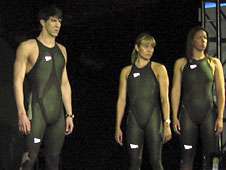
The new swimsuits were unveiled in New York. Credit: NASA/Kathy Barnstorff
Swimmers around the world are breaking records this year like never before, including at this week's U.S. Olympic trials. Some attribute it to extensive training as athletes prepare to compete at this summer's games in Beijing. Others say one factor may be a new swimsuit ... a space-age swimsuit made of fabric tested at NASA.
"When I hit the water, I feel like a rocket," said world champion swimmer Michael Phelps about the Speedo LZR Racer suit. Phelps, who won six gold medals and two bronze at the last Summer Olympics in Australia, helped develop the much-talked swimwear. He and others who have worn the skintight body suit have already set 40 of 44 world records since the LZR Racer debuted in February.
NASA researcher Steve Wilkinson also had a hand in the swimsuit's development. The aerospace engineer at NASA's Langley Research Center in Hampton, Va., admits he doesn't know much about swimming or swimwear.
"Most of the work we do in my branch is internal NASA work … fundamental research in laminar and turbulent boundary layer physics," said Wilkinson.
One area Wilkinson focuses on is drag reduction … how to make something propel though air or water faster and more efficiently. That was Wilkinson's task for Speedo ... to test swimsuit material for drag.
"We evaluated the surface roughness effects of nearly 60 fabrics or patterns in one of our small low speed wind tunnels," said Wilkinson. "We were assessing which fabrics and weaves had the lowest drag. The tests have generally shown the smoother the fabric, the lower the drag."
But how can you test a material that's supposed to be used in water in a wind tunnel that uses air? It turns out that air and water obey the same physical laws of motion, so a wind tunnel can simulate similar drag a fabric would experience in water. Testing in air is also less expensive, simpler and offers more testing options than testing in water.
Warnaco Inc., which is the U.S. licensee of the Speedo swimwear brand, approached NASA Langley to test fabric samples, since NASA Langley has researched drag reduction for aircraft and even boats for decades.
Just like reducing drag helps planes fly more efficiently, reducing drag helps swimmers go faster. Studies indicate viscous drag or skin friction is almost one-third of the total restraining force on a swimmer. Wind tunnel tests measure the drag on the surface of the fabrics.
"This is the first time I've tested a fabric and there were some challenges involved," said researcher Wilkinson. "It was a challenge to figure out how to get the fabric on a test plate and how to prepare the edges so nothing would interfere with air flow over the fabric. I think we've done a really good job with the help of Speedo coming up with a protocol that lets us to test these fabrics with ease and precision."
The candidate materials Wilkinson receives from the company come in the form of tubes. He stretches the tubes over a smooth, flat aluminum plate, then tapes down the edges. The plate goes into the small wind tunnel test section. With a flip of a switch, air flows over it. Wilkinson runs the tunnel through a number of wind speeds and, with the help of sensors, measures drag on the surface. He records the data and then sends it on to Speedo researchers.
The engineer says his research has given him a whole new perspective on swimming and as a result he'll view the Olympics differently this year. "As I watch, I’m going to be wondering if he or she was wearing a fabric that I tested in this wind tunnel," said Wilkinson. "I'm also going to be paying very close attention to the time."
Source: by Kathy Barnstorff, NASA Langley Research Center
-
Olympic Swimmers Shattering Records in NASA-Tested Suit
Aug 18, 2008 |
4.5 / 5 (11) |
3
-
NASA Know-How Helps Athletes Rocket Through Water
Feb 12, 2008 |
4.3 / 5 (8) |
1
-
Bombings, beheadings? Stats show a peaceful world
Oct 22, 2011 |
4.6 / 5 (22) |
28
-
Airlines positioned for big gains in efficiency
Jul 04, 2011 |
4.6 / 5 (8) |
4
-
Solar sail flares can be seen in broad daylight
Feb 03, 2011 |
5 / 5 (2) |
4
-
Engineers build first sub-10-nm carbon nanotube transistor
Feb 01, 2012 |
4.9 / 5 (31) |
30
-
Something old, something new: Evolution and the structural divergence of duplicate genes
Jan 31, 2012 |
4.6 / 5 (7) |
1
-
The hidden nanoworld of ice crystals: Revealing the dynamic behavior of quasi-liquid layers
Jan 30, 2012 |
5 / 5 (3) |
1
-
Stock market network reveals investor clustering
Jan 27, 2012 |
3.9 / 5 (23) |
8
-
Of microchemistry and molecules: Electronic microfluidic device synthesizes biocompatible probes
Jan 26, 2012 |
5 / 5 (1) |
0
-
Doubts about surface plasmons
Feb 11, 2012
-
excited U-236 decay time in the U235 fission chain
Feb 09, 2012
-
Polar catastrophe?
Feb 09, 2012
-
Large scale field sonication
Feb 09, 2012
-
states and energy of paired electrons in BCS
Feb 08, 2012
-
difference between longitudinal and transverse refractive indices
Feb 08, 2012
- More from Physics Forums - Atomic, Solid State, Comp. Physics
More news stories
Explained: Sigma
It's a question that arises with virtually every major new finding in science or medicine: What makes a result reliable enough to be taken seriously? The answer has to do with statistical significance -- but ...
Feb 09, 2012 |
5 / 5 (19) |
76
Quantum physicist explains $100K offer for proof scaled-up quantum computing is impossible
(PhysOrg.com) -- MIT researcher Scott Aaronson has certainly riled the physics community with his offer this past Friday, of $100,000 to anyone who can prove that scaled-up quantum computing is impossible. ...
Diamond light, brighter than the sun
Its the size of five football pitches and generates light 10 billion times brighter than the sun. As the Diamond Light Source celebrates its tenth anniversary this year, Penny Bailey visits one of the ...
Feb 07, 2012 |
4.4 / 5 (8) |
18
|
Physicists 'record' magnetic breakthrough
An international team of scientists has demonstrated a revolutionary new way of magnetic recording which will allow information to be processed hundreds of times faster than by current hard drive technology.
Feb 07, 2012 |
4.5 / 5 (42) |
14
|
Hints of the Higgs - papers are submitted
Back in December 2011, the ATLAS and CMS experiments at CERN presented some exciting results that provided tantalising hints of the Higgs boson.
Feb 08, 2012 |
4.1 / 5 (7) |
10
Scientists discover molecular secrets of 2,000-year-old Chinese herbal remedy
For roughly two thousand years, Chinese herbalists have treated Malaria using a root extract, commonly known as Chang Shan, from a type of hydrangea that grows in Tibet and Nepal. More recent studies suggest that halofuginone, ...
New method to examine batteries -- MRI from the inside
There is an ever-increasing need for advanced batteries for portable electronics, such as phones, cameras, and music players, but also to power electric vehicles and to facilitate the distribution and storage of energy derived ...
A mitosis mystery solved: How chromosomes align perfectly in a dividing cell
Although the process of mitotic cell division has been studied intensely for more than 50 years, Whitehead Institute researchers have only now solved the mystery of how cells correctly align their chromosomes during symmetric ...
Starve a virus, feed a cure? Findings show how some cells protect themselves against HIV
A protein that protects some of our immune cells from the most common and virulent form of HIV works by starving the virus of the molecular building blocks that it needs to replicate, according to research published online ...
Researchers find extensive RNA editing in human transcriptome
In a new study published online in Nature Biotechnology, researchers from BGI, the world's largest genomics organization, reported the evidence of extensive RNA editing in a human cell line by analysis of RNA-seq data, demons ...
The proteins ensuring genome protection
Researchers from the University of Geneva (UNIGE), Switzerland, have discovered the crucial role of two proteins in developing a cell 'anti-enzyme shield'. This protection system, which operates at the level of molecular ...
Jun 30, 2008
Rank: 5 / 5 (5)
Jul 01, 2008
Rank: 5 / 5 (1)
Jul 02, 2008
Rank: not rated yet