Using a light touch to measure protein bonds
June 30, 2008 Using a light touch to measure protein bonds

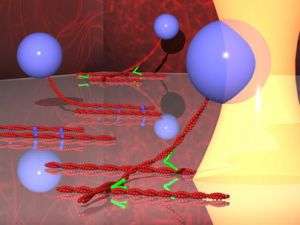
The strength of actin binding protein interactions cross-linking a surface bound and bead tethered actin filament are probed using force from an optical trap. Filamin in green which forms networks of actin filaments shown as a confocal image on the right and alpha-actinin in blue which bundles actin filaments, shown as an image on the left, were probed using this assay configuration. Image courtesy / Hyungsuk Lee, Jorge M. Ferrer, and Matthew J. Lang

MIT researchers have developed a novel technique to measure the strength of the bonds between two protein molecules important in cell machinery: Gently tugging them apart with light beams.

"It's really giving us a molecular-level picture of what's going on," said Matthew Lang, an assistant professor of biological and mechanical engineering and senior author of a paper on the work appearing in the June 30 advanced online issue of the Proceedings of the National Academy of Sciences.

Last fall, Lang and others demonstrated that light beams could be used to pick up and move individual cells around the surface of a microchip.

Now they have applied the optical tweezers to measuring protein microarchitectures, allowing them to study the forces that give cells their structure and the ability to move.

The researchers focused on proteins that bind to actin filaments, an important component of the cytoskeleton. Depending on the arrangement and interaction of actin filaments, they can provide structural support, help the cell crawl across a surface or sustain a load (in muscle cells).

"We're trying to understand how nature engineered these molecular linkages to use in different ways," said Lang.

Actin filaments are most commonly found either bonded or crosslinked by a much smaller actin binding protein.

The researchers studied the interactions between the proteins by pinning one actin filament to a surface and controlling the motion of the second one with a beam of light. As the researchers tug on a bead attached to the second filament, the bond mediated by the actin-binding protein eventually breaks.

With this technique, the researchers can get a precise measurement of the force holding the proteins together, which is on the order of piconewtons (10^-12 newtons).

The same technique could be used to investigate many of the other hundreds of protein interactions that occur in the cytoskeleton, said Lang.

Source: Massachusetts Institute of Technology


print this article email this article download pdf blog this article bookmark this article     Stumble it Digg this share on Facebook retweet share on Reddit add to delicious
Rate this story - 3 /5 (1 vote)


June 30, 2008 all stories

Comments: 0

3 /5 (1 vote)
  • Stumble this up

  • Digg this

  • share this

  • hide
  • Related Stories

  • Researchers have immune cells running in circles
    created Nov 02, 2009 | popularity not rated yet | comments 0
  • How HIV cripples immune cells
    created Sep 16, 2009 | popularity not rated yet | comments 0
  • Dividing cells 'feel' their way out of warp
    created Sep 10, 2009 | popularity not rated yet | comments 0
  • Biologists Unlock Secrets of Plants' Growing Tips
    created Aug 25, 2009 | popularity not rated yet | comments 0
  • Scientists control living cells with light; advances could enhance stem cells' power
    created Aug 11, 2009 | popularity not rated yet | comments 0


Other News

Scientists successfully reprogram blood cells

Biology / Cell & Microbiology

created 6 hours ago | popularity 5 / 5 (2) | comments 0

Researchers have transplanted genetically modified hematopoietic stem cells into mice so that their developing red blood cells produce a critical lysosomal enzyme -preventing or reducing organ and central nervous system damage ...


Iowa State University researcher discovers key to vital DNA, protein interaction

Researchers discover key to vital DNA, protein interaction

Biology / Other

created 1hour ago | popularity not rated yet | comments 0

(PhysOrg.com) -- A researcher at Iowa State University has discovered how a group of proteins from plant pathogenic bacteria interact with DNA in the plant cell, opening up the possibility for what the scientist ...


New discovery allows scientists for the first time to experimentally annotate genomes

New discovery allows scientists for the first time to experimentally annotate genomes

Biology / Biotechnology

created 5 hours ago | popularity 5 / 5 (3) | comments 0

Over the last 20 years, the sequencing of the human genome, along with related organisms, has represented one of the largest scientific endeavors in the history of mankind. The information collected from genome ...


Study shows that some malignant tumors can be shut down after all

Biology / Cell & Microbiology

created 9 hours ago | popularity 5 / 5 (3) | comments 1

Oncologists have had their hands tied because more than half of all human cancers have mutations that disable a protein called p53. As a critical anti-cancer watchdog, p53 masterminds several cancer-fighting operations within ...


The bizarre lives of bone-eating worms

Biology / Plants & Animals

created 1hour ago | popularity not rated yet | comments 0

The females of the recently discovered Osedax marine worms feast on submerged bones via a complex relationship with symbiotic bacteria, and they are turning out to be far more diverse and widespread than scientists expected. ...