When using gestures, rules of grammar remain the same
June 30, 2008 When using gestures, rules of grammar remain the same

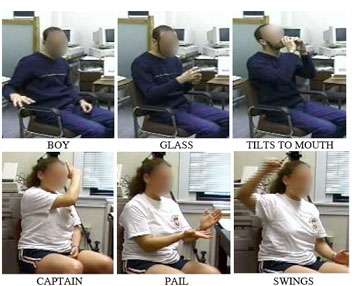
Speakers in four different languages all use the same word order when making gestures to communicate ideas. They put the subject first, followed by the object and then the verb, despite the order used in many spoken languages.

The mind apparently has a consistent way of ordering an event that defies the order in which subjects, verbs, and objects typically appear in languages, according to research at the University of Chicago.

"Not surprisingly, speakers of different languages describe events using the word orders prescribed by their language. The surprise is that when the same speakers are asked to 'speak' with their hands and not their mouths, they ignore these orders – they all use exactly the same order when they gesture," said Susan Goldin-Meadow, the Bearsdley Rum Distinguished Service Professor in Psychology and lead author of the paper, "The Natural Order of Events: How Speakers of Different Languages Represent Events Nonverbally" published in the current issue of the Proceedings of the National Academy of Sciences.

For the study, the team tested 40 speakers of four different languages: 10 English, 10 Mandarin Chinese, 10 Spanish and 10 Turkish speakers. They showed them simple video sequences of activities and asked them to describe the action first in speech and a second time using only gestures. They also gave another 40 speakers of the same languages transparencies to assemble after watching the video sequences. Some of the videos portrayed real people and others animated toys that represented a variety of sentence types: a girl waves, a duck moves to a wheelbarrow, a woman twists a knob and a girl gives a flower to man.

When asked to describe the scenes in speech, the speakers used the word orders typical of their respective languages. English, Spanish, and Chinese speakers first produced the subject, followed by the verb, and then the object (woman twists knob). Turkish speakers first produced the subject, followed by the object, and then the verb (woman knob twists).

But when asked to describe the same scenes using only their hands, all of the adults, no matter what language they spoke, produced the same order –– subject, object, verb (woman knob twists). When asked to assemble the transparencies after watching the video sequences (another nonverbal task, but one that is not communicative), people also tended to follow the subject, object, verb ordering found in the gestures produced without speech.

The grammars of modern languages developed over time and are the result of very distant cultural considerations that are difficult for linguists to study.

Newly emerging sign languages, however, offer intriguing corroborating evidence that the subject-object-verb (SOV) order is a fundamental one.

SOV is the order currently emerging in a language created spontaneously without any external influence. Al-Sayyid Bedouin Sign Language arose within the last 70 years in an isolated community with a high incidence of profound prelingual deafness. In the space of one generation, the language assumed grammatical structure, including the SOV order.

Moreover, when deaf children invent their own gesture systems, they use OV order. Chinese and American deaf children, whose hearing losses prevent them from acquiring spoken language and whose hearing parents have not exposed them to sign language, use the OV order in the gesture sentences they create.

The research challenges the idea that the language we speak inevitably shapes the way we think when we are not speaking. This study is the first to test the notion with respect to word order.

"Our data suggest that the ordering we use when representing events in a nonverbal format is not highly susceptible to language's influence," Goldin-Meadow and her co-authors write. "Rather, there appears to be a natural order that humans use when asked to represent events nonverbally. Indeed, the influence may well go in the other direction—the ordering seen in our nonverbal tasks may shape language in its emerging stages."

Source: University of Chicago


print this article email this article download pdf blog this article bookmark this article     Stumble it Digg this share on Facebook retweet share on Reddit add to delicious
Rate this story - 4.7 /5 (46 votes)

Rank Filter

Move the slider to adjust rank threshold, so that you can hide some of the comments.


Display comments: newest first

  • Ragtime - Jun 30, 2008
    • Rank: 4.3 / 5 (3)
    The sign language is apparently quite ancient and it leads to the common origin of human species. Many guestures are comon even with quite primitive animals. For example, at the case of fright or dismay most of criters opens their jaws showing teeth for obvious reason.
  • barakn - Jun 30, 2008
    • Rank: 1 / 5 (4)
    ...whereas humans showing teeth are smiling or laughing. What was your point?
  • fleem - Jun 30, 2008
    • Rank: 5 / 5 (2)
    It is also interesting that subject-object-verb just happens to be the required order of instructions in an arithmetic processor-. Such instructions are called "postfix" or "reverse-Polish". An arithmetic processor implements its short-term memory in the form of a first-in/last-out stack, and operations on that stack accomplish the arithmetic. For example, to perform A plus B, the process is:
    Push A onto the stack
    Push B onto the stack
    Pop two numbers and push their sum

    For a more complex example, (A plus (B plus C)) becomes:
    Push A
    Push B
    Push C
    Pop two numbers and push their sum
    Pop two numbers and push their sum

    (I used the word "plus" instead of the plus sign because strangley the plus sign doen't appear in these posts!)
  • Smellyhat - Jul 01, 2008
    • Rank: 3.5 / 5 (2)
    How about we all play charades in SVO sequence for a while before we draw any major inferences.
  • kc5tja - Jul 01, 2008
    • Rank: 2 / 5 (1)
    @Smellyhat: People have been playing charades in SVO since the game first came out. How about you actually understand the scientific basis for the research before jumping to conclusions?

    The whole point of the research was to isolate and eliminate everyday, common experiences, and rely EXCLUSIVELY on human intellect at inventing a non-verbal notation for communication. And, it seems that either God or evolution (whichever you believe in most) have both spoken: SOV rules.

    I'm sorry you don't agree with the hard evidence. But, then, nature has never much cared for what any human being thought about things anyway.
  • menkaur - Jul 01, 2008
    • Rank: 2 / 5 (1)
    this could be a cool tool study for developing an universal language and for language translation systems ....
  • Smellyhat - Jul 02, 2008
    • Rank: not rated yet
    @kc5tja: Clearly I've offended you, for which I apologize. There was a greater balance of literal intent than wryness to the comment.

    I suggest the following experiment.

    Prepare a game of charades, using very simple English (single subject & object) sentences that need to be communicated by gestures only.

    There will be two teams.

    The first team will be constrained to act out the charade in a subject-verb-object order; that is, they may never attempt to indicate the verb before the second team has guessed the subject, and may never attempt to indicate the object before the second team has guessed the verb.

    The second team, on the other hand, is constrained to act out the charade in subject-object-verb order. They may never attempt to indicate the verb until after the first team has guessed both the subject and the object, and never attempt to indicate the object before the first team has guessed the subject.

    I predict that the second team will win the game in sufficiently dominant number of instances to be persuasive of causality.

    My hypothesis is that there are fundamental informational reasons that the subject-object-verb order will always emerge as the better strategy, irrespective of the 'natural' language order of the speaker.

    Firstly, I'm guessing that while the order of the subject, object, and verb are [nearly] arbitrary in a string of information, they are nowhere near arbitrary in an extended temporal sequence of gestures;

    And secondly, I'm guessing that it is more efficient to constrain the semantic domain by eliminating the physical objects with physical gestures first.

    To make a tournament of the event, include an object-subject-verb team, and an object-verb-subject team; and most especially two teams forced to start with the verb.

    If I'm right, of course, it may or may not be predictive of some neurological structure.
  • DoctorKnowledge - Jul 02, 2008
    • Rank: not rated yet
    Great experiment. And the comments here suggest that it will be thought-provoking for other discoveries, too.

    My "take" on the results was different. And that is, if a person is operating in a very difficult communication situation -- where it's not sure if anything at all can be imparted -- they will start with the concept that is easiest and most sure to communicate. If the observer doesn't get that first part -- there's little reason to continue (and probably a great chance of failure or protracted clarifications). Equally, the observer probably assumes the communicator will attempt to impart the least ambiguous part of the message first.

June 30, 2008 all stories

Comments: 8

4.7 /5 (46 votes)
  • Stumble this up

  • Digg this

  • share this

  • hide
  • Related Stories

  • Babies' language learning starts from the womb
    created Nov 05, 2009 | popularity not rated yet | comments 0
  • What is unique in the brain of an Arabic speaker?
    created Nov 04, 2009 | popularity not rated yet | comments 0
  • Babble Of Baby Reveals Language Skills
    created Nov 03, 2009 | popularity not rated yet | comments 0
  • Scholar helps classify clicks in African languages
    created Oct 22, 2009 | popularity not rated yet | comments 0
  • Dyslexia varies across language barriers
    created Oct 12, 2009 | popularity not rated yet | comments 0


  • hide
  • Relevant PhysicsForums posts

  • Improving the brain through chemistry
    created Nov 07, 2009
  • Sleep / REM Sleep and homeostasis
    created Nov 07, 2009
  • The Biceps Reflex
    created Nov 05, 2009
  • Consequenses of striking a Vein and an artery?
    created Nov 05, 2009
  • More from Physics Forums - Medical Sciences

Other News

Young tennis players who play only 1 sport are more prone to injuries

Young tennis players who play only one sport are more prone to injuries

Medicine & Health / Health

created 43 minutes ago | popularity not rated yet | comments 0

Gifted young athletes are under increasing pressure to play only one sport year round.


Scientists uncover new key to the puzzle of hormone therapy and breast cancer

Scientists uncover new key to the puzzle of hormone therapy and breast cancer

Medicine & Health / Cancer

created 42 minutes ago | popularity 5 / 5 (1) | comments 0

The use of postmenopausal hormone therapy has decreased over time in the United States, which researchers suggest may play a key role in the declining rate of atypical ductal hyperplasia, a known risk factor ...


Lawmaker wants probe of E. coli and school lunches

Medicine & Health / Diseases

created 1hour ago | popularity not rated yet | comments 0

(AP) -- The chairman of the House Education and Labor Committee wants an investigation into the risk of deadly E. coli getting into school lunches.


Developmental delay could stem from nicotinic receptor deletion

Medicine & Health / Genetics

created 16 hours ago | popularity 4.5 / 5 (2) | comments 0

The loss of a gene through deletion of genetic material on chromosome 15 is associated with significant abnormalities in learning and behavior, said a consortium of researchers led by Baylor College of Medicine in a report ...


Expanding drug treatment: Is US ready to step up? (AP)

Expanding drug treatment: Is US ready to step up?

Medicine & Health / Other

created 11 hours ago | popularity not rated yet | comments 0

(AP) -- Based on the rhetoric, America's war on drugs seems poised to shift into a more enlightened phase where treatment of addicts gains favor over imprisonment of low-level offenders. Questions abound, ...