New map IDs the core of the human brain
July 1st, 2008 Brain Map

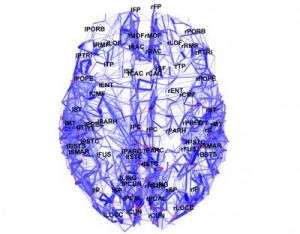
The first complete high-resolution map of the human cerebral cortex identifies a single network core that could be key to the workings of both hemispheres of the brain. Credit: Indiana University

An international team of researchers has created the first complete high-resolution map of how millions of neural fibers in the human cerebral cortex -- the outer layer of the brain responsible for higher level thinking -- connect and communicate. Their groundbreaking work identified a single network core, or hub, that may be key to the workings of both hemispheres of the brain.

The work by the researchers from Indiana University, University of Lausanne, Switzerland, Ecole Polytechnique Fédérale de Lausanne, Switzerland, and Harvard Medical School marks a major step in understanding the most complicated and mysterious organ in the human body.

It not only provides a comprehensive map of brain connections (the brain "connectome"), but also describes a novel application of a non-invasive technique that can be used by other scientists to continue mapping the trillions of neural connections in the brain at even greater resolution, which is becoming a new field of science termed "connectomics."

"This is one of the first steps necessary for building large-scale computational models of the human brain to help us understand processes that are difficult to observe, such as disease states and recovery processes to injuries," said Olaf Sporns, co-author of the study and neuroscientist at Indiana University.

The findings appear in the journal PLoS Biology today (June 30). Co-authors include Patric Hagmann and Reto Meuli, University Hospital Center and University of Lausanne; Leila Cammoun and Xavier Gigandet, Ecole Polytechnique Fédérale de Lausanne; Van J. Wedeen, Massachusetts General Hospital and Harvard Medical Center; and Christopher J. Honey, IU.

Until now, scientists have mostly used functional magnetic resonance imaging (fMRI) technology to measure brain activity -- locating which parts of the brain become active during perception or cognition -- but there has been little understanding of the role of the underlying anatomy in generating this activity. What is known of neural fiber connections and pathways has largely been learned from animal studies, and so far, no complete map of brain connections in the human brain exists.

In this new study, a team of neuroimaging researchers led by Hagmann used state-of-the-art diffusion MRI technology, which is a non-invasive scanning technique that estimates fiber connection trajectories based on gradient maps of the diffusion of water molecules through brain tissue. A highly sensitive variant of the method, called diffusion spectrum imaging (DSI), can depict the orientation of multiple fibers that cross a single location. The study applies this technique to the entire human cortex, resulting in maps of millions of neural fibers running throughout this highly furrowed part of the brain.

Sporns then carried out a computational analysis trying to identify regions of the brain that played a more central role in the connectivity, serving as hubs in the cortical network. Surprisingly, these analyses revealed a single highly and densely connected structural core in the brain of all participants.

"We found that the core, the most central part of the brain, is in the medial posterior portion of the cortex, and it straddles both hemispheres," Sporns said. "This wasn't known before. Researchers have been interested in this part of the brain for other reasons. For example, when you're at rest, this area uses up a lot of metabolic energy, but until now it hasn't been clear why."

The researchers then asked whether the structural connections of the brain in fact shape its dynamic activity, Sporns said. The study examined the brains of five human participants who were imaged using both fMRI and DSI techniques to compare how closely the brain activity observed in the fMRI mapped to the underlying fiber networks.

"It turns out they're quite closely related," Sporns said. "We can measure a significant correlation between brain anatomy and brain dynamics. This means that if we know how the brain is connected we can predict what the brain will do."

Sporns said he and Hagmann plan to look at more brains soon, to map brain connectivity as brains develop and age, and as they change in the course of disease and dysfunction.

Article: http://biology.plosjournals.org/perlserv/?request=get-document&doi=10.1371/journal.pbio.0060159

Source: Indiana University


print this article email this article download pdf blog this article bookmark this article     Digg this Stumble it share on Facebook share on Reddit add to delicious save to Yahoo! bookmarks
4.4/5 after 14 votes

Rank Filter

Move the slider to adjust rank threshold, so that you can hide some of the comments.


Display comments: newest first


July 1st, 2008 all stories
Medicine & Health / Research

Comments: 1
Rank: 4.4/5 after 14 votes

  • Stumble this up

  • Digg this

  • Share it:
  • share on Facebook
  • share on MySpace
  • share on Slashdot
  • rss-newsfeed
  • share on Google
  • share on Reddit
  • add to delicious
  • save to Yahoo! bookmarks
  • share on Windows Live
  • Add to Mixx!
Rating: 4.4/5 after 14 votes

  • Related Stories

  • Blood stem cell growth factor reverses memory decline in mice
    created Jul 01, 2009 | popularity not rated yet | comments 0
  • Alterations in brain's white matter key to schizophrenia, study shows
    created Jun 22, 2009 | popularity not rated yet | comments 0
  • New website to help translate genetic data into medical therapies
    created Jun 13, 2009 | popularity not rated yet | comments 0
  • Biological link established between tumors and depression
    created May 18, 2009 | popularity not rated yet | comments 0
  • Neuroscientists discover long-term potentiation in the olfactory bulb
    created May 03, 2009 | popularity not rated yet | comments 0


  • Physicists Demonstrate Quantum Memory with Matter Qubits
    Physicists Demonstrate Quantum Memory with Matter Qubits
    Physics / General Physics
    created Jul 03, 2009 | popularity 4.4 / 5 (17) | comments 1
  • 'Holey' Nanosheets for Wastewater Dye Removal
    Nanotechnology / Nanomaterials
    created Jul 01, 2009 | popularity 5 / 5 (5) | comments 1
  • Jellyfish Robot Swims Like its Biological Counterpart
    Jellyfish Robot Swims Like its Biological Counterpart
    Electronics / Robotics
    created Jun 26, 2009 | popularity 4.4 / 5 (8) | comments 1
  • Could Maxwell's Demon Exist in Nanoscale Systems?
    Could Maxwell's Demon Exist in Nanoscale Systems?
    Physics / General Physics
    created Jun 24, 2009 | popularity 4.4 / 5 (18) | comments 29
  • Living Safely with Robots, Beyond Asimov's Laws
    Living Safely with Robots, Beyond Asimov's Laws
    Electronics / Robotics
    created Jun 22, 2009 | popularity 4.6 / 5 (52) | comments 40
  • Other News

    Researchers highlight new direction for drug discovery

    Medicine & Health / Research

    created 23 minutes ago | popularity not rated yet | comments 0

    In a discovery that rebuffs conventional scientific thinking, researchers at Georgetown University Medical Center (GUMC) have discovered a novel way to block the activity of the fusion protein responsible for Ewing's sarcoma, ...


    Variations in 5 genes raise risk for most common brain tumors

    Medicine & Health / Genetics

    created 2 hours ago | popularity not rated yet | comments 1

    Common genetic variations spread across five genes raise a person's risk of developing the most frequent type of brain tumor, an international research team reports online in Nature Genetics.


    MicroRNAs hold promise for treating diseases in blood vessels

    Medicine & Health / Research

    created 2 hours ago | popularity not rated yet | comments 0

    A newly discovered mechanism controls whether muscle cells in blood vessels hasten the development of both atherosclerosis and Alzheimer's disease, according to an article published online today in the journal Nature.


    Malaysian authorities seize 'Viagra coffee' : report

    Medicine & Health / Health

    created 5 hours ago | popularity not rated yet | comments 0

    Malaysia's health authorities have seized over 20,000 dollars worth of coffee mixed with sildenafil, the main ingredient in erectile dysfunction drug Viagra, a report said Sunday.


    Wind power may have its own environmental problems

    Medicine & Health / Health

    created 1hour ago | popularity not rated yet | comments 0

    Wind power generation is expected to be a clean and environmentally friendly natural energy source, but a new kind of environmental problem has surfaced as infrasonic waves caused by windmills are suspected of causing health ...